
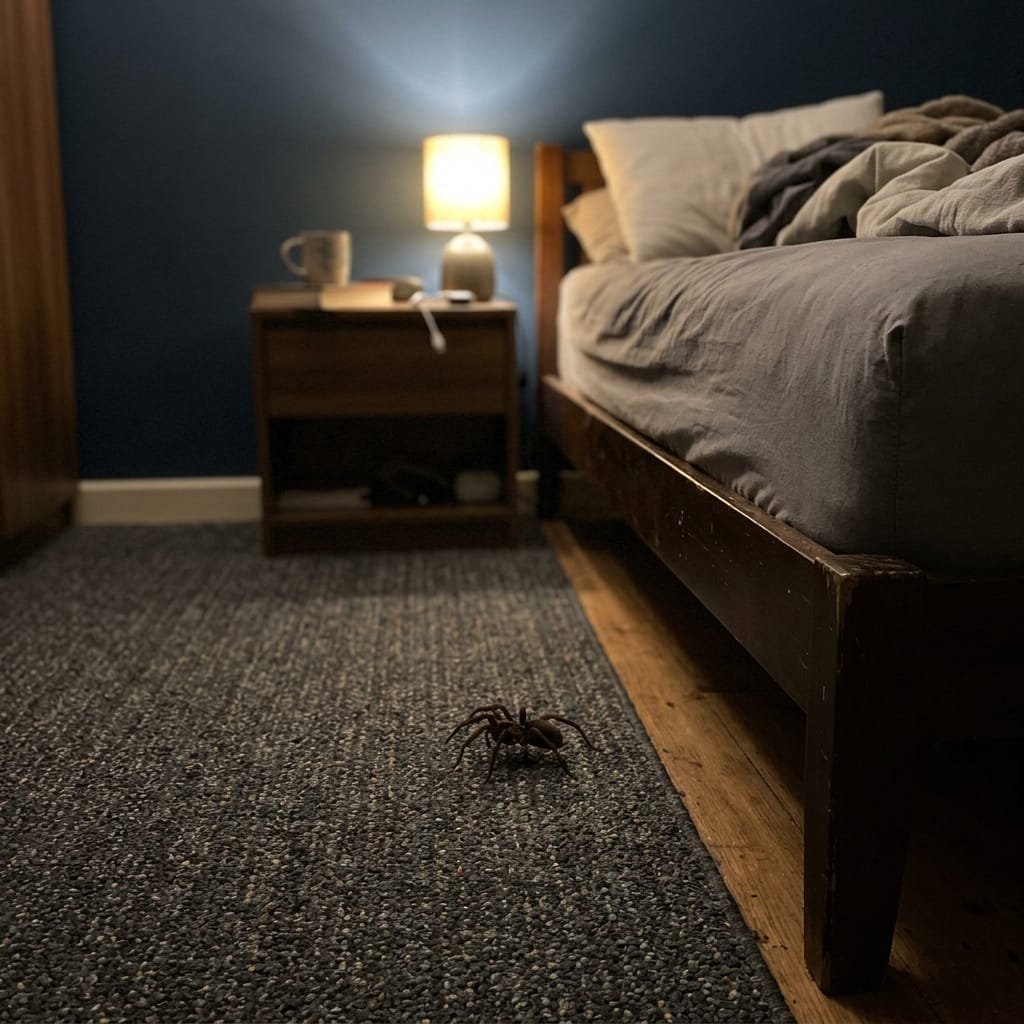
Found a Spider Beside Your Bed? What You Should Know
Finding a small dark spider-like creature on the floor beside your bed can be unsettling, especially when you notice it just before going to sleep.
But an important point often gets missed in scary posts about spiders:
Seeing a spider in your bedroom does not automatically mean you are in danger.
Most spiders found around homes are not medically important, and spiders generally avoid people rather than deliberately attacking them.
Still, identifying what you’re dealing with is useful—particularly if spiders are repeatedly appearing around your bed, clothing, shoes, or other undisturbed areas.
Why Do Spiders Enter Bedrooms?
Spiders can end up indoors for several ordinary reasons.
They may enter through gaps around doors, windows, walls, or other openings. Some species also move indoors while searching for prey or shelter.
A bedroom can provide places for a spider to hide, particularly underneath furniture, behind objects, around corners, or in areas that aren’t disturbed frequently.
Some spiders are more active at night. For example, sac spiders may wander through homes at night while searching for prey and may hide in silken retreats during the day.
So finding a spider on the floor at night isn’t necessarily unusual.
Is Every Dark Spider Dangerous?
No.
This is one of the biggest misconceptions about spiders.
Spiders have venom because they use it to subdue their prey, but most spider species have venom that poses little or no significant threat to humans. Most spiders also prefer to escape rather than bite.
The appearance of a spider can also be misleading.
A small dark spider isn’t automatically a black widow, brown recluse, or another medically important species.
Accurate identification requires more than simply looking at the general color.
What Should You Look At?
If you safely photograph the spider, several features can help with identification.
Body shape
Is the abdomen:
- Round?
- Long and narrow?
- Bulky?
- Flattened?
Leg shape
Are the legs:
- Very long?
- Short and thick?
- Similar in color to the body?
- Darker at the ends?
Markings
Look for distinctive patterns on the abdomen or body.
A small triangular marking, stripe, spots, or contrasting colors can sometimes help distinguish one group from another.
Size
Size is particularly useful.
A spider that is only a few millimeters long belongs to a very different group from one with a large body and several-inch leg span.
For example, the common house spider is quite small, with females typically measuring about 5–6 mm in body length.
Some Spiders Commonly Live Inside Homes
The common house spider is one example.
It is widely distributed and commonly builds webs in homes, particularly around corners, windows, basements, and other sheltered areas.
Despite living around people, it is not considered medically important and rarely bites humans.
Other spiders may simply wander indoors rather than establish a permanent population.
That distinction is important: one spider on the bedroom floor doesn’t necessarily mean you have a spider infestation.
What About Spiders Near Beds?
This is where people understandably become nervous.
Some wandering spiders can encounter people while searching for prey at night.
Sac spiders, for example, may wander through homes and can sometimes become trapped between skin and bedding or clothing. Their bites can be painful, although they generally don’t result in serious medical conditions.
This is different from a spider intentionally seeking out a sleeping person.
Spiders aren’t generally interested in biting humans.
What If You Wake Up With a Bite?
Don’t automatically assume that a mysterious skin mark is a spider bite.
This is an important point in spider-bite stories.
The CDC has specifically warned that conditions such as skin infections can be mistaken for spider bites.
A red mark on the skin by itself doesn’t establish that a spider caused it.
If you actually see a spider and later develop a mark, keep the spider or a clear photograph if it can be done safely. Identification can help a healthcare professional determine whether the suspected spider is relevant.
When Can a Spider Bite Be Serious?
A small number of spider species can cause medically significant bites.
In the United States, black widows and brown recluse spiders are among the best-known examples.
Symptoms depend on the species and the individual.
Black widow envenomation can produce symptoms such as significant muscle or abdominal cramping, nausea, weakness, and—in severe cases—difficulty breathing.
Brown recluse bites can initially be subtle and may later become painful, with redness and tissue damage developing in some cases.
However, there is another important caution: brown recluse bites are frequently overdiagnosed. Other skin problems can look similar.
So a worsening skin lesion shouldn’t automatically be labeled a spider bite without proper evaluation.
What Should You Do If You Find One?
If you see a spider beside your bed, don’t try to grab it with your bare hands.
Instead, keep your distance and, if possible, take a clear photograph.
You can then:
- Identify it using a reliable identification resource.
- Carefully remove it using an appropriate method.
- Check around the bedroom for additional spiders or webs.
- Look around windows, baseboards, furniture, and other sheltered areas.
If spiders are repeatedly appearing, reducing clutter and removing potential hiding places can help. Sealing gaps around doors and windows can also reduce opportunities for spiders to enter.
Check Around the Bedroom
If you’ve found one spider, take a quick look around the room.
Pay particular attention to:
- Under the bed
- Behind furniture
- Window corners
- Closets
- Shoes
- Boxes
- Clothing left on the floor
- Dark, undisturbed spaces
This doesn’t mean you should panic or search the entire house.
You’re simply looking for evidence of whether the spider was an isolated visitor or whether there are suitable hiding places nearby.
Don’t Spray Everything Immediately
Seeing one spider doesn’t necessarily justify spraying an entire bedroom with insecticide.
Spiders are predators and can actually reduce populations of other insects in and around homes.
If you repeatedly find spiders, identifying the species and addressing entry points or insect prey may be more useful than indiscriminate spraying.
When Should You Get Medical Help?
If you believe you’ve been bitten and develop significant or worsening symptoms, seek medical advice.
More concerning symptoms can include:
- Severe or increasing pain
- Significant swelling
- Muscle cramps
- Nausea or vomiting
- Difficulty breathing
- Severe weakness
- Rapidly worsening skin changes
- Signs of a serious allergic reaction
The exact response depends on the suspected species and the person’s symptoms. Some spider bites can require prompt medical assessment.
If symptoms are severe or you believe you may be having a medical emergency, seek emergency medical care immediately.
What About the Spider in the Photo?
The photograph shows a small dark spider-like creature beside a bed, but it would be inappropriate to identify it as a particular dangerous species from this image alone.
Color and general body shape aren’t enough for a reliable species identification.
The important awareness point is that a spider found in a bedroom should be treated with caution, not panic.
Don’t handle an unknown spider directly, and don’t assume that every spider is dangerous.
The Bottom Line
Finding a spider beside your bed can definitely be unsettling.
But most spiders encountered around homes are harmless to people, and spiders generally don’t seek out humans to attack them.
The best response is simple:
Don’t touch an unidentified spider with your bare hands. Take a photo if you can do so safely, identify it, and pay attention to any actual symptoms rather than assuming every skin mark is a spider bite.
And if a suspected bite causes severe or rapidly worsening symptoms, don’t wait for the spider to be identified before seeking medical care.
Sometimes the frightening-looking creature beside your bed is simply a harmless house spider looking for its next meal.