
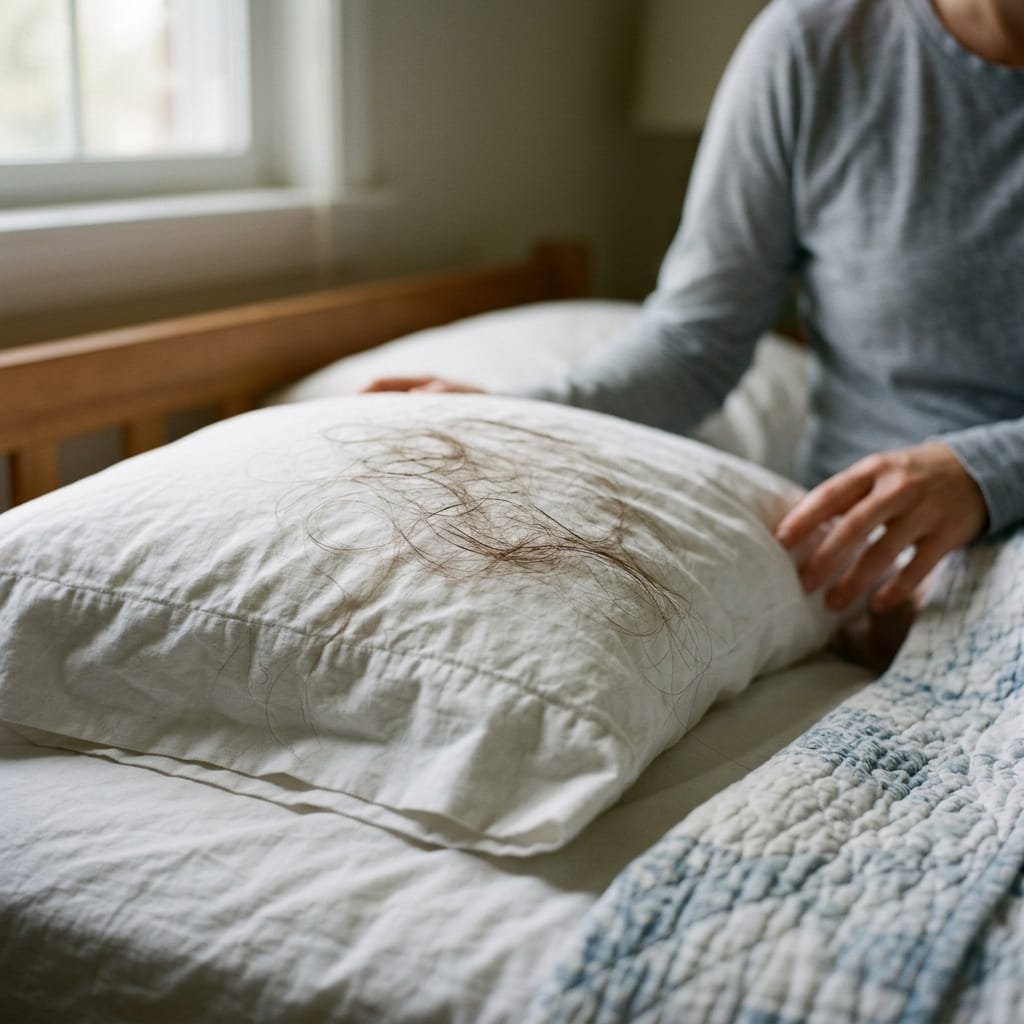
If You Find This Much Hair on Your Pillow, Your Body May Be Telling You Something
Finding a few hairs on your pillow in the morning is normal. Hair naturally goes through a growth, resting and shedding cycle, and the American Academy of Dermatology says losing around 50–100 hairs a day can be normal.
But if you suddenly notice much more hair than you normally see on your pillow, brush or shower drain, that’s different.
It doesn’t automatically mean you’re going bald. In many cases, increased shedding happens because something affected your body a few weeks or months earlier.
The Most Common Reason: Your Hair Cycle Changed
One of the most common explanations for sudden excessive shedding is telogen effluvium.
Normally, most scalp hairs are in the growing stage. After a major physical or emotional stress, more hairs can prematurely enter the resting stage. Those hairs eventually shed, creating a noticeable increase in hair on your pillow, brush and shower drain.
The surprising part is the timing.
You may experience the trigger first and not notice the hair shedding until about 2–3 months later.
That’s why someone may think:
“Nothing happened recently. Why is my hair suddenly falling out?”
The trigger may have happened months ago.
1. You Had a High Fever or Illness
A significant illness—especially one involving a high fever—can temporarily disrupt the normal hair cycle.
The body prioritizes essential functions during physical stress, and more hair follicles can shift into the resting phase. The increased shedding becomes noticeable later rather than immediately.
So think back:
Did you have a bad infection, high fever or significant illness a couple of months ago?
That could help explain the change.
2. Major Stress Can Show Up in Your Hair Later
Emotional stress can also trigger excessive shedding.
This can happen after major life events, prolonged stress, grief, relationship problems, work pressure or other significant emotional strain.
Again, the important thing is that the hair doesn’t necessarily fall out while you’re experiencing the stress.
The increased shedding can appear later because of the natural hair cycle.
3. Rapid Weight Loss or a Restrictive Diet
If you’ve recently lost a significant amount of weight or dramatically restricted your food intake, your hair may respond.
Very restrictive diets—particularly those that don’t provide enough protein—can trigger telogen effluvium.
This is one reason crash dieting can sometimes affect more than your weight.
Your body needs adequate nutrition to support normal hair growth.
Instead of immediately buying a “hair vitamin,” it’s better to consider whether your overall diet is providing enough nutrition and discuss persistent shedding with a healthcare professional.
4. Hormonal Changes
Hormonal changes can also cause noticeable shedding.
A well-known example is hair shedding after childbirth. Many women notice increased shedding a few months after giving birth because of changes in hormone levels. This is usually temporary.
Other hormonal changes can also affect hair, including some thyroid disorders and changes associated with hormonal medications.
So if your increased shedding started around a major hormonal change, tell your doctor or dermatologist.
5. Tight Hairstyles Can Pull Hair Out
Your hairstyle can matter too.
Frequently wearing hair tightly pulled into ponytails, buns, braids or other styles that place repeated tension on the follicles can cause traction alopecia.
Early traction-related hair loss can sometimes be prevented from getting worse by reducing the pulling.
If your hairstyle causes scalp pain or tightness, that’s a good reason to loosen it.
6. Hair Damage Can Look Like Hair Loss
Not every strand you see is necessarily falling from the root.
Hair that has been weakened by repeated chemical treatments, coloring, relaxing, perming or other damage can break.
That can make it seem as though you’re suddenly losing huge amounts of hair.
The difference matters because hair shedding and hair breakage have different causes and require different approaches.
7. Hereditary Hair Loss Is Different
There’s another important possibility: hereditary hair loss.
This usually doesn’t appear as a sudden pile of hair on the pillow. Instead, it tends to cause gradual thinning.
In women, an early sign can be a widening part or overall thinning on top of the scalp.
So if you’ve been noticing your part becoming wider over months or years, that pattern is different from sudden excessive shedding.
What About the Hair on Your Pillow?
Here’s the important part:
Don’t use the amount of hair on one pillow as a diagnosis.
Some hairs may have accumulated over more than one night, and longer strands can make a small amount look dramatic.
Instead, look for a change from your normal pattern.
Ask yourself:
- Is my brush suddenly collecting much more hair?
- Is my shower drain getting unusually full?
- Does my ponytail feel thinner?
- Can I see more scalp than before?
- Is my hair part becoming wider?
- Am I developing a bald or noticeably thin patch?
Those changes are more meaningful than counting individual hairs.
When Should You Take It Seriously?
Make an appointment with a dermatologist or healthcare professional if the shedding is sudden, persistent, excessive or accompanied by visible thinning.
It’s particularly important to get checked if you develop:
- A distinct bald patch
- Rapid overall thinning
- A widening part
- Loss of eyebrows or other body hair
- Scalp pain, burning, redness or significant scaling
- Hair loss that continues without improvement
There are many possible causes of hair loss, and identifying the actual cause is important because treatment depends on what’s happening.
Don’t Blame Stress for Everything
This is important.
Stress can cause excessive shedding, but assuming every case of hair loss is “just stress” can cause other causes to be overlooked.
Hair loss can also be related to hereditary factors, hormonal changes, illness, certain medications, nutritional problems, autoimmune conditions and hair-care practices.
That’s why persistent or significant hair loss deserves an actual evaluation.
Will the Hair Grow Back?
Often, excessive shedding from telogen effluvium is temporary.
Once the underlying trigger has passed, the hair cycle can gradually return toward normal. Cleveland Clinic notes that acute telogen effluvium commonly resolves, with regrowth occurring over the following months.
But not every type of hair loss is temporary.
That’s another reason identifying the cause matters.
What Should You Do Right Now?
If you’ve suddenly noticed more hair than usual:
Don’t panic.
First, think back over the previous 2–3 months.
Ask yourself whether you had:
- A high fever or significant illness
- Major emotional stress
- Surgery
- Significant weight loss
- A restrictive diet
- Childbirth
- A major hormonal change
- A new medication
These are all potential clues.
Also avoid unnecessarily tight hairstyles and excessive chemical or heat treatments while you’re figuring out what’s happening.
And don’t start taking high-dose supplements simply because you’re shedding. The right treatment depends on the actual cause.
The Bottom Line
A few hairs on your pillow are normal.
But if you’re suddenly seeing far more hair than usual, your body may be responding to something that happened earlier—such as illness, fever, major stress, rapid weight loss, hormonal changes or another trigger.
One of the most interesting things about excessive shedding is that the cause can happen months before you actually notice the hair loss.
So don’t look only at what happened yesterday.
Think back a few months.
And if the shedding continues, your hair is visibly thinning, or you develop bald patches or scalp symptoms, get the cause checked rather than guessing.