
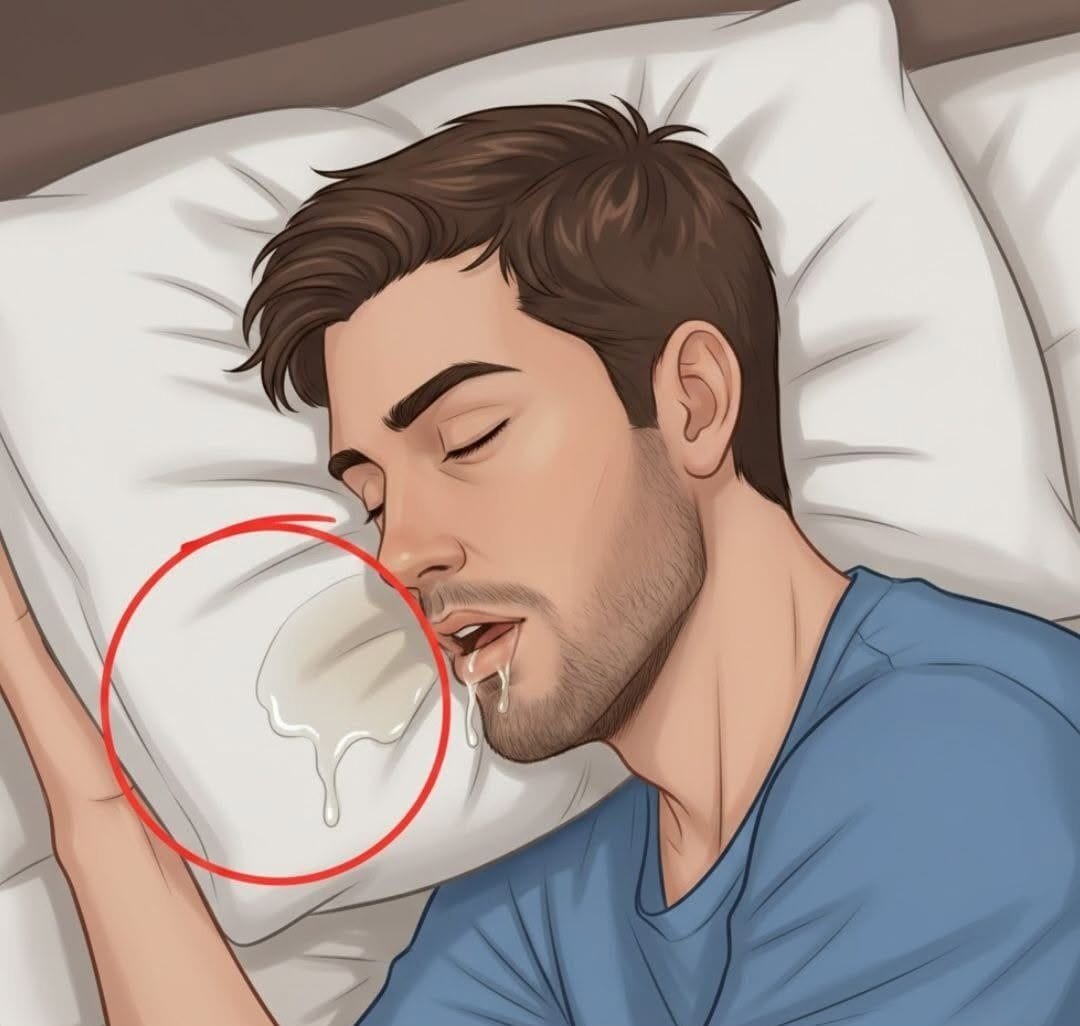
If You Drool While Sleeping Often, Here Are 6 Possible Causes You Should Know
Waking up with a wet pillow can be embarrassing, but occasional drooling during sleep is usually not a sign that something is seriously wrong. Your body continues making saliva while you sleep, and because swallowing becomes less frequent and the muscles around your mouth relax, some saliva can escape.
Your sleeping position can make a difference too. People who sleep on their side or stomach may be more likely to notice saliva on their pillow because gravity allows it to move toward the lips. Nasal congestion can also cause you to sleep with your mouth open, making nighttime drooling more noticeable.
The situation deserves more attention when drooling is new, unusually frequent, or accompanied by other symptoms.
For example, drooling together with sudden facial weakness, arm weakness, trouble speaking, vision changes, or loss of balance can be an emergency because those symptoms may occur with a stroke.
At the same time, it is important not to assume that drooling itself means a stroke or another serious neurological disease. A wet pillow by itself cannot tell you what is happening inside your brain.
The important question is: What else is happening along with the drooling?
Why Do Adults Drool While Sleeping?
Sometimes the Reason Is Completely Harmless
Saliva is produced continuously throughout the day and night. When you’re awake, you usually swallow it automatically without thinking about it.
During sleep, swallowing becomes less frequent and the muscles controlling the mouth relax. If your lips remain slightly open, saliva can gradually escape.
Your sleeping position can also influence where saliva goes.
Someone who sleeps on their back may notice less drooling because gravity tends to keep saliva farther inside the mouth. Side and stomach sleeping can make it easier for saliva to reach the lips and eventually the pillow.
Breathing problems can contribute as well.
If allergies, a cold, sinus congestion, or another nasal problem makes it difficult to breathe through your nose, you may naturally begin breathing through your mouth while asleep. Keeping your mouth open can make drooling easier.
So if you have occasionally drooled for years, sleep on your side, and otherwise feel perfectly well, there may be nothing alarming behind it.
What matters more is a change in your usual pattern.
If you suddenly begin drooling heavily when you never did before, or the drooling appears alongside swallowing problems, facial changes, movement problems, or breathing symptoms, it makes sense to look for an underlying cause.
Six Conditions That Can Sometimes Be Associated With Excessive Drooling
1. Mouth, Throat, or Dental Problems
Problems affecting the mouth and throat can sometimes increase saliva production or make swallowing uncomfortable.
Infections and inflammation involving areas such as the tonsils or throat can be associated with excessive drooling. Dental problems and other conditions affecting the mouth can also interfere with normal lip closure or swallowing.
Pay attention if the drooling occurs together with symptoms such as:
- Tooth or jaw pain
- Swollen or irritated gums
- Mouth sores
- Significant throat pain
- Fever
- Difficulty swallowing
These symptoms do not necessarily mean something dangerous is happening, but persistent problems deserve appropriate medical or dental attention.
2. Facial Nerve Problems, Including Bell’s Palsy
Another possible reason saliva becomes difficult to control is weakness affecting the facial muscles.
Bell’s palsy can cause sudden weakness or paralysis on one side of the face. Someone may notice an uneven smile, difficulty moving one side of the mouth, or trouble completely closing one eye. When the muscles around the mouth become weak, keeping saliva inside the mouth can also become more difficult.
But there is an important warning here.
Sudden facial weakness should never automatically be assumed to be Bell’s palsy.
A stroke can also cause facial drooping.
If facial weakness occurs together with arm weakness, difficulty speaking, sudden balance problems, or vision changes, seek emergency medical help immediately. The American Stroke Association uses the B.E. F.A.S.T. warning signs—Balance, Eyes, Face, Arm, Speech, and Time to act—to help recognize possible stroke symptoms.
Even when the cause turns out to be Bell’s palsy, prompt evaluation is important. Treatment decisions can be time-sensitive, and protecting the eye becomes particularly important if the eyelid cannot close normally.
3. Acid Reflux or GERD
Nighttime drooling can sometimes occur alongside gastroesophageal reflux disease, commonly called GERD.
GERD happens when stomach contents repeatedly move upward into the esophagus. Some people experience classic heartburn, while others notice a sour taste, throat irritation, coughing, regurgitation, or other symptoms.
Increased saliva can occur with reflux. This is sometimes referred to as water brash, where the mouth produces additional saliva in response to acid or reflux reaching the esophagus.
If you frequently wake up with saliva around your mouth and also experience nighttime heartburn, sour fluid, or regurgitation, reflux may be worth discussing with a healthcare professional.
However, drooling alone does not prove that you have GERD.
The surrounding symptoms provide the important clue.
4. Parkinson’s Disease and Problems With Automatic Swallowing
Parkinson’s disease is another condition that can be associated with drooling.
However, this does not mean that someone who drools while sleeping has Parkinson’s disease.
Parkinson’s is a neurological condition that can cause symptoms such as tremor, stiffness, slowed movement, and changes in walking. Drooling can occur because swallowing becomes less automatic or because controlling saliva becomes more difficult.
In other words, the problem is not necessarily that the body is producing an enormous amount of saliva.
Instead, saliva may not be swallowed as efficiently.
This is why doctors look at the entire pattern rather than diagnosing Parkinson’s based on one symptom.
If drooling is accompanied by persistent tremor, stiffness, noticeably slower movements, changes in walking, or other neurological changes, a medical evaluation may be appropriate.
But if the only symptom is occasionally waking up with saliva on your pillow, there is no reason to jump immediately to a Parkinson’s diagnosis.
5. Nasal Obstruction and Sleep-Related Breathing Problems
Another common factor behind nighttime drooling is difficulty breathing comfortably through the nose.
Allergies, congestion, sinus inflammation, or structural problems can encourage mouth breathing during sleep. When the mouth stays open, saliva has an easier path out.
Sleep-related breathing disorders can also be worth considering when drooling appears alongside other nighttime symptoms.
For example, obstructive sleep apnea can cause repeated narrowing or blockage of the upper airway while a person sleeps. Common warning signs can include:
- Loud or persistent snoring
- Pauses in breathing noticed by another person
- Waking up gasping or choking
- Morning headaches
- Excessive daytime sleepiness
- Frequent nighttime awakenings
Drooling by itself cannot diagnose sleep apnea.
However, frequent mouth breathing combined with loud snoring or witnessed breathing pauses is worth discussing with a healthcare professional. A clinician may determine whether further testing, such as a sleep study, is appropriate.
Sometimes the simpler issue is chronic nasal congestion.
If you have been unable to breathe normally through your nose for weeks or months, finding and treating the cause may reduce mouth breathing and potentially reduce nighttime drooling as well.
6. Stroke or Another Neurological Swallowing Problem
This is the condition people often worry about when they see dramatic claims about nighttime drooling online.
And there is an important distinction to understand.
Drooling alone does not mean that you are having a stroke.
A stroke can interfere with the muscles involved in facial control and swallowing. Someone experiencing swallowing difficulty may drool, cough or choke while eating, have difficulty moving food around the mouth, or feel as though food is getting stuck.
The emergency concern arises when drooling appears as part of a sudden neurological change.
Watch for symptoms such as:
- Sudden facial drooping
- Sudden weakness or numbness, particularly on one side
- Difficulty speaking or understanding speech
- Sudden vision changes
- Sudden loss of balance or coordination
- Sudden severe neurological symptoms
If these symptoms appear suddenly, seek emergency medical attention immediately.
Do not wait to see whether they disappear.
Even symptoms that improve can sometimes represent a transient ischemic attack, or TIA, which still requires urgent medical assessment.
The key point is that the sudden neurological symptoms—not the saliva on the pillow—create the emergency.
What Should You Do If You Drool Frequently at Night?
Before assuming the worst, look for ordinary explanations.
Think about your sleeping position. If you almost always sleep on your side or stomach, gravity may be contributing.
Next, consider your nose.
Have you recently developed allergies, a cold, sinus congestion, or another problem that forces you to breathe through your mouth?
Also think about timing.
Did the drooling begin after starting a new medication or changing a dose? Some medications can influence saliva production, so this information can be useful when speaking with a healthcare professional.
Your oral health matters too.
Persistent gum irritation, tooth problems, mouth infections, or poorly fitting dental appliances can affect comfort and normal saliva control.
If reflux symptoms are present, mention them as well.
You can make a simple record of what you are experiencing. Write down when the drooling started, how often it happens, whether it occurs every night, and whether you have noticed snoring, choking, reflux, facial weakness, tremor, swallowing problems, or nasal congestion.
That information can help a healthcare professional understand the pattern.
Avoid taking random medications simply to reduce saliva without knowing why the drooling is happening. Saliva has important functions, including helping protect the mouth and supporting swallowing.
The better approach is to identify and address the underlying reason.
When Should You See a Doctor?
Frequent or newly developed drooling is worth discussing with a healthcare professional when it continues, interferes with sleep, causes significant skin irritation, or appears alongside unexplained symptoms.
Swallowing problems deserve particular attention.
If you repeatedly cough or choke while eating or drinking, feel that food gets stuck, or have difficulty swallowing normally, tell a healthcare professional. Dysphagia can increase the risk of food or liquid entering the airway, which can lead to complications.
New facial weakness should also be evaluated promptly.
And if you suddenly develop facial drooping, arm weakness, speech problems, vision changes, or severe balance problems, treat the situation as an emergency.
Do not assume that you can simply sleep it off.
Frequently Asked Questions
Is it normal for adults to drool while sleeping?
Yes. Occasional nighttime drooling can happen to healthy adults, particularly people who sleep on their side or stomach. Mouth breathing and nasal congestion can also contribute.
Does drooling from one side mean I am having a stroke?
No. The side you sleep on can influence where saliva escapes. One-sided drooling becomes much more concerning when it occurs with sudden facial weakness, arm weakness, speech problems, vision changes, or balance problems.
Can Parkinson’s disease cause drooling?
Yes, drooling can occur with Parkinson’s disease, often because swallowing and automatic saliva control are affected. But drooling by itself is not enough to diagnose Parkinson’s.
Can acid reflux cause nighttime drooling?
GERD can sometimes be associated with increased saliva production. If drooling occurs together with heartburn, regurgitation, sour taste, or throat irritation, discuss the symptoms with a healthcare professional.
When is nighttime drooling an emergency?
Drooling requires urgent attention when it occurs suddenly with symptoms such as facial drooping, arm weakness, difficulty speaking, sudden vision changes, or sudden balance problems. These may be signs of a stroke.
The Bottom Line
Finding saliva on your pillow does not automatically mean that something is seriously wrong.
For many adults, nighttime drooling has a simple explanation: sleeping position, relaxed facial muscles, an open mouth, temporary congestion, or another everyday factor.
But a new or persistent change deserves more attention when other symptoms appear.
Problems involving the mouth, facial nerves, reflux, neurological movement, breathing, or swallowing can sometimes be associated with excessive drooling.
The most important thing is to look at the whole picture.
If the drooling is occasional and you otherwise feel well, there may be little reason for concern.
If you are having repeated swallowing difficulties, choking while eating, new facial weakness, significant movement changes, persistent reflux, loud snoring, or other unexplained symptoms, arrange an appropriate medical evaluation.
And remember the most important warning: sudden facial drooping, arm weakness, speech difficulty, vision changes, or loss of balance can be signs of stroke and require immediate emergency care.
A wet pillow alone is not a diagnosis.
What matters is what changed, what other symptoms are present, and how suddenly they appeared.