
Yes, Mosquitoes Can Actually Pee While They’re Feeding on You — Here’s Why
You probably know the basic story: a mosquito lands on your skin, inserts its mouthparts, drinks your blood, and flies away.
But there is another part of the process that sounds almost unbelievable.
A female mosquito can begin releasing urine while she is still feeding on you.
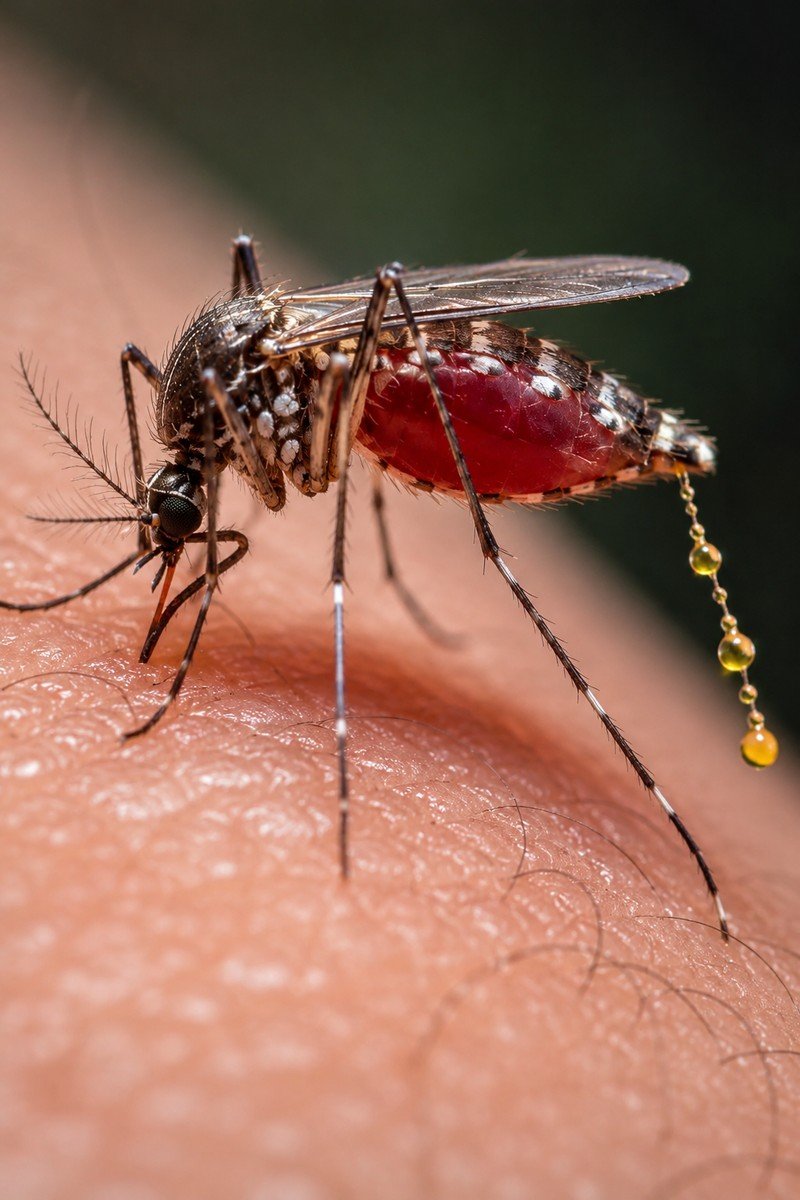
That tiny droplet you may see hanging from the rear of a blood-fed mosquito is not simply random moisture. It is part of an incredibly efficient biological system that helps the insect deal with the enormous amount of fluid and salt it has just swallowed.
And there is a very good reason she needs to get rid of it quickly.
First: Only Female Mosquitoes Bite
When people say “mosquitoes drink blood,” there is an important distinction.
Female mosquitoes are the ones that take blood meals. Male mosquitoes do not bite humans for blood.
Male mosquitoes primarily feed on plant nectar and other sugary fluids. Female mosquitoes also consume nectar for energy, but many species need the nutrients from a blood meal to support egg development.
Blood provides proteins, amino acids, salts and other nutrients that can be used during reproduction. In species such as Aedes aegypti, the protein-rich blood meal helps trigger the physiological processes required for developing eggs.
So when a female mosquito bites you, she is not drinking blood because she needs it as her ordinary source of energy.
She is essentially collecting a nutrient-rich reproductive meal.
But that meal comes with a problem.
A very big problem for a tiny flying insect.
The Mosquito Doesn’t Just Get Blood
Imagine drinking a huge amount of liquid in a very short period.
Now imagine that you weigh only a few milligrams and have to fly away immediately afterward.
That’s essentially the problem a female mosquito faces.
A blood meal can contain a surprisingly large amount of water and dissolved salts in addition to the nutrients the mosquito actually needs.
In Aedes aegypti, a female can ingest enough blood to more than double her body weight in a matter of minutes. That sudden increase in body mass can interfere with flight and make the mosquito more vulnerable while she is still on the host.
For a human, gaining a little weight from a drink obviously isn’t going to stop us from walking away.
For a mosquito weighing only a few milligrams, however, the difference is enormous.
Every extra bit of fluid matters.
So the mosquito has evolved an ingenious solution:
Get rid of the excess liquid almost immediately.
This Is Where the “Peeing” Comes In
Female mosquitoes have an excretory system that includes structures called Malpighian tubules.
They perform a function somewhat comparable to the role kidneys play in vertebrates: they help regulate the insect’s water and ion balance and produce urine.
When a female mosquito begins taking a blood meal, her body rapidly responds to the sudden influx of water and salts.
The Malpighian tubules dramatically increase their activity.
The mosquito begins producing urine at a very high rate, and the first droplets can be expelled while she is still feeding.
That means the mosquito isn’t necessarily waiting until she finishes drinking before dealing with the extra fluid.
She starts processing it almost immediately.
This rapid fluid loss is called diuresis.
And it is one of the most remarkable examples of how an insect can rapidly adjust its physiology to survive a meal.
Why Does She Need to Get Rid of the Water So Fast?
The blood meal is valuable, but the mosquito doesn’t need to keep all of its water and salts.
A large portion of what enters her body is excess fluid.
If she simply kept everything she swallowed, the mosquito would become heavily bloated and much harder to fly.
Researchers studying Aedes aegypti have found that the mosquito mounts a powerful diuretic response during and after blood feeding. The first phase of the urine produced is particularly rich in sodium, chloride and water—the very components she needs to remove quickly from the blood meal.
So, in a very simple sense:
Blood goes in → useful nutrients are retained → excess water and salts are rapidly removed.
It’s almost like the mosquito is concentrating the meal.
The Tiny Droplet You See Is Part of This Process
If you’ve ever seen a close-up photograph of a mosquito feeding, you may notice something unusual.
There can be a tiny transparent or slightly colored droplet hanging from the mosquito’s abdomen.
That isn’t necessarily a strange parasite or some mysterious substance.
It can be urine being expelled during the blood-feeding process.
Researchers have actually measured these tiny droplets in laboratory studies. In Aedes aegypti, urine droplets can be only a few nanoliters in volume, yet they are produced rapidly enough to remove a significant amount of the unwanted fluid from a blood meal.
To us, the droplet looks almost invisible.
For the mosquito, it represents an important physiological cleanup operation.
What Exactly Is in Mosquito Urine?
This is where the viral claim that mosquitoes “pee blood” can become misleading.
They are not simply drinking your blood and then passing the same blood straight back out.
The mosquito’s digestive and excretory systems process the meal.
During the initial rapid diuresis, the expelled fluid contains large amounts of water and sodium and chloride ions. Later, the composition changes as digestion progresses, and potassium and other metabolic products become more involved.
The mosquito’s Malpighian tubules actively move ions and water into the tubules, creating the fluid that eventually becomes urine.
The hindgut and rectum can then modify that fluid by selectively reabsorbing substances and water before the final urine leaves the body.
So the process is much more sophisticated than simply “blood in, pee out.”
Why Doesn’t the Mosquito Just Keep the Water?
Because water isn’t the main prize of the blood meal.
The mosquito is interested in obtaining nutrients that can help with reproduction.
The problem is that vertebrate blood contains a huge amount of water compared with the concentrated nutrients the insect ultimately needs.
Therefore, the mosquito has to separate the useful components from the excess fluid.
Scientists describe this as a rapid post-blood-meal diuresis.
In Aedes aegypti, urine production can begin within seconds of starting a blood meal. During the first hour after feeding, the mosquito can eliminate a substantial portion of the water and sodium associated with the blood plasma.
This allows the insect to reduce its fluid load while retaining nutrients needed for digestion and egg production.
It Can Start Before the Meal Is Even Finished
This may be the strangest part.
You might imagine the mosquito first filling up completely and then flying somewhere to get rid of the excess.
But that’s not what happens.
The excretion process can begin during feeding.
Studies of female Aedes aegypti show that the first urine droplets can be released while the mosquito is still attached to its host.
This makes biological sense.
Why carry unnecessary water around when you can remove it immediately?
The mosquito’s body essentially begins processing the meal as it arrives.
It’s a bit like filling a container while simultaneously draining away everything you don’t need.
The Mosquito’s “Kidneys” Work Extremely Fast
Mosquitoes don’t have kidneys like humans do.
Instead, their Malpighian tubules perform the major role in producing urine and controlling the balance of water and dissolved ions.
These tiny tubular structures work together with parts of the digestive tract to regulate the mosquito’s internal environment.
After a blood meal, their activity can increase dramatically.
In research on Aedes aegypti, the urine flow rate can reach extremely high levels relative to the insect’s tiny body size. The first phase is particularly rapid and is dominated by the removal of sodium, chloride and water.
This is essential because the mosquito has suddenly gone from a lightweight flying insect to an insect carrying a substantial fluid load.
What Happens to the Blood After That?
Once the excess water and salts are removed, the remaining blood meal becomes more concentrated.
The mosquito can then digest the blood cells and proteins.
Those nutrients are extremely important for the development of her eggs.
In other words, the mosquito isn’t simply “drinking and dumping” the entire meal.
Her body is carefully processing it.
The water and certain ions can be removed quickly, while valuable nutrients are retained and subsequently digested.
This separation allows the mosquito to get the reproductive benefits of blood without carrying around all of the unnecessary fluid.
It’s Not Just About Staying Light
Rapid urination isn’t merely a convenience.
It can be a matter of survival.
A mosquito that has just consumed a large blood meal is heavier and less maneuverable than before.
That can make her more vulnerable to being swatted, attacked by predators or otherwise harmed while trying to escape.
Researchers have therefore described the blood meal as creating several simultaneous challenges: increased body mass, excess water, and changes in salt concentration inside the insect. Rapid diuresis helps address these problems.
So that tiny droplet leaving the mosquito’s body is actually part of an important survival strategy.
Does This Mean Mosquitoes Pee on Everyone They Bite?
The basic physiological process is real, but it is worth avoiding an exaggerated interpretation.
Different mosquito species can have somewhat different feeding and excretion patterns.
The strongest experimental evidence for rapid urination during feeding comes from laboratory studies of species such as Aedes aegypti.
So the accurate takeaway isn’t that every mosquito always produces a visible stream of urine every time it bites a person.
Rather:
Blood-feeding female mosquitoes can rapidly excrete excess water and salts, and in some species this begins while they are still feeding.
That’s the fascinating part.
And What About the Yellow Droplets in Photos?
Those dramatic macro photographs showing a mosquito with a series of droplets hanging behind its abdomen are based on a real biological phenomenon.
The droplets can represent the mosquito’s rapid excretion of fluid following a blood meal.
The yellowish appearance in an image, however, shouldn’t automatically be interpreted as “pure urine” or as a specific chemical composition. Lighting, magnification, background and the contents of the droplet can affect how it appears.
The underlying process is much more interesting than the color anyway.
The mosquito is rapidly regulating its internal water and salt balance while processing your blood meal.
A Tiny Insect With an Extremely Efficient System
The next time you see a mosquito feeding, it may be tempting to think that the insect is simply taking a sip of blood.
But physiologically, much more is happening.
The female mosquito is:
- finding a blood vessel,
- injecting saliva,
- taking in a large blood meal,
- rapidly dealing with excess water,
- regulating sodium and other ions,
- concentrating the nutrients in the meal,
- digesting proteins and other nutrients,
- and eventually using those nutrients to support egg development.
And she can begin getting rid of the unwanted fluid before she has even finished feeding.
That’s why the strange-looking droplet in a mosquito photograph isn’t just a bizarre visual detail.
It represents an incredibly fast physiological adaptation.
So, Do Mosquitoes Really Pee While They Bite You?
Yes—at least in well-studied blood-feeding species such as Aedes aegypti, females can begin excreting urine while they are still taking a blood meal.
But the viral version of the fact needs a little context.
They’re not simply “drinking your blood and peeing it back out.”
Their bodies rapidly separate and eliminate excess water and salts, while retaining the nutrients needed from the blood meal. The Malpighian tubules act as their primary renal system, and the process is hormonally regulated to happen extremely quickly.
So the next time a mosquito bites you, remember:
It isn’t just taking blood. Its body is simultaneously trying to get rid of what it doesn’t need.
And that tiny droplet falling from the mosquito’s abdomen?
It may be the insect’s remarkably efficient way of saying:
“I don’t need to carry all of that water with me.”
The science behind the surprising fact
This phenomenon is known as post-blood-meal diuresis, and scientists have studied it for decades because it reveals how efficiently mosquitoes control water and salt balance. Modern research continues to examine the hormones and molecular mechanisms that switch this rapid excretion system on and off.
One tiny mosquito. One huge blood meal. And an entire miniature “kidney system” working almost immediately.