
Table of Contents
Toggle🤯 Have You Ever Noticed the Tiny Hairs on Your Fingers? Here’s Why They’re There
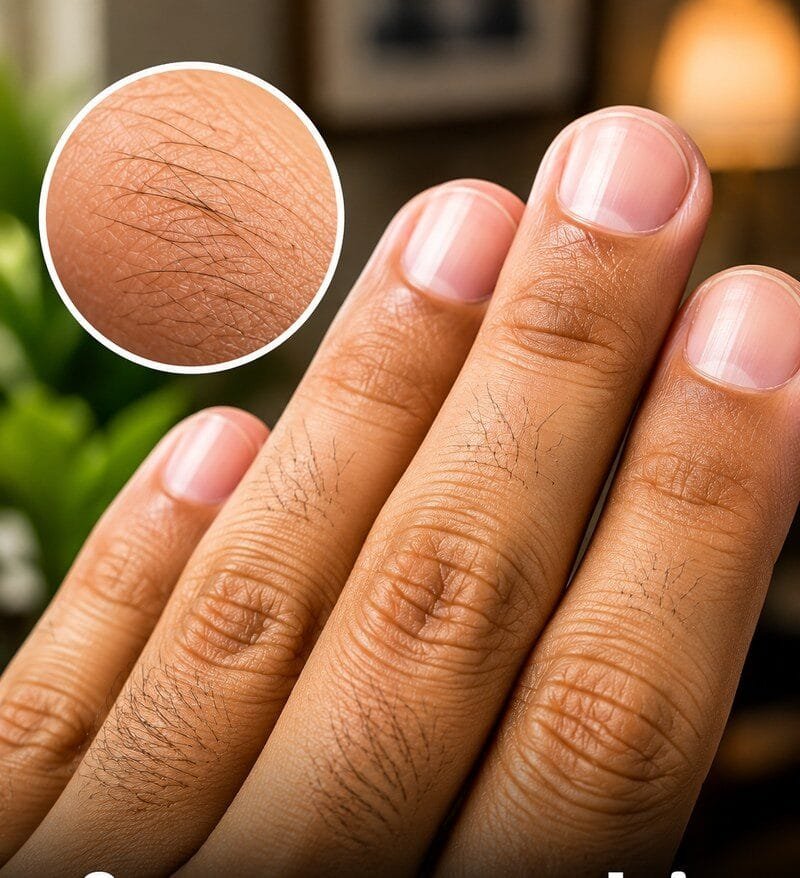
Have you ever looked closely at your fingers and suddenly noticed something you had somehow never paid attention to before?
Tiny hairs.
They can be so fine and short that you may need bright light—or even a magnifying glass—to notice them properly. Some people have only a few visible hairs, while others may have more noticeable growth along the fingers or the back of the hand.
And once you spot them, you may start wondering:
Why are those tiny hairs there in the first place?
Are they completely useless?
Do they serve some hidden purpose?
Or are they simply leftover traces of the much hairier bodies our distant ancestors had?
The answer is actually more interesting than you might expect.
🖐️ Yes, Hair Can Grow on Your Fingers
Most people associate body hair with areas such as the scalp, arms, legs, face, chest, or underarms.
But hair follicles are distributed across much of the skin.
The palms of the hands and soles of the feet are different because they are glabrous skin, meaning they normally don’t contain hair follicles. The backs and sides of the fingers, however, can contain hair follicles, so fine hairs can naturally grow there.
The tiny hairs you notice are often vellus hairs—short, fine hairs that are much smaller and less pigmented than the thicker terminal hairs found on areas such as the scalp.
That is one reason they can be so easy to overlook.
They’re not necessarily something new that suddenly appeared.
They may have been there for years.
You simply weren’t looking closely enough.
Why Are They So Tiny?
Not all human hair is the same.
Hair follicles can produce different types of hair depending on their location and biological characteristics.
Terminal hair tends to be thicker, longer and more strongly pigmented. Scalp hair is a familiar example.
Vellus hair, on the other hand, is usually much finer, shorter and lighter.
That’s why the tiny hairs on the fingers can look almost invisible from a normal distance.
Under bright light, however, the angle changes.
The fine hairs catch the light.
Suddenly, you can see dozens of individual strands that were practically invisible before.
And once you notice them, you may find yourself checking every finger.
Why Doesn’t Everyone Have the Same Amount?
This is one of the reasons the appearance of finger hair can be surprising.
Human bodies naturally vary.
Hair density, thickness, color, growth rate and distribution differ between individuals.
Genetics play an important role in determining how much hair grows in different areas of the body. Hormonal factors, age and other biological characteristics can also influence hair growth.
So one person might look at their fingers and see almost completely smooth skin.
Another person might see several fine dark hairs.
Both can be completely normal.
Even on the same hand, the distribution doesn’t have to be perfectly symmetrical.
You might notice hairs on one finger while another finger appears almost hairless.
That doesn’t automatically mean something is wrong.
But What Is the Purpose of These Tiny Hairs?
This is where the answer gets more interesting.
It’s tempting to say that tiny body hairs are completely useless.
But hair follicles aren’t simply decorative structures.
Hair follicles are connected to nerves, and movement of hairs can contribute to the detection of mechanical stimuli such as light touch or movement. Researchers have found that sensory nerve endings around hair follicles can respond when a hair shaft is deflected.
In simple terms:
A tiny hair can act like a very small mechanical sensor.
Imagine a very light object brushing against your skin.
If it moves a hair, that movement can mechanically stimulate structures associated with the hair follicle and send information through sensory nerves.
You don’t necessarily think, “I felt my hair move.”
Your nervous system simply processes the sensation as part of what’s happening on your skin.
Your Hair Follicles Are Connected to Your Nervous System
This is one of the coolest things about body hair.
A hair isn’t just a dead strand sticking out of your skin.
The visible portion of the hair is made primarily of keratinized cells, but the hair follicle underneath the skin is a living structure surrounded by nerves and other tissues.
Those sensory nerve endings help the nervous system detect mechanical changes around the follicle.
Scientific research has demonstrated that movement or deflection of hair can activate mechanosensory pathways. More recent work in humans has also provided evidence that specific sensory nerve fibers respond to selective hair deflection.
So even though a tiny finger hair may look insignificant, its follicle is part of a much larger sensory system.
Could Finger Hairs Help You Sense Something Touching Your Skin?
Potentially, yes—but there’s an important distinction.
Your fingers already have an extremely sophisticated system for detecting touch.
The fingertips, especially, are packed with sensory receptors that help you detect pressure, texture, vibration and other physical characteristics of objects.
The palms and fingertips are also hairless, which is important for their highly refined tactile function.
The small hairs found on the hair-bearing portions of the fingers and hand are not responsible for all of your touch sensation.
Instead, hair follicles and their associated sensory structures can contribute to detecting mechanical stimulation in hairy skin.
So you shouldn’t think of those tiny hairs as miniature “fingertips.”
They’re simply one small part of the body’s sensory machinery.
Why Don’t We Feel Every Hair Moving?
If hair follicles can respond to movement, you might wonder why you don’t constantly notice individual hairs moving around.
That’s because your nervous system is incredibly good at filtering information.
Your skin is continuously exposed to tiny mechanical changes—clothing rubbing against you, air moving over the skin, your own movements, pressure from objects and countless other signals.
Your brain doesn’t need to consciously focus on every single one.
Instead, your sensory system processes an enormous amount of information in the background.
Hair follicle-associated receptors can contribute to this process without you consciously thinking about each individual hair.
Are These Hairs There to Keep Your Fingers Warm?
This is where viral explanations often become too simple.
Hair can contribute to temperature regulation in mammals, and hair follicles are involved in the body’s piloerection response—the familiar phenomenon commonly called goosebumps.
But in modern humans, tiny hairs on the fingers aren’t an important insulation system.
They’re far too sparse and fine to function like the thick fur of an animal.
So if you see a few tiny hairs on your fingers, you shouldn’t assume their main purpose is keeping your hands warm.
Their sensory relationship with the skin is a more interesting explanation for why hair follicles can matter biologically.
Why Do We Have Hair at All?
Human body hair is partly a remnant of our evolutionary history.
Our ancestors had considerably more body hair than modern humans.
Over evolutionary time, humans became much less hairy in many areas while retaining thicker hair in particular regions.
Exactly why human body hair evolved the way it did is a complex scientific question involving thermoregulation, sexual selection, parasites, sensory functions and other evolutionary pressures.
There’s no single explanation that accounts for every hair on the human body.
And it’s important not to assume that every tiny hair has one specific job.
Biology is rarely that simple.
The Strange Thing About Human Hands
Our hands are among the most important sensory tools we have.
We use them to:
- feel temperature,
- detect pressure,
- recognize textures,
- grip objects,
- type,
- write,
- manipulate tiny objects,
- and interact with the world around us.
The fingertips are particularly sensitive because of their dense network of sensory receptors.
Yet while we’re constantly using our hands to explore the environment, we often completely ignore the tiny hairs growing nearby.
That’s partly because the hairs are so small.
And because your brain is much more interested in the object you’re touching than in the individual hairs sitting on your skin.
Why Do the Hairs Look More Visible Under Bright Light?
There’s a simple optical reason.
Fine hairs can be difficult to see when they are close in color to your skin.
Lighting from the side or above can create tiny highlights along the hair shaft, making individual strands stand out.
A magnifying lens makes the difference even more dramatic.
You may suddenly see:
- individual hair shafts,
- pores,
- tiny follicles,
- skin lines,
- wrinkles,
- and fine surface texture.
That’s why the hairs can appear almost nonexistent one moment and surprisingly obvious the next.
They didn’t suddenly grow.
You simply changed the way you were looking at them.
Why Are Some Finger Hairs Darker?
Hair color is influenced largely by the amount and type of melanin produced within the hair follicle.
Very fine vellus hairs are often lightly pigmented and therefore difficult to see.
But if individual hairs are darker or thicker, they can become much more noticeable against the surrounding skin.
This can also vary naturally between people.
Someone with darker, more pigmented body hair may notice fine hairs that another person with lighter hair would barely see.
Again, that difference by itself isn’t unusual.
Is It Normal to Have Hair on Your Fingers?
In many cases, yes.
Hair on the back or sides of the fingers can simply be a normal feature of an individual’s hair distribution.
The presence, absence, thickness and visibility of these hairs can vary considerably.
What matters more is whether you’re seeing a sudden and unusual change.
For example, if someone experiences a rapid change in hair growth accompanied by other unusual symptoms, that’s a different situation and may be worth discussing with a healthcare professional.
But simply discovering a few fine hairs on your fingers?
That can be completely normal.
What About Removing Them?
If you don’t like the appearance of finger hair, you can remove it just as people remove hair from other parts of the body.
Shaving, trimming, waxing, threading or other cosmetic methods may be used depending on the area and personal preference.
Removing the visible hair doesn’t mean you’ve removed the follicle itself.
And shaving doesn’t make hair biologically grow back thicker. It can look or feel thicker temporarily because shaving cuts the hair at its surface, leaving a blunt tip as it grows out.
So if you suddenly notice your finger hairs after shaving, don’t panic.
The hair hasn’t magically transformed into a different type.
When Should You Pay Attention to New Hair Growth?
Most small hairs on the fingers aren’t something to worry about.
However, a sudden, significant change in body-hair growth can sometimes occur alongside hormonal changes or certain medical conditions.
The important point is context.
A couple of fine hairs that you’ve simply never noticed before is very different from rapidly developing coarse hair in multiple areas along with other changes in your body.
If hair growth changes suddenly or is accompanied by other symptoms that concern you, it’s reasonable to speak with a healthcare professional rather than trying to diagnose the cause from the hair alone.
So, What’s the Real Purpose of Those Tiny Finger Hairs?
The answer isn’t simply:
“They are useless.”
Human hair follicles are biologically active structures with connections to sensory nerves. Hair movement can provide mechanical information to the nervous system, and research continues to reveal how hair follicles participate in touch and sensation.
At the same time, we shouldn’t exaggerate their role.
The tiny hairs on your fingers aren’t essential sensory organs, and they aren’t the reason you can feel everything with your hands.
They’re one small part of a complicated skin-and-nervous-system network.
And for many people, their most noticeable feature is simply that they’re easy to overlook.
Until someone points them out.
Now You’re Probably Going to Check Your Fingers 😂
Here’s the funny part.
Before reading this article, you may never have thought about the hair on your fingers.
Now you’re probably looking at your hand.
Maybe you’re turning it under the light.
Maybe you’re checking one finger.
Then another.
And suddenly you’re noticing tiny hairs that have probably been there for years.
That’s one of the strange things about the human body.
We’re surrounded by tiny biological details that we rarely notice.
Your fingerprints, pores, hair follicles, skin lines and microscopic structures are all working together every second—yet most of the time, your brain simply ignores them.
So go ahead.
Turn your hand toward a bright light.
Look closely.
You might discover a few tiny hairs you’ve never noticed before. 🖐️👀
And now you’ll know that they’re not necessarily random or meaningless.
They’re part of the incredibly complicated biology of your skin.