
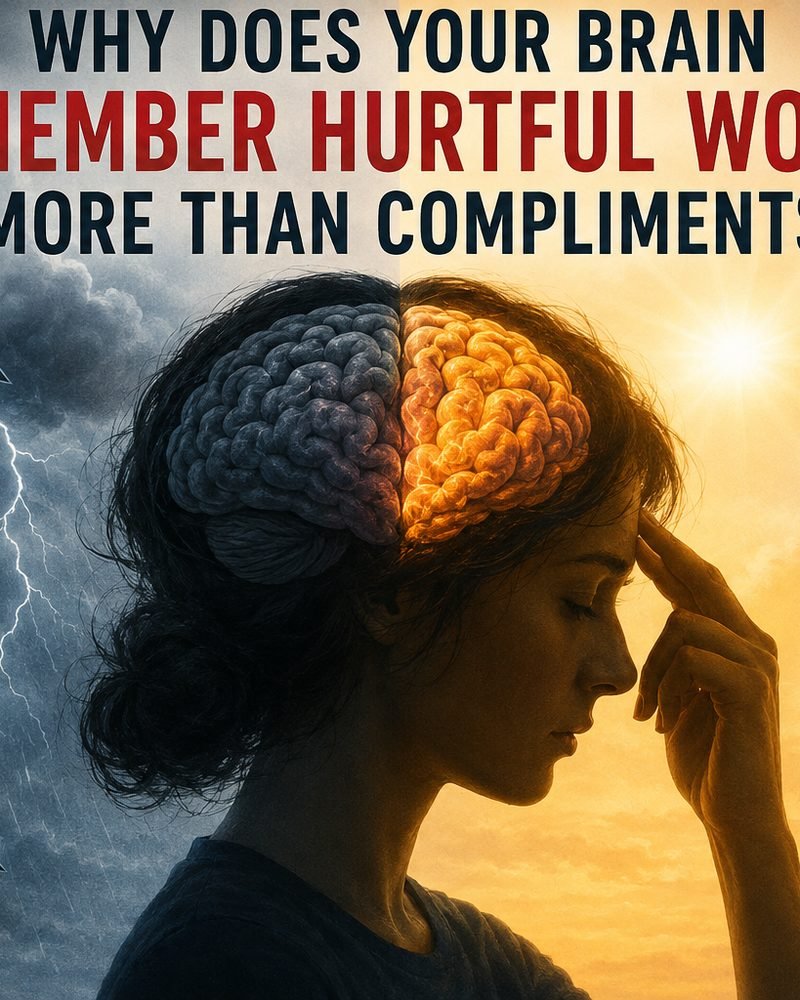
Why Does Your Brain Remember Hurtful Words More Than Compliments?
Have you ever received several compliments but found yourself thinking about one negative comment for the rest of the day?
Maybe someone criticized your appearance. Maybe a friend made a hurtful remark. Perhaps someone questioned your abilities or embarrassed you in front of others.
The strange part is that you may forget most of the positive things people said.
But that one negative sentence?
You remember it.
Sometimes you can remember exactly where you were, who said it, and even the expression on their face.
Why does the brain do this?
The answer is connected to a fascinating psychological phenomenon called negativity bias.
It helps explain why bad experiences can sometimes feel more powerful than good ones—and why one hurtful remark can occupy your mind long after the conversation has ended.
Your Brain’s Main Job Isn’t to Keep You Happy
The human brain is capable of happiness, pleasure, love, excitement and countless other positive emotions.
But keeping you happy isn’t its primary biological purpose.
One of its most important jobs is to help you survive and respond to your environment.
Your brain is constantly evaluating what’s happening around you.
Is something dangerous?
Is something unusual?
Should I pay attention?
Do I need to react?
Could this experience teach me something?
From an evolutionary perspective, detecting potential danger quickly could have been extremely valuable.
If an early human failed to notice something pleasant, there usually wasn’t a serious consequence.
But failing to notice a predator, hostile person, injury or other danger could be much more costly.
That may be one reason the human brain became especially sensitive to negative information.
What Is Negativity Bias?
Negativity bias is the tendency for negative events, experiences and information to sometimes have a greater psychological impact than positive experiences of similar intensity.
Researchers have studied this phenomenon across several areas, including attention, judgment, decision-making, learning and memory.
Think about two simple statements:
“You’re doing a great job.”
and
“You’re not good enough.”
Both are just sentences.
But they don’t necessarily feel the same.
The positive statement may make you smile.
The negative statement may cause you to stop and think.
You might immediately ask yourself:
Why did they say that?
Is it true?
Did I make a mistake?
Do other people think the same thing?
That extra mental processing can make the negative experience much more memorable.
Why Does an Insult Get So Much Attention?
Your brain has limited attention.
You encounter thousands of pieces of information every day, but you can’t consciously focus on all of them.
So your brain has to decide what deserves attention.
Potentially threatening or emotionally important information often gets priority.
An insult can feel important because it may involve your reputation, relationships, self-esteem or sense of belonging.
If the comment comes from someone whose opinion matters to you, the effect can be even stronger.
For example, criticism from a stranger might be annoying.
But the same criticism from someone you love could stay in your mind for much longer.
The words haven’t changed.
Their emotional meaning has.
Why Can Negative Experiences Feel More Emotional?
Negative experiences can trigger strong emotions such as anger, embarrassment, fear, sadness or disappointment.
Those emotions can make the experience stand out.
You might remember the exact words someone used.
You may remember what you were wearing.
You might remember where you were sitting.
You may even remember what you thought immediately afterward.
That’s because emotionally meaningful experiences can receive more attention than ordinary events.
And what receives more attention has a greater chance of becoming something you remember later.
Why Do We Replay Hurtful Conversations?
This is where things can become frustrating.
The conversation is over.
The person has left.
The situation is finished.
But your brain keeps replaying it.
You think:
“I should have said this.”
Then:
“Why did they say that?”
Then:
“Maybe they were right.”
Then you imagine a completely different response.
The original conversation might have lasted only a few minutes.
But you can spend hours thinking about it.
This repeated mental attention can keep the experience psychologically active.
Instead of being something that happened once, it becomes something you repeatedly revisit.
Does Remembering an Insult Mean It Was True?
No.
And this is extremely important.
Memory is not a truth detector.
Your brain can remember something because it was emotionally powerful, surprising, embarrassing or personally meaningful.
That doesn’t mean the information was accurate.
Someone could tell you:
“You’ll never succeed.”
You might remember that sentence for decades.
But the fact that you remember it doesn’t make it true.
A person’s opinion can become a powerful memory without becoming an accurate description of who you are.
Why Don’t Compliments Always Stay With Us?
Positive experiences can absolutely create long-lasting memories.
A kind word from a parent can be remembered for decades.
A teacher’s encouragement can influence someone’s confidence for years.
A compliment from someone you love can remain meaningful throughout your life.
So it isn’t accurate to say that the brain simply “forgets praise.”
The difference is that positive information often doesn’t create the same sense of urgency as negative information.
If someone says:
“You’re wonderful.”
there may be nothing your brain needs to investigate.
But if someone says:
“You’re doing everything wrong.”
your brain may immediately start searching for an explanation.
That extra attention can make the negative statement more prominent.
What About the Famous “30 Minutes” Claim?
You may have seen a viral claim saying that:
“The brain remembers an insult for decades but forgets praise in 30 minutes.”
It sounds fascinating.
But it shouldn’t be treated as a universal scientific rule.
There isn’t a fixed timer in the brain that makes every compliment disappear after 30 minutes.
Human memory varies enormously.
Some positive experiences may be forgotten quickly.
Others become incredibly strong memories that last a lifetime.
The scientifically safer explanation is that negative information can sometimes receive more attention and have a stronger emotional impact than positive information.
Exactly how long a memory lasts depends on many factors, including emotional intensity, personal meaning, repetition, attention and context.
Why Social Rejection Can Feel So Powerful
Humans are highly social.
Relationships, friendship, family, cooperation and belonging are extremely important parts of human life.
Because of that, social rejection can carry a lot of emotional weight.
Being criticized by someone you care about can make you wonder whether the relationship has changed.
Being embarrassed publicly can make you worry about how others see you.
Being excluded can make you question where you belong.
These situations can attract significant attention because social relationships matter to us.
That’s one reason a negative comment can sometimes feel much bigger than the words themselves.
One Negative Comment Can Overshadow Dozens of Positive Ones
Imagine posting a picture online.
You receive 50 positive comments.
Then one person writes something cruel.
What do you think about afterward?
You might find yourself focusing almost entirely on the negative comment.
You may reread it.
You may wonder why the person wrote it.
You might even look through their profile.
Meanwhile, the other 50 comments are still there.
But they aren’t demanding the same amount of attention.
This is a simple example of how negativity bias can appear in everyday life.
The negative comment doesn’t necessarily have more value. It simply captured more attention.
Your Brain May Be Trying to Learn From Negative Experiences
There is another way to understand this tendency.
Your brain doesn’t necessarily keep returning to unpleasant experiences because it wants to make you miserable.
It may be trying to understand what happened.
If something went wrong, remembering it could potentially help you avoid the same situation in the future.
If someone behaved badly toward you, remembering warning signs might help you recognize similar behavior later.
If you made an important mistake, remembering the mistake may help you avoid repeating it.
In this sense, negative experiences can contain useful information.
The problem is that sometimes the brain continues analyzing an event long after there is anything useful left to learn from it.
Repetition Can Make a Thought Feel More Important
There’s another factor that can keep negative experiences alive:
repetition.
Imagine someone says something hurtful.
You think about it once.
Then again before bed.
Then you tell a friend.
The next day, you remember it again.
A week later, something reminds you of it.
Each time the memory comes back, you’re giving it additional attention.
Repeated thinking doesn’t mean the memory is becoming perfectly accurate. Human memory can actually change over time.
But repeatedly focusing on an experience can keep it highly accessible in your mind.
This is one reason rumination can make old negative experiences feel surprisingly fresh.
Childhood Comments Can Stay for Years
Many people remember negative comments from childhood long into adulthood.
A teacher might have told them they weren’t smart.
A classmate might have mocked their appearance.
A friend might have excluded them.
An adult might have made a comment that seemed insignificant to them but enormous to the child hearing it.
Childhood and adolescence are important periods for developing identity and beliefs about ourselves.
Because of that, emotionally significant experiences during these years can become deeply associated with how someone sees themselves.
That’s why an old sentence from childhood can occasionally return to your mind decades later.
Positive Memories Can Be Just as Powerful
Negativity bias doesn’t mean humans are incapable of remembering good experiences.
Far from it.
Think about a moment when someone believed in you.
A teacher encouraged you.
A family member supported you.
A friend helped you when you needed them.
You achieved something you were proud of.
These experiences can remain emotionally powerful for years.
The point is not that negative memories always win.
Rather, negative experiences may sometimes receive a psychological advantage because they attract attention and emotional processing.
Your Brain Doesn’t Know Everything That Feels Threatening Is Actually Dangerous
Modern life has changed dramatically.
Most people aren’t spending their days trying to avoid predators or find enough food to survive.
But our brains still have systems that respond to potential threats.
Today, a “threat” might be much more social or emotional.
It could be:
- criticism from a boss,
- rejection from a friend,
- an embarrassing mistake,
- a harsh message,
- an argument,
- or a negative comment online.
These situations aren’t necessarily dangerous in the physical sense.
But they can still feel important.
And when something feels important, your brain may pay close attention to it.
Why One Harsh Sentence Can Feel Louder Than Ten Kind Ones
Imagine someone says:
“You’re beautiful.”
Then another person says:
“You look awful.”
You might logically know that the second person’s opinion doesn’t define you.
But emotionally, the negative comment may still bother you.
Why?
Because your brain doesn’t simply count positive and negative statements.
It evaluates their emotional significance.
A negative comment can create uncertainty and a desire to understand what happened.
That additional processing can make it feel louder in your mind.
Attention Doesn’t Equal Importance
This is one of the most useful lessons to take from negativity bias.
Just because something occupies your thoughts doesn’t mean it deserves that much space.
Your brain’s attention system is designed to notice information that might matter.
It isn’t designed to determine your worth.
A criticism may receive a huge amount of attention while being completely unfair.
A compliment may receive little attention while being completely sincere.
Attention and truth are two different things.
How Can You Give Positive Experiences More Attention?
You can’t simply turn negativity bias off.
It’s a normal part of human psychology.
But you can become more aware of it.
When someone gives you a genuine compliment, try not to immediately dismiss it.
When something goes well, allow yourself to recognize it.
When someone treats you kindly, take a moment to appreciate what happened.
When you accomplish something difficult, don’t immediately move on to the next problem.
Your brain may naturally highlight what’s wrong.
That doesn’t mean you can’t deliberately notice what’s right.
The Brain Isn’t Your Enemy
If you frequently remember embarrassing moments or hurtful comments, it can be tempting to think something is wrong with your mind.
But having negative memories doesn’t mean your brain is broken.
The same ability that makes you remember unpleasant experiences can help you learn from mistakes and recognize potential problems.
The goal isn’t to erase every negative memory.
It’s to understand that a memory can exist without controlling your present.
You can remember something without believing it.
You can acknowledge that a comment hurt without accepting the person’s judgment.
And you can recognize a negative thought without treating it as a fact.
So, Why Does Your Brain Remember Hurtful Words More Than Compliments?
There isn’t one simple explanation.
Negative experiences can sometimes be remembered more strongly because they attract attention, create emotional reactions, feel personally important, and may trigger repeated thinking.
This is part of what negativity bias helps explain.
Meanwhile, positive experiences may feel less urgent and therefore receive less immediate attention.
But that doesn’t mean compliments are unimportant.
And it doesn’t mean negative comments are accurate.
It simply means your brain may naturally give negative information more psychological weight.
The Takeaway
The next time one hurtful sentence suddenly comes back to you, remember something important:
Your brain remembered it because it felt significant—not necessarily because it was true.
A criticism can be memorable without being fair.
An insult can be emotionally powerful without being accurate.
And one negative opinion doesn’t automatically outweigh dozens of positive ones.
Your brain may notice the negative first because paying attention to potential problems has helped humans survive.
But you don’t have to let that instinct decide how you see yourself.
The harshest thing someone ever said about you is still just something someone said. It doesn’t have to become the definition of who you are.