
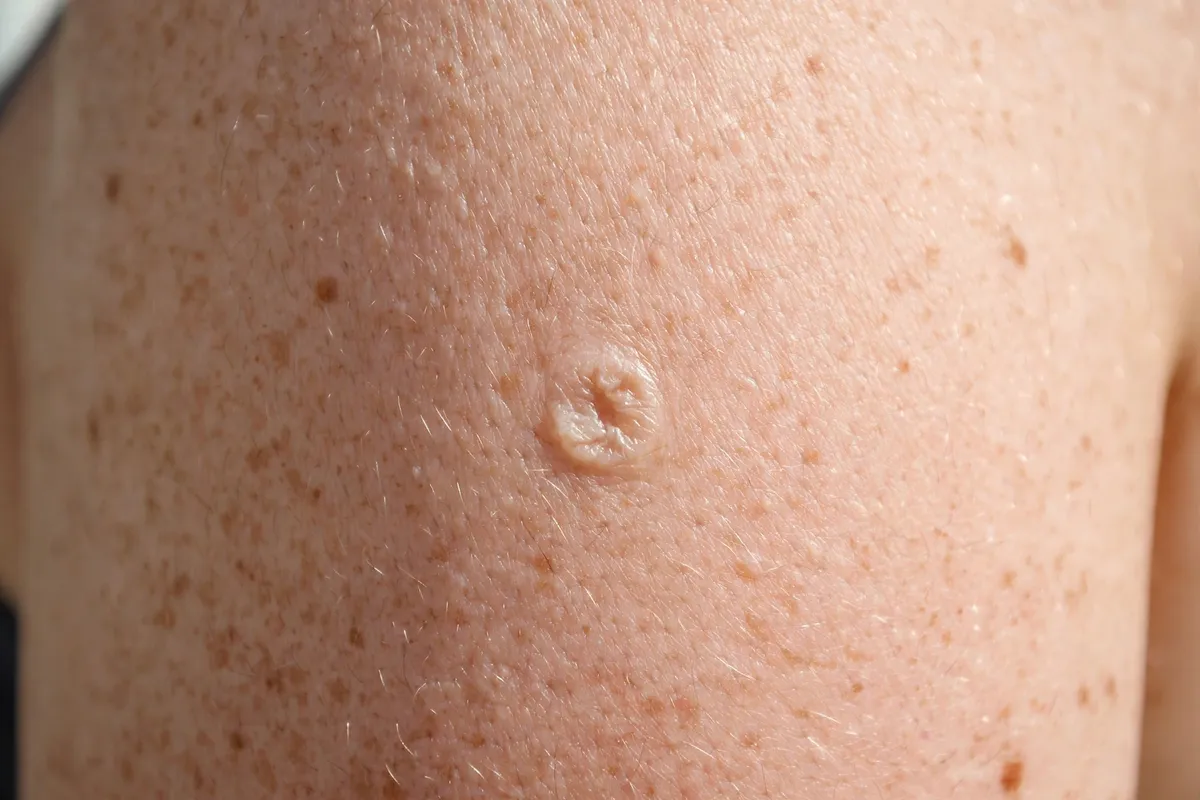
Look at your upper arm. Now look at your parent’s upper arm. Your uncle’s. Your neighbor’s. Chances are, many of you share the exact same small, round, slightly dented scar — almost like a tiny crater stamped into the skin. Same size. Same shape. Same spot.
It is one of the strangest coincidences of the human body: millions of people across the world, of different ages, backgrounds, and countries, all carrying an identical mark. So what is it? A birthmark? A childhood injury everyone forgot? A secret symbol?
The truth is more fascinating than any of those guesses. That little scar is a leftover from one of the greatest victories in the history of medicine — and it tells the story of a disease that once terrified the entire planet.
What Is This Mysterious Scar?
That small, round, slightly indented scar on the upper arm is a smallpox vaccine scar. If you were born before the early 1970s in most countries, you almost certainly received the smallpox vaccine as a child — and the vaccination left this permanent little mark behind.
Smallpox was one of the deadliest diseases humanity ever faced. For centuries, it swept through cities and villages, killing roughly 3 out of every 10 people it infected and leaving survivors disfigured. Then, through one of the most remarkable public health campaigns in history, the disease was wiped out completely — declared eradicated worldwide in 1980. It remains the only human disease ever fully eliminated.
The scar on your arm is the calling card of that victory.
Why Does Everyone Have the Same Scar?
This is the part that surprises most people. The reason the scar looks identical on everyone is that the smallpox vaccine was given in a very unusual way — completely different from the quick needle jab you get for a flu shot today.
The vaccine used a live virus called vaccinia, a close cousin of the smallpox virus but far less dangerous. Instead of a regular syringe, health workers used a special tool called a bifurcated needle — a needle with two tiny prongs at the tip, like a miniature fork.
The process went like this: the needle was dipped into the vaccine solution, picking up a drop of liquid between its prongs. Then the health worker pressed it into the skin of the upper arm, making a series of quick, shallow punctures in a small circular area. This deliberate, controlled scratching of the skin was intentional — it was designed to let the virus enter the top layer of skin and trigger the immune system to build protection.
Because every vaccination used the same tool, the same technique, and the same spot on the arm, the resulting scar came out looking the same on nearly everyone. It was not a coincidence at all — it was a standardized medical procedure, repeated hundreds of millions of times around the world.
How the Scar Forms: From Scratch to Permanent Mark
The formation of the scar is actually a visible record of your immune system doing its job. Here is what happened in the days and weeks after that little scratch:
- Days 1–3: A small red bump appeared at the vaccination site as the virus began to multiply in the skin.
- Days 4–7: The bump developed into a fluid-filled blister — a sign that the immune system was mounting its defense.
- Days 8–14: The blister dried out and hardened into a scab.
- Weeks 3–4: The scab fell off, revealing new skin underneath.
As the body repaired the damaged tissue, it laid down collagen fibers in a different pattern than normal skin. That is why the finished scar looks slightly sunken or pitted — the “dented” appearance is simply how that particular patch of skin healed.
The final result: a small, circular scar, usually about the size of a pencil eraser, sitting slightly below the level of the surrounding skin.
A Mark That Once Served as Proof of Immunity
During the era of mass vaccination, this scar was more than a curiosity — it was official proof that you were protected. Health officials would check for it during medical screenings. Immigrants arriving at places like Ellis Island in the United States had their arms examined for the telltale mark. No scar could mean quarantine or revaccination on the spot.
In some countries, schoolchildren lined up for the vaccine together, and the matching scars became a shared childhood memory — a badge of a generation that helped defeat a killer disease.
Routine smallpox vaccination for children ended in the early 1970s in most countries (including the United States in 1972), once the disease was nearly gone. That is why younger generations usually do not have the scar — it belongs mostly to those born before that era.
Smallpox Scar vs. BCG Scar: Not All Marks Are the Same
You may have heard of another vaccine that leaves a mark: the BCG vaccine, given to protect against tuberculosis. The BCG shot is still used in many countries today and can also leave a small scar on the upper arm — which sometimes causes confusion.
Here is how to tell them apart:
- Smallpox scar: round, slightly dented or pitted in the center, usually larger (about 1 cm). Found mostly in people vaccinated before the 1970s.
- BCG scar: smaller, often slightly raised rather than dented. Common in people from countries where BCG is still part of routine childhood vaccination.
Both are harmless, but they come from different vaccines, different techniques, and different eras of medical history.
Is the Scar Dangerous? Should You Worry?
In the vast majority of cases, a smallpox vaccine scar is completely harmless and needs no medical attention whatsoever. It is simply healed skin — a finished chapter, not an ongoing problem.
That said, a few people notice minor quirks:
- Occasional itching around the scar, especially in dry weather
- A feeling of tightness in the area, since scar tissue is less stretchy than normal skin
- Keloids — in some people, the body produces extra scar tissue during healing, creating a thicker, raised scar. This varies from person to person and is largely influenced by genetics.
These are cosmetic and comfort issues, not health dangers. However, as with any skin change, if a scar suddenly changes color, grows, bleeds, or becomes painful, it is worth having a doctor take a look — that advice applies to all scars, not just this one.
Can You Remove or Reduce the Scar?
For most people, the scar is a badge of honor — a conversation starter and a piece of living history. But if it bothers you cosmetically, there are options, ranging from simple to medical:
- Sun protection first: This is the single most important step. Ultraviolet rays can darken scar tissue permanently, making it more noticeable. Keep the area covered or use sunscreen.
- Moisturizers: Products like aloe vera gel, cocoa butter, or vitamin E oil are commonly used to soften scar tissue. Results vary from person to person, but keeping the skin hydrated never hurts.
- Silicone sheets or gels: For raised scars or keloids, silicone dressings can help flatten and fade the tissue over time.
- Professional treatments: Dermatologists may offer options like dermabrasion, laser therapy, or surgical revision for more dramatic improvement.
No method erases a scar completely or works the same for everyone — but for most people, simply protecting it from the sun keeps it as faint as possible.
Frequently Asked Questions
Why don’t younger people have this scar?
Routine smallpox vaccination ended in the early 1970s in most countries after the disease was nearly eradicated. If you were born after that, you were never vaccinated — so no scratch, no scar. It is essentially a generational mark.
Does the scar mean I am still immune to smallpox?
Not necessarily. The scar proves you were vaccinated, but immunity fades over decades. Since smallpox no longer exists in nature, this does not matter for daily life — but the scar itself is not a guarantee of current protection.
Can the smallpox vaccine scar cause health problems?
For the overwhelming majority of people, no. It is stable, healed tissue. Rare issues like keloids or persistent itching are manageable and not dangerous. Any sudden change in any scar deserves a doctor’s check, as a general rule.
Is it the same as the BCG (tuberculosis) vaccine scar?
No. They look similar at a glance, but the smallpox scar is usually rounder, more dented, and found in older generations, while BCG scars tend to be smaller, sometimes raised, and are common in countries that still use the BCG vaccine today.
Will my children or grandchildren have this scar?
Almost certainly not. With smallpox eradicated and routine vaccination discontinued worldwide, the smallpox scar is slowly becoming a piece of history — a mark that will one day exist only in old photographs and family stories.
The Bigger Picture
That little dent on your arm is easy to overlook. But think about what it represents: a moment when humanity faced one of its oldest killers — and won. Every identical scar is a reminder that a simple scratch on the arm, repeated hundreds of millions of times by health workers around the world, helped erase a disease from the face of the earth.
So the next time someone asks about that strange round mark, you will know the answer. It is not a mystery at all. It is a medal — one that an entire generation wears on their skin.
You May Also Like
If you found this mystery fascinating, here are more body curiosities readers love: