
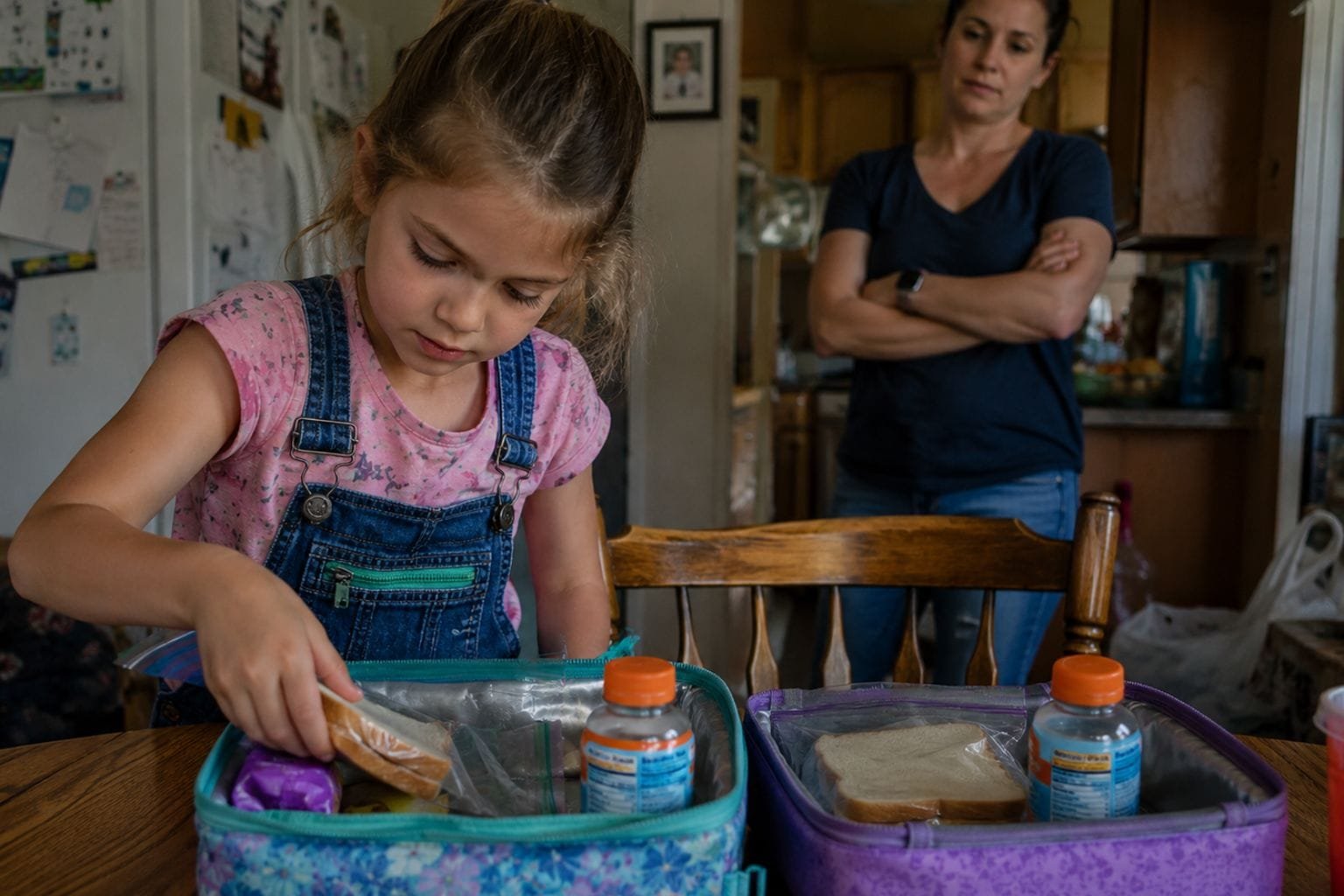
Every morning, before the school bus arrived, seven-year-old Emma would sit at the kitchen table and carefully pack her lunch.
She always packed two.
Her mother noticed it almost immediately.
At first, she assumed Emma was simply hungry. Maybe she wanted an extra sandwich. Maybe she was sharing with a friend.
So she never questioned it.
But after several weeks, something started to bother her.
The second lunch always came home untouched.
The sandwich was still there.
The fruit was still there.
Even the little bottle of water remained unopened.
Emma never seemed to eat any of it.
Her mother finally asked her about it one morning.
“Sweetheart, why do you keep packing two lunches?”
Emma stopped what she was doing.
For a moment, she didn’t answer.
Then she quietly said, “It’s not for me.”
Her mother smiled and assumed it was something simple.
“Are you sharing with one of your friends?”
Emma nodded.
But she wouldn’t say anything else.
And somehow, that answer was enough for her mother.
Until the teacher called.
The Phone Call
It happened on a Thursday afternoon.
Emma’s mother was putting groceries away when her phone rang.
It was Emma’s teacher.
Her voice sounded unusually serious.
“Is Emma packing two lunches every morning?”
Her mother froze.
“Yes,” she said. “She has been doing that for weeks. Why?”
There was a short pause.
Then the teacher said something that completely changed the way Emma’s mother saw those lunches.
“I think you should know where the second one is going.”
What the Teacher Had Seen
For several days, Emma’s teacher had noticed something unusual during lunchtime.
Emma would take both lunchboxes outside.
She would open her own first.
Then she would quietly walk toward the far end of the playground.
At first, the teacher assumed she was meeting a friend.
But there was never another child waiting for her.
Instead, Emma would sit beside the old wooden fence.
She would open the second lunchbox.
And then she would do something that made the teacher stop and watch.
She would leave the food beside the fence.
Then she would walk away.
The teacher couldn’t understand it.
Until one afternoon, she decided to follow from a distance.
That’s when she saw a small boy from another class quietly approach the fence.
He looked around before picking up the lunch.
He ate quickly.
Then he disappeared back toward the school.
The teacher realized that Emma had been giving her second lunch to him.
Her Mother Wanted to Know Why
When Emma’s mother heard this, she immediately asked:
“Who is the boy?”
The teacher explained that she wasn’t completely sure.
He was a quiet child who had recently transferred to the school.
He rarely spoke during lunch.
And he often sat alone.
Emma’s mother waited until Emma came home that afternoon.
She sat beside her daughter at the kitchen table.
“Emma,” she said gently, “you can tell me anything.”
Emma looked down.
Then she finally explained.
The boy had once asked her if she had an extra snack.
She gave him part of her sandwich.
The next day, she brought another one.
Eventually, she started bringing a whole second lunch.
Her mother asked why she never told her.
Emma shrugged.
“He looked hungry.”
That was all she said.
The Part Her Mother Didn’t Know
But there was another reason Emma had become so determined to bring that second lunch.
A few weeks earlier, she had noticed the boy sitting alone during lunch.
He wasn’t eating.
Emma had asked him why.
He told her that sometimes his family didn’t have enough food to pack lunch.
Emma went home that day thinking about him.
The next morning, she asked her mother if she could have another sandwich.
Her mother assumed she was simply extra hungry.
She had no idea that Emma had packed it for someone else.
And from that day forward, Emma quietly made sure there was always enough.
The Teacher’s Reaction
Emma’s teacher later told her mother that she had never seen anything quite like it.
What touched her most wasn’t simply that Emma shared her food.
It was that Emma never expected anything in return.
She didn’t tell the other children.
She didn’t ask for praise.
She didn’t even tell her mother.
She simply noticed someone who needed help and quietly did something about it.
The teacher decided the school needed to handle the situation carefully.
She didn’t want the boy embarrassed.
She didn’t want Emma praised publicly in a way that might make him uncomfortable.
Instead, the school quietly connected the family with available meal-support resources.
And something else changed too.
The little boy stopped having to wonder whether he would have something to eat at lunchtime.
A Conversation at the Kitchen Table
That evening, Emma’s mother sat beside her daughter again.
She told her how proud she was.
But she also explained something important.
“You don’t have to solve everything by yourself,” she said.
Emma nodded.
Then she asked:
“Can I still make two lunches?”
Her mother smiled.
“Yes.”
“But next time,” she said, “you don’t have to hide it from me.”
Emma thought for a moment.
“Okay.”
The next morning, Emma packed two lunches again.
But this time, her mother helped.
She added an extra apple.
A sandwich.
A small snack.
And a bottle of water.
Then she placed both lunchboxes beside the front door.
Sometimes Kindness Is Quiet
Stories like Emma’s are a reminder that kindness doesn’t always look dramatic.
Sometimes it’s a child putting an extra sandwich into a lunchbox.
Sometimes it’s sitting beside someone who is eating alone.
Sometimes it’s simply noticing that someone else might need a little help.
Emma didn’t know how to solve a family’s problems.
She didn’t need to.
She only knew that another child was hungry.
So she shared what she had.
And perhaps that’s what made the story so meaningful.
She wasn’t trying to be a hero.
She was just being a friend.
The Second Lunch
A few weeks later, Emma’s mother was cleaning out the kitchen cabinets when she found an old lunchbox tucked behind the others.
She smiled.
There were two lunchboxes sitting side by side.
One belonged to Emma.
The other had become a symbol of something much bigger.
Her mother later said that the second lunch taught her a lesson she hadn’t expected to learn from her seven-year-old daughter:
You don’t always need to have a lot to give something. Sometimes you simply have to notice who needs it.
And every morning after that, there were still two lunches by the door.
This time, nobody wondered why.