
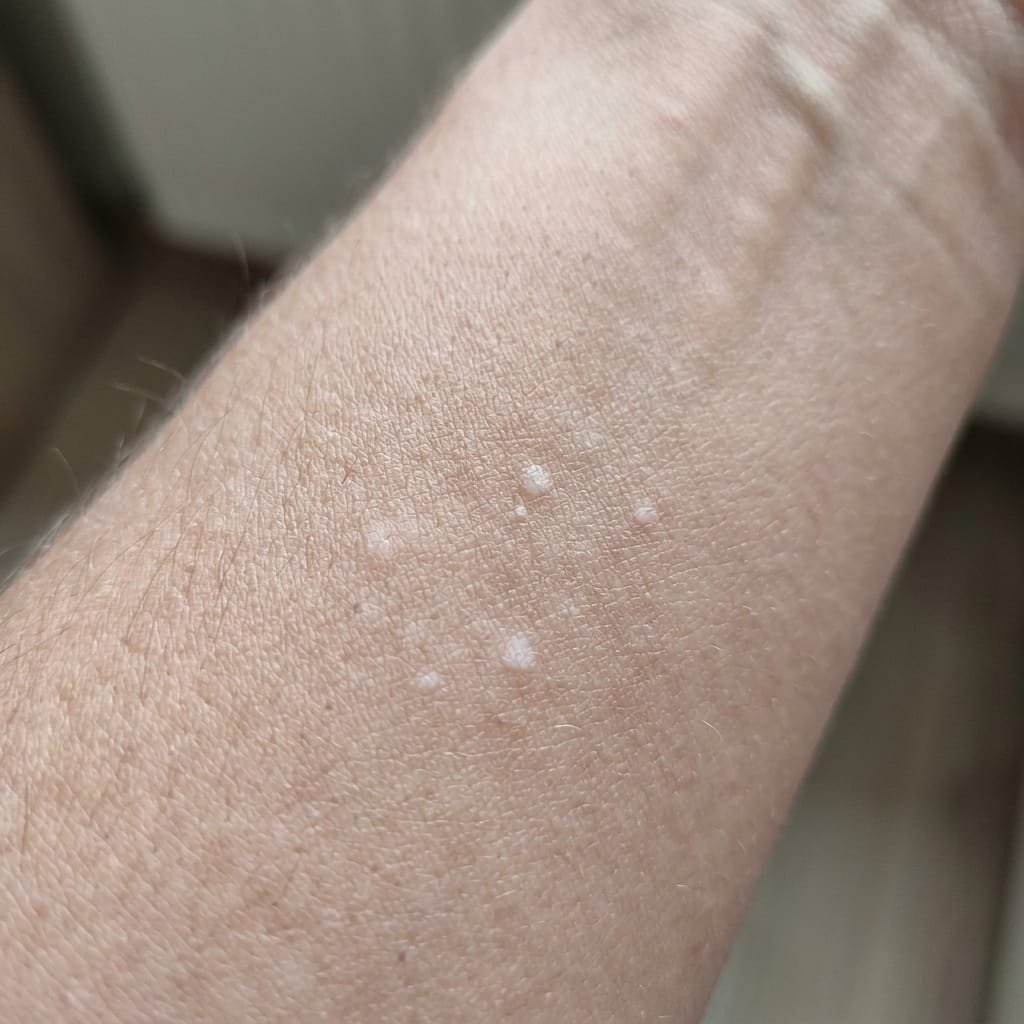
Tiny White Spots on the Skin: What Could They Mean?
Noticing several tiny pale or white spots on your forearm can be surprising, especially when the surrounding skin looks completely normal.
The first thing to know is that small light-colored spots are not a diagnosis by themselves. Different skin conditions can produce similar-looking areas, and details such as the size, shape, texture, location, how long they’ve been present, and whether they’re changing all matter.
Why Do Small White Spots Appear?
Skin gets its color mainly from melanin, a pigment produced by specialized cells called melanocytes. When an area produces less pigment, it can appear lighter than the surrounding skin.
There are several possible reasons this can happen.
Some causes are temporary or relatively harmless, while others need evaluation by a dermatologist.
Tinea Versicolor Can Cause Light Spots
One common possibility is tinea versicolor, a superficial fungal/yeast infection of the skin.
The yeast involved normally lives on healthy skin. Problems can occur when it grows excessively, affecting the skin’s normal pigmentation. This can produce lighter or darker patches, sometimes with mild scaling or itching.
Tinea versicolor commonly affects the upper body, shoulders, chest, back, neck, and upper arms. It can become more noticeable after sun exposure because the affected areas don’t tan in the same way as the surrounding skin.
Warm, humid weather can make this condition more common, which is one reason it is frequently seen in tropical and subtropical climates.
What About Vitiligo?
Another possibility people often think about when they notice white areas is vitiligo.
Vitiligo is an autoimmune condition in which the immune system attacks melanocytes, the cells responsible for producing skin pigment. As those cells are lost or stop functioning, affected areas can become significantly lighter or completely white.
Vitiligo can occur at any age and on different areas of the body.
However, a few tiny pale spots in a photograph do not mean that a person has vitiligo. A dermatologist may need to examine the skin and look at how the spots are developing before making a diagnosis.
Skin Can Also Become Lighter After Irritation
Another reason for a lighter area is previous skin inflammation or irritation.
For example, eczema or another irritated patch can sometimes leave lighter-colored skin after the inflammation improves. Mayo Clinic notes that this type of post-inflammatory color change can occur with several skin conditions.
A person may not always remember the original irritation, particularly if it happened weeks earlier.
Why Does Sun Exposure Make Some Spots Easier to See?
This is an important clue.
When surrounding skin becomes darker from sun exposure while a lighter area does not tan to the same degree, the contrast becomes much more obvious.
This can make previously subtle spots suddenly appear noticeable.
Tinea versicolor, for example, often becomes more visible after sun exposure because the affected areas don’t tan normally.
That doesn’t mean sunlight caused the spots; it can simply make the difference in pigmentation easier to see.
Look at the Texture Too
Color isn’t the only clue.
Ask yourself:
Are the spots completely smooth?
Smooth light spots can have different causes from spots that are dry or scaly.
Are they itchy?
Mild itching can occur with tinea versicolor, although not every person experiences symptoms.
Is there fine scaling?
A slightly scaly surface can be an important clue when evaluating certain superficial fungal conditions.
Are the spots becoming larger or multiplying?
Changes over time are worth paying attention to.
Where Are the Spots?
Location can also help narrow down possibilities.
Tinea versicolor commonly appears on the trunk and shoulders and can also involve the upper arms.
Vitiligo, on the other hand, can affect different parts of the body and may produce clearly lighter or white patches.
A dermatologist considers the location along with the appearance and distribution of the spots.
Does Skin Tone Make a Difference?
Light spots can be more noticeable on darker skin because there is a greater contrast between the affected and unaffected areas.
This doesn’t necessarily mean the condition itself is more serious.
It simply means that changes in pigmentation may be easier to see.
Should You Be Worried?
Usually, a small number of pale spots without other symptoms is not an emergency.
But new or changing skin discoloration shouldn’t automatically be ignored either.
Mayo Clinic recommends medical evaluation when a discolored patch continues to enlarge or when additional patches develop elsewhere.
It’s particularly sensible to seek professional advice if:
- The spots are spreading.
- New areas keep appearing.
- They become itchy or scaly.
- The skin becomes painful or inflamed.
- The areas become completely white.
- Hair growing from an affected area also changes color.
- The spots persist and you don’t know why they’re there.
Don’t Diagnose It From a Photograph
This is especially important with images like the one in this article.
A photograph can show that an area looks lighter, but it cannot reliably determine whether the cause is fungal, inflammatory, pigment-related, or something else.
A dermatologist may examine the spots under appropriate lighting or use additional examination methods when necessary.
That’s why it is better to think of a photograph as a clue, not a diagnosis.
What Should You Do If You Notice These Spots?
Start by observing them rather than immediately applying multiple products.
Take a clear photograph so you can compare the appearance later.
Note whether the spots change in:
- Size
- Number
- Color
- Texture
- Location
Avoid repeatedly scrubbing the area or using harsh skin products simply because the spots look unusual.
If the spots persist, spread, or become more noticeable, arrange an evaluation with a healthcare professional.
The Bottom Line
Tiny pale spots on the skin can have several explanations.
They may be related to a superficial fungal condition such as tinea versicolor, pigment loss such as vitiligo, previous skin irritation, or other causes of changes in pigmentation.
The important thing is not to diagnose the cause from appearance alone.
If you notice new spots, keep an eye on whether they’re changing. And if they spread, become symptomatic, or don’t go away, a dermatologist can determine what’s actually causing the color change.
So if you suddenly notice tiny white spots on your arm, don’t panic—but don’t assume you know the cause just by looking at them either.