
Found a Strange Bird Feather? Here’s What Its Pattern Can Tell You
Finding a feather on your lawn can seem like a small discovery, but a closer look can reveal much more than you might expect.
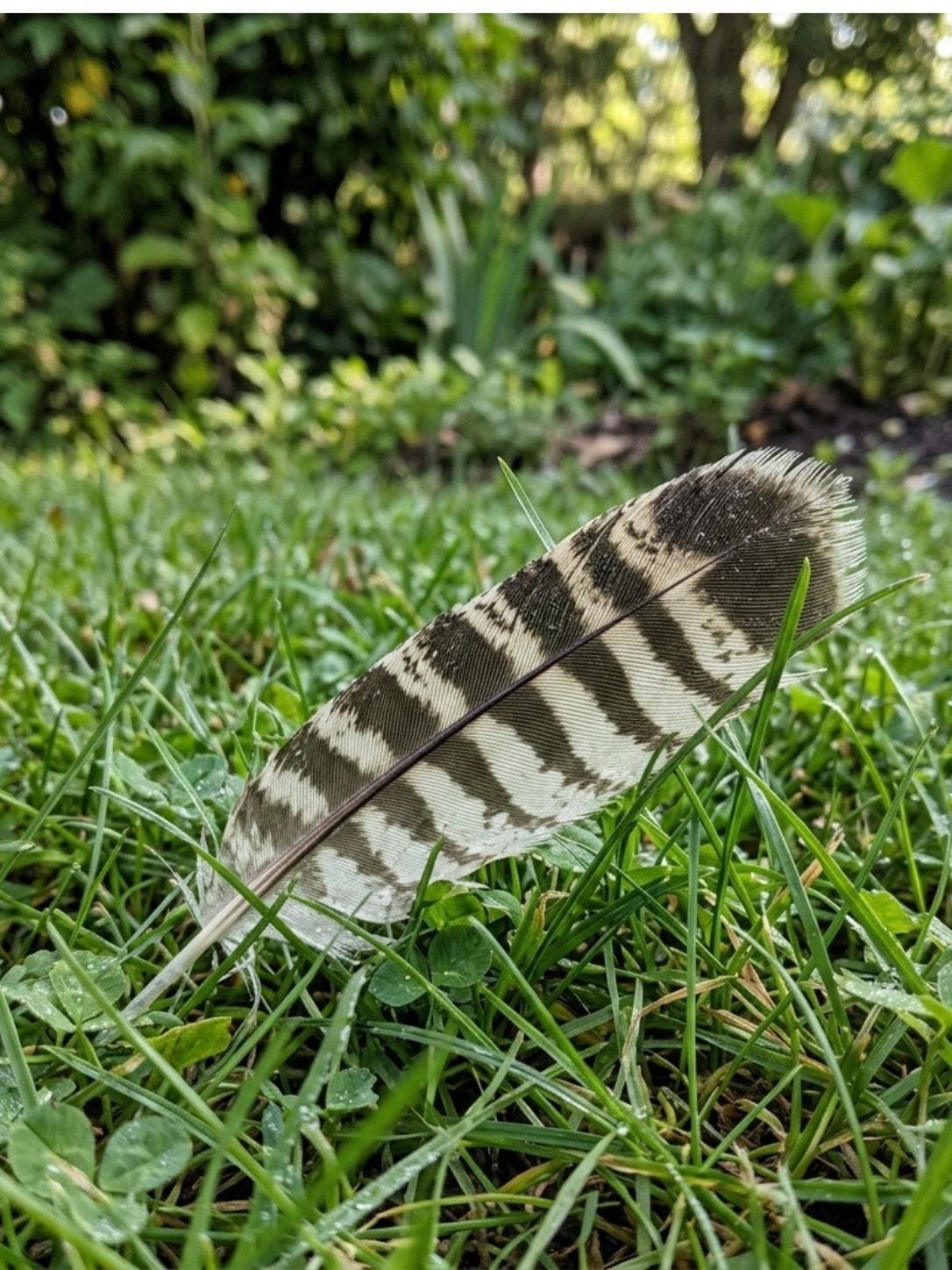
A feather with alternating dark and pale markings may look unusual, especially when you don’t know which bird it came from. The pattern can provide clues about the bird, but one feather by itself usually isn’t enough to identify a species with certainty.
Bird identification normally combines several clues, including feather patterns, shape, size, habitat, and other characteristics.
Why Do Bird Feathers Have Different Colors?
Feather color comes from pigments and the microscopic structure of the feather.
Dark areas commonly contain more melanin, while lighter areas contain less pigment or reflect light differently.
Birds can have extremely detailed patterns across their feathers. Stripes, spots, bars, patches, and contrasting edges can all be useful when identifying a bird.
That’s why a feather that appears to be simply “brown and white” can actually contain several useful identification clues.
What Do Alternating Dark and Light Bands Mean?
Dark and pale bands can occur naturally as part of a bird’s plumage pattern.
Some species have barred or banded feathers, while others have spots, streaks, or contrasting edges.
The exact pattern can depend on which feather it is.
A tail feather may look completely different from a wing feather from the same bird.
This is why identifying the feather’s location on the bird is important.
Could the Feather Be From a Young Bird?
Yes.
Birds don’t necessarily have the same plumage throughout their lives.
Young birds can have different colors and patterns from adults, and some species require several years to develop their definitive adult plumage.
That means a feather with an unusual pattern doesn’t necessarily belong to an unusual bird.
It may simply have come from a juvenile bird.
Molting Can Also Explain Strange Feathers
Birds regularly replace old feathers through a process called molting.
Feathers eventually become worn and need to be replaced. During molt, a bird may temporarily have a mixture of older and newer feathers, which can make its plumage look uneven or patchy.
This is completely normal.
In fact, bird researchers and experienced birders can use molt patterns to learn about a bird’s age and development.
Why Does an Old Feather Look Different?
A feather lying outside may not look exactly like it did when it was attached to the bird.
Sunlight can bleach feathers over time, while weather, friction, dirt, and normal wear can change their appearance.
The Cornell Lab of Ornithology notes that feathers can become paler from sun exposure and that wear can obscure some of the original markings.
So a faded feather shouldn’t automatically be assumed to have unusual genetics or coloration.
Can You Identify the Bird From One Feather?
Sometimes you can narrow it down, but identification from a single feather can be difficult.
Look at several characteristics:
1. Overall length
Measure the feather from the tip to the base.
A very small feather suggests a different part of the bird than a long flight feather.
2. Shape
Is it:
- Long and narrow?
- Broad?
- Rounded?
- Pointed?
- Curved?
Shape can help determine whether you’re looking at a wing, tail, or body feather.
3. Color pattern
Look carefully at the arrangement of the markings.
Notice:
- Dark bands
- Pale edges
- Spots
- Stripes
- Solid sections
- Color changes along the shaft
Birders commonly use these kinds of field marks when identifying birds.
4. The central shaft
The stiff central structure running through the feather is called the rachis.
The finer structures branching from it are called barbs.
Together, these structures create the familiar flat surface of a feather.
Looking closely at this structure can also help determine what type of feather you’re examining.
Is a Feather With Dark and Pale Markings Unusual?
Not necessarily.
Many birds naturally have contrasting feather patterns.
For example, some birds have strongly barred tails or wings, while others have subtle pale edges around darker feathers.
In some species, young birds may have more streaking or barring than adults.
So an unusual-looking feather may actually be completely normal for the bird that lost it.
Could It Be a Damaged Feather?
Yes.
Feathers can become worn or damaged during normal activity.
Birds use their feathers constantly for flight, insulation, protection, and other functions. Over time, feathers experience considerable wear.
Once a mature feather is damaged, it cannot repair itself. Instead, the bird eventually replaces it during molt.
A feather found on the ground may therefore have:
- Frayed edges
- Missing barbs
- Faded areas
- Broken sections
- Dirt
- Bent portions
These features don’t necessarily indicate illness.
What If the Feather Looks Very Different From Normal?
Rare color abnormalities do occur.
Birds can occasionally have unusual pigmentation caused by genetic variation or other factors. Terms such as leucism, albinism, and melanism describe some types of abnormal pigmentation.
However, a single unusually colored feather isn’t enough to conclude that the bird had a pigment disorder.
The feather may simply be faded, dirty, damaged, or from a species with naturally unusual plumage.
Should You Pick Up a Feather?
If you find a feather outdoors, it’s best to avoid making assumptions about its origin based only on appearance.
You can photograph it where you found it and record details such as:
- Where you found it
- Approximate length
- Main colors
- Pattern
- Shape
- Whether other feathers were nearby
The surrounding habitat can be particularly useful because bird identification relies partly on habitat and location in addition to appearance.
The Most Important Clue May Be Nearby
If you found the feather in your backyard, look around.
Are there birds regularly visiting the area?
Do you have:
- Bird feeders?
- Trees or shrubs?
- Nesting areas?
- Water sources?
- Open grass?
- Nearby woodland?
Seeing which birds are actually using the area can provide an important clue.
Still, it’s better to treat this as a clue rather than proof.
Why the Feather in the Photo Is Interesting
The alternating dark and pale pattern makes this feather visually distinctive, but the pattern alone isn’t enough to name the bird.
It could represent normal species-specific coloration, a feather from a younger bird, seasonal plumage, or simply a feather that has experienced some fading or wear.
The correct identification would require additional information such as the feather’s exact size and shape, where it was found, and ideally a photograph showing both sides of the entire feather.
Final Takeaway
A strange-looking feather on your lawn isn’t necessarily a sign that something unusual happened to a bird.
Its markings may simply be part of normal plumage.
Birds replace worn feathers through molting, and their feather colors and patterns can vary with species, age, season, and individual development.
So next time you find a feather with an unusual pattern, don’t just look at its color.
Look at its shape, size, markings, condition, and where you found it.
Those small details can turn an ordinary feather lying in the grass into a fascinating clue about the bird that left it behind.