
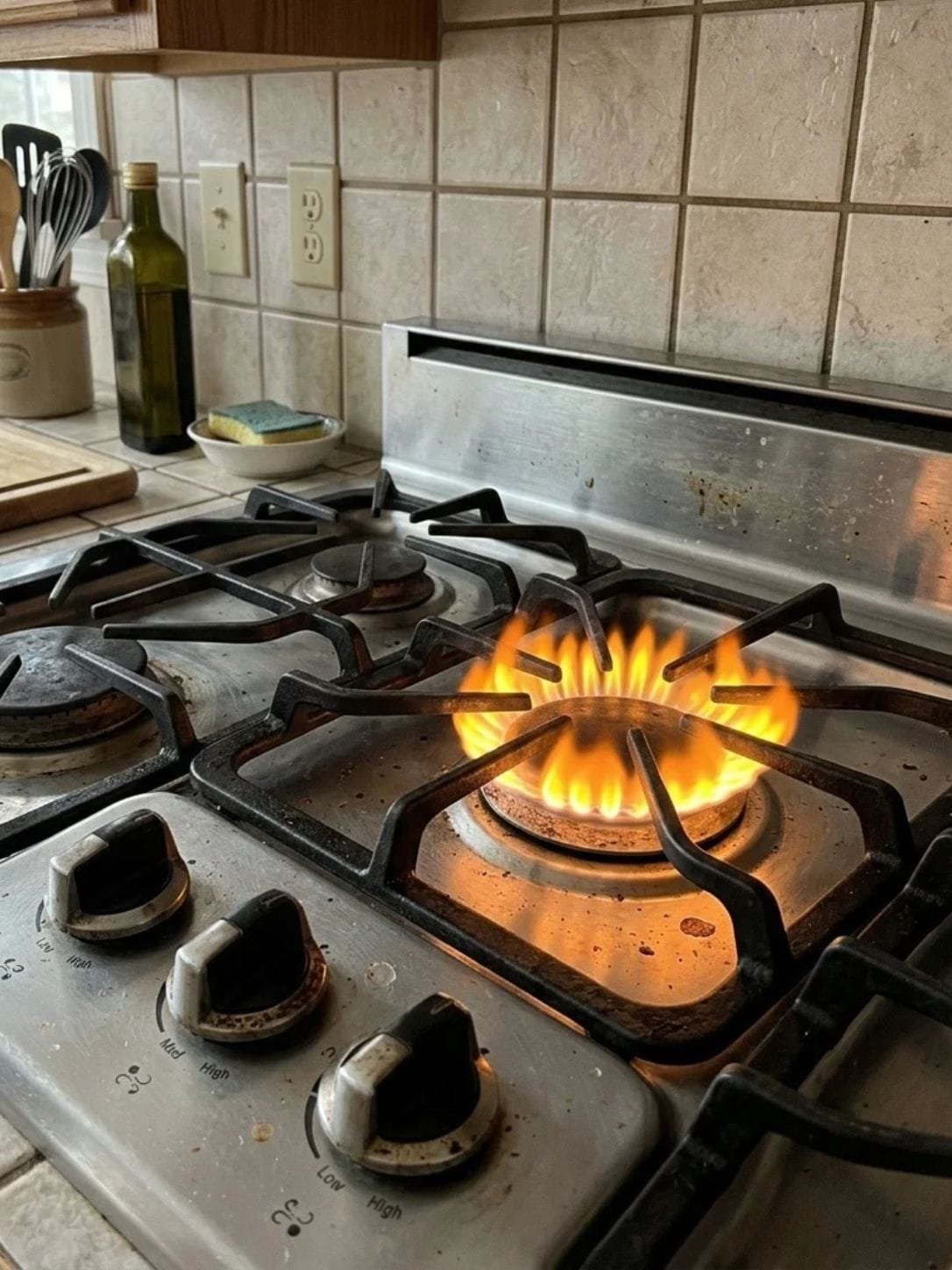
Why Is My Gas Stove Flame Orange Instead of Blue?
A gas stove normally produces a mostly blue flame. So if a burner that usually burns blue suddenly starts producing a noticeable orange or yellow flame, it is something worth paying attention to.
An unusual flame does not automatically mean there is an immediate emergency, but a persistent yellow or orange flame can indicate that the burner is not getting the correct fuel-to-air mixture. That can lead to less efficient combustion and, in some circumstances, increased production of carbon monoxide (CO).
What Does a Normal Gas Flame Look Like?
For many household gas appliances, a properly adjusted burner produces a predominantly blue flame.
The blue color is associated with efficient combustion.
A temporary change in flame appearance can sometimes happen for harmless reasons, but a persistent yellow or orange flame should not simply be ignored. Gas-safety guidance specifically lists a yellow or orange flame where blue is normally expected as a warning sign that an appliance may not be operating correctly.
Why Can a Gas Flame Turn Orange?
One important possibility is an incorrect air-to-gas mixture.
Gas needs an appropriate amount of air to burn efficiently. If the mixture is not correct, combustion can become incomplete.
The U.S. Consumer Product Safety Commission explains that incomplete combustion of fuels such as natural gas and propane can produce carbon monoxide. Problems with the fuel-air mixture can occur for several reasons, including restricted combustion air or appliance problems.
There can also be less serious explanations for a temporary color change, so the flame color alone cannot tell you exactly what has gone wrong.
Why Is Carbon Monoxide the Main Concern?
Carbon monoxide is particularly dangerous because it is colorless and odorless.
You cannot reliably detect it by smelling the air.
CO interferes with the body’s ability to transport oxygen. Exposure can cause symptoms such as headache, dizziness, weakness, nausea, confusion, and fatigue; serious exposure can lead to unconsciousness and death.
That’s why an unusual flame is worth investigating even when the stove appears to be working normally.
Does an Orange Flame Mean Carbon Monoxide Is Definitely Present?
No.
This is an important distinction.
An orange or yellow flame is a warning sign, not proof that dangerous carbon monoxide is currently accumulating in the room.
Other factors can affect flame appearance, and the appliance needs to be assessed properly to determine whether combustion is occurring correctly.
Gas Networks Ireland specifically identifies a yellow or orange flame as one possible indication of a carbon-monoxide-related appliance problem, along with things such as soot, staining, condensation, or unusual appliance behavior.
What If Only One Burner Has an Orange Flame?
That can be useful information.
If one burner looks different while the others remain normal, the problem may be localized to that burner.
For example, the burner may have contamination, a blockage, or another issue affecting how gas and air mix.
If all burners suddenly change appearance, the cause could be different and should be assessed by someone qualified to work on the appliance.
Either way, a persistent abnormal flame shouldn’t be treated as normal simply because the stove still lights.
What About a Temporary Orange Tip?
A brief change in flame appearance isn’t necessarily the same as a burner that consistently burns yellow or orange.
The important warning sign is a persistent abnormal flame, particularly when it is accompanied by other changes such as soot, discoloration, unusual odors, or symptoms occurring when the appliance is operating.
If the flame repeatedly returns to orange or yellow, have the appliance checked rather than assuming it will correct itself.
Other Warning Signs to Watch For
Don’t focus only on the flame.
Look for:
- Soot or blackening around the appliance
- Unusual discoloration
- Strange appliance behavior
- Condensation around the area
- Persistent yellow/orange flames
- Headaches or dizziness while the appliance is operating
- Multiple people in the home developing similar symptoms
These signs don’t prove that carbon monoxide is present, but they can indicate that a fuel-burning appliance needs attention.
What Should You Do If Your Flame Looks Like This?
If the flame remains unusually yellow or orange, stop treating it as normal and arrange for the appliance to be inspected by a qualified gas appliance professional.
Do not attempt to modify gas valves, burner settings, or internal components yourself unless you are specifically qualified to do so.
The CPSC advises that fuel-burning appliances should be installed and maintained according to manufacturer instructions and that people should not service them without the appropriate knowledge, skills, and tools.
What If You Feel Sick While the Stove Is On?
This is more serious.
If you develop symptoms such as headache, dizziness, nausea, unusual weakness, confusion, or other unexplained symptoms while a gas appliance is operating, don’t assume it’s simply tiredness or a normal illness. These can occur with carbon monoxide exposure.
Move to fresh air and follow your local emergency and gas-safety procedures. If a carbon monoxide alarm sounds, leave the property and do not re-enter until emergency responders or qualified professionals say it is safe.
A Carbon Monoxide Alarm Adds Protection
A carbon monoxide alarm is an important additional safety measure in homes with fuel-burning appliances.
However, an alarm is not a replacement for proper appliance installation, maintenance, ventilation, and inspection.
Follow the alarm manufacturer’s instructions for placement, testing, battery replacement, and maintenance.
Keep the Kitchen Properly Ventilated
Gas combustion requires air.
Make sure ventilation openings aren’t blocked, and use your kitchen exhaust system according to the manufacturer’s instructions. The CPSC recommends using exhaust fans over gas cooking stoves and keeping burners properly adjusted.
Also, never use a gas stove or oven as a way to heat your home. The CPSC specifically warns against this practice because fuel-burning appliances can produce carbon monoxide and other combustion pollutants.
Don’t Ignore a Change You Keep Seeing
A stove that has always produced a blue flame but suddenly develops a persistent orange or yellow flame deserves attention.
It may turn out to be a relatively simple burner issue, but you shouldn’t try to determine that by guessing or by continuing to use a malfunctioning appliance indefinitely.
The safest approach is to recognize the warning sign and have the appliance checked properly.
Final Takeaway
A persistent orange or yellow flame on a gas stove is not something to casually ignore.
It doesn’t automatically mean your kitchen contains dangerous carbon monoxide, but it can indicate a combustion or burner problem that deserves professional attention. Incomplete combustion can produce carbon monoxide, which is especially dangerous because you cannot see or smell it.
So if your normally blue gas flame suddenly starts looking like the one in the photo:
Don’t panic—but don’t ignore it either.
Have the appliance checked, keep ventilation unobstructed, use a properly installed CO alarm as an additional safeguard, and take symptoms or a sounding CO alarm seriously.