
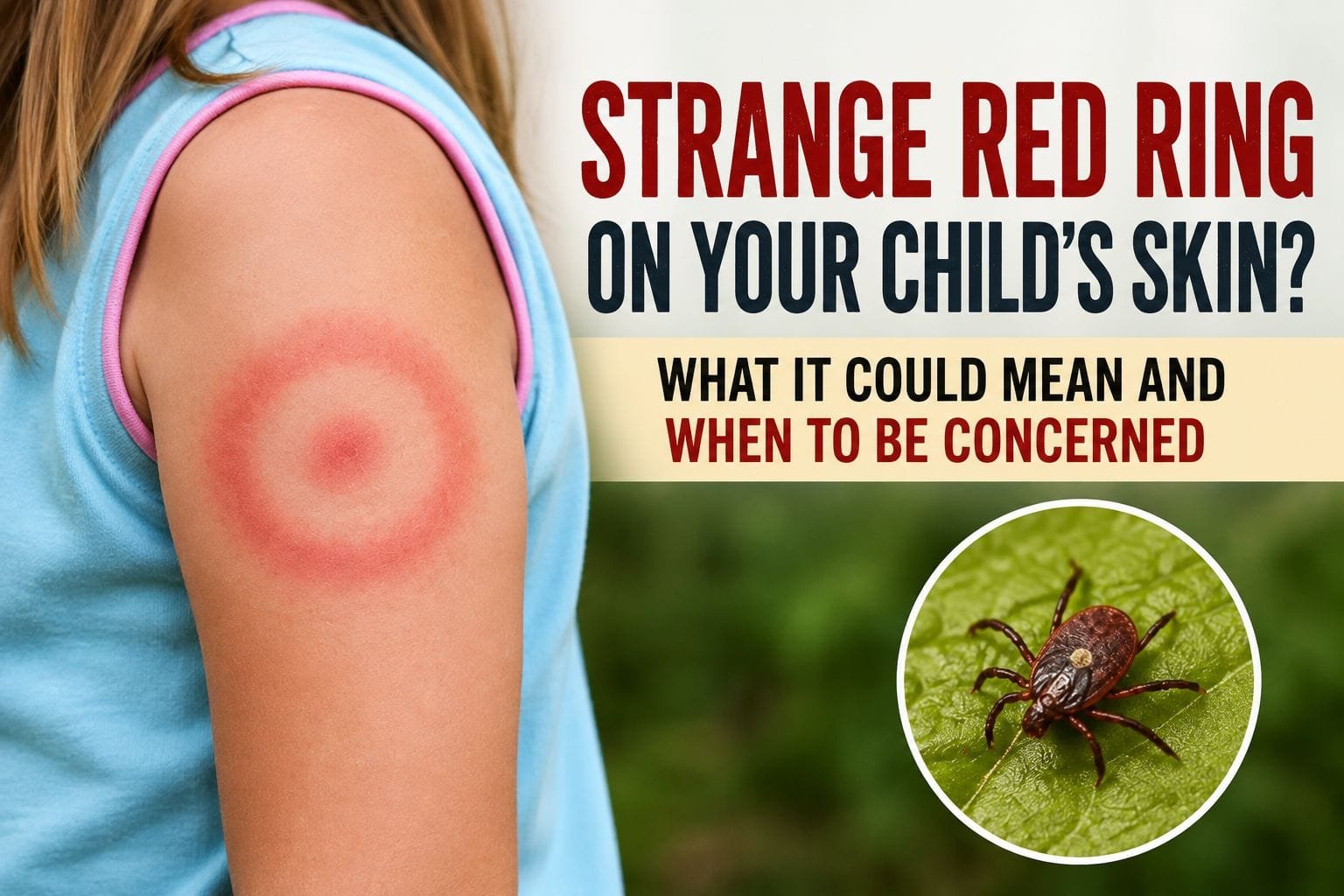
One morning, you notice something unusual on your child’s skin.
A red, circular mark has appeared on the arm. It almost looks like a target or bull’s-eye, with a darker area toward the center and redness spreading around it.
At first, it may seem like a simple insect bite.
But when a rash appears after spending time outdoors, especially in an area where ticks are common, it deserves attention.
A circular rash can have several possible causes. One important possibility is erythema migrans (EM), the characteristic expanding rash associated with Lyme disease. However, not every round or ring-shaped rash is Lyme disease, and a healthcare professional may need to evaluate the appearance, timing, symptoms, and possible tick exposure.
What Does a Bull’s-Eye Rash Look Like?
An erythema migrans rash often begins as a reddish area near the location of a tick bite and gradually expands over several days.
It can be round or oval, and the center may become lighter as the rash grows, creating a bull’s-eye-like appearance.
However, the classic bull’s-eye pattern does not appear in every case of Lyme disease. The rash can look different from person to person.
That is why it is better not to rely on a photograph alone to determine what caused a rash.
Could It Be Lyme Disease?
Lyme disease is caused by bacteria transmitted through the bite of infected Ixodes ticks.
Early symptoms can include:
- An expanding rash
- Fever or chills
- Headache
- Fatigue
- Muscle aches
- Joint pain
- Swollen lymph nodes
According to the CDC, erythema migrans commonly appears 3–30 days after an infected tick bite. The rash usually expands gradually rather than simply remaining the same size.
If your child has a new expanding rash after possible tick exposure, contacting a healthcare professional is a sensible step.
Not Every Circular Rash Is Lyme Disease
This is an important point.
A red ring on the skin does not automatically mean Lyme disease.
An ordinary reaction to tick saliva can produce redness around the bite. These reactions generally appear within hours, usually do not continue expanding, and often disappear within a few days.
Other skin conditions, insect bites, allergic reactions, and infections can also produce circular or ring-shaped marks.
That is why the timing and progression of the rash matter.
What About a Lone Star Tick?
There is another possibility that can make these rashes particularly confusing.
Bites from the lone star tick (Amblyomma americanum) can sometimes be followed by an erythema-migrans-like rash known as Southern Tick-Associated Rash Illness (STARI).
STARI can resemble early Lyme disease, making the two conditions difficult to distinguish based on appearance alone. Recent CDC-published research also describes a pediatric STARI case involving a lone star tick and an EM-like skin lesion.
Importantly, STARI is not Lyme disease, and its cause remains uncertain.
What Should You Do If Your Child Develops a Rash Like This?
Don’t immediately assume the worst.
Instead, take a clear photograph of the rash so you can compare its size and appearance later.
You can also gently note its approximate size and the date you first noticed it.
Then consider these questions:
- Was your child recently in woods, tall grass, or brush?
- Could a tick have been attached?
- Did you find a tick on your child?
- Is the rash getting larger?
- Does your child have a fever?
- Is your child unusually tired?
- Are there headaches, muscle aches, or joint pain?
- Are swollen lymph nodes present?
This information can help a healthcare professional understand the situation.
Watch Whether the Rash Expands
One of the most important clues is whether the rash changes over time.
A simple local reaction may appear relatively soon after a bite and then fade.
An erythema migrans rash, on the other hand, typically expands gradually over days.
If you notice that a circular rash is becoming larger, don’t simply wait for it to disappear without discussing it with a healthcare professional.
Don’t Wait for Every Possible Symptom
Parents sometimes assume that a child must have a fever, headache, or other symptoms before a tick-related illness becomes a concern.
That’s not necessarily true.
The CDC notes that an expanding erythema migrans rash can itself be an important clinical sign of early Lyme disease. In appropriate circumstances, healthcare providers may diagnose Lyme disease clinically rather than waiting for laboratory testing.
Early blood tests can also be negative because antibodies may not yet have developed.
That’s one reason the child’s history, exposure, symptoms, and physical examination are important.
What Happens If It Is Lyme Disease?
The encouraging news is that Lyme disease is treatable.
When appropriate antibiotics are given during the early stages, most people recover rapidly and completely. Treatment choices can depend on factors such as age, medical history, allergies, pregnancy status, and the particular presentation of the illness.
For children, healthcare professionals select an appropriate antibiotic and dose based on the child’s individual circumstances.
Parents should not start leftover antibiotics or give a child someone else’s medication.
What If There Was No Tick Bite?
Not remembering a tick bite does not necessarily rule out Lyme disease.
Ticks can be extremely small, and people don’t always notice when they have been bitten.
If a child develops an unexplained expanding rash and has potentially been exposed to ticks, tell the healthcare professional about the outdoor exposure even if nobody remembers seeing a tick.
How to Check Your Child for Ticks
After outdoor activities, especially in wooded or brushy areas, make tick checks a routine.
Look carefully around:
- The scalp and hairline
- Behind the ears
- Neck
- Armpits
- Waist
- Groin
- Behind the knees
- Between the toes
- Other areas where clothing fits tightly
Ticks can be easy to miss, especially when they are very small.
Check clothing and gear as well, and remember that pets can also bring ticks into the home.
What If You Find an Attached Tick?
Remove it promptly.
Use clean, fine-tipped tweezers and grasp the tick as close to the skin as possible. Pull upward steadily without twisting or jerking.
After removal, clean the bite area and your hands.
If you can safely photograph the tick before disposing of it, that photograph may be useful later for identification.
When Should You Contact a Doctor?
Contact your child’s healthcare professional if:
- The rash is expanding.
- Your child develops fever or chills.
- Your child develops a headache.
- Your child becomes unusually tired.
- Muscle or joint aches develop.
- Swollen lymph nodes appear.
- You found a tick attached before the rash appeared.
- Your child develops other unusual symptoms after possible tick exposure.
Seek urgent medical attention if your child develops severe symptoms or appears seriously ill.
The Rash in the Photo Is Not Enough to Make a Diagnosis
A photograph can show what a rash looks like, but it cannot reliably tell you exactly what caused it.
Even an experienced clinician may need information about the child’s recent activities, geographic exposure, timing, symptoms, and how the rash changes.
So if you see a strange expanding red ring on your child’s skin, don’t try to diagnose it solely from an image circulating online.
Use the image as a reason to pay attention and seek appropriate medical advice, rather than as proof of a particular disease.
How to Reduce Tick Exposure
The easiest way to reduce the risk of tick-related illness is to prevent tick bites.
When spending time outdoors:
- Stay on cleared paths when possible.
- Avoid brushing against tall grass and dense vegetation.
- Use an appropriate EPA-registered insect repellent.
- Wear clothing that provides good skin coverage.
- Check children for ticks after outdoor activities.
- Check pets regularly.
- Shower after returning indoors.
- Inspect clothing and outdoor gear.
These simple habits can significantly reduce opportunities for ticks to remain attached.
Final Thoughts
A strange circular rash on a child’s arm can understandably make any parent nervous.
But a red ring doesn’t automatically mean Lyme disease.
The important clues are how the rash looks, when it appeared, whether it is expanding, whether there was possible tick exposure, and whether other symptoms develop.
If your child develops an expanding rash after spending time somewhere ticks may be present, take a photograph, keep track of its progression, and contact a healthcare professional for proper evaluation.
Early recognition of Lyme disease matters because appropriate treatment can help prevent more serious complications.
And remember: not every bull’s-eye-looking rash is Lyme disease, but an unexplained expanding rash after possible tick exposure should not simply be ignored.
Frequently Asked Questions
Is every bull’s-eye rash Lyme disease?
No. Several conditions can cause circular or ring-shaped rashes. Lyme disease is one possibility, while tick-bite reactions and STARI can produce similar-looking lesions.
How quickly can a Lyme rash appear?
The CDC says erythema migrans commonly appears 3–30 days after the bite of an infected tick.
Can children get Lyme disease?
Yes. Children can develop Lyme disease after being bitten by an infected tick.
Can a lone star tick cause a bull’s-eye-like rash?
Yes. Lone star tick bites can be associated with STARI, which can produce an erythema-migrans-like rash and can resemble Lyme disease.
Should I wait for the rash to disappear?
If the rash is expanding or your child has other concerning symptoms after possible tick exposure, it’s better to contact a healthcare professional rather than simply waiting.
Can Lyme disease be treated?
Yes. Appropriate antibiotic treatment is effective for early Lyme disease, with the specific medication and regimen determined by a healthcare professional.