
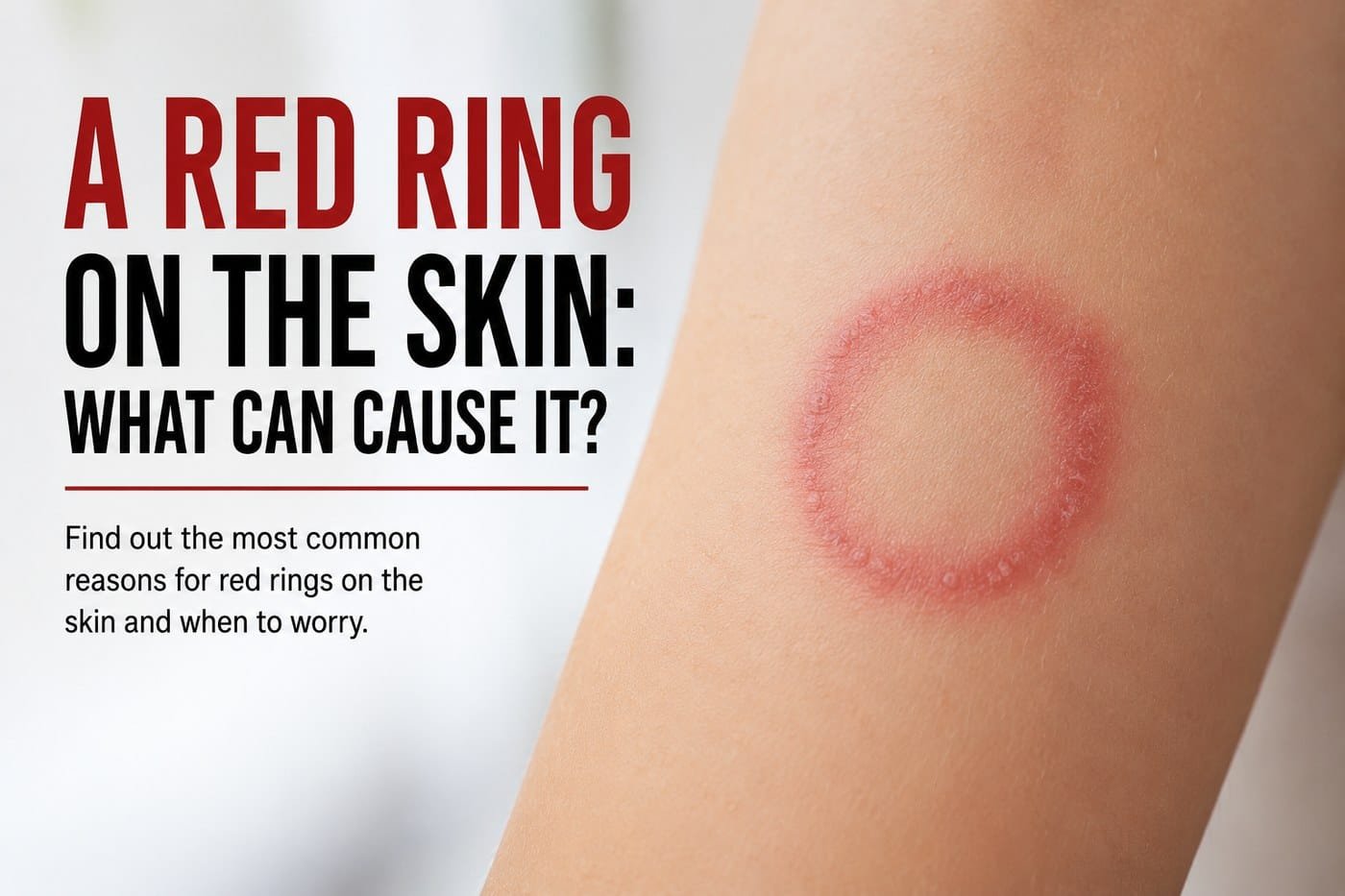
A Red Ring on the Skin: What Can Cause It?
A suddenly appearing red ring on the skin can be alarming, especially when it seems to be getting larger. While some circular marks are harmless reactions to irritation or insect bites, others can be signs of an infection or another skin condition that needs medical attention.
The important thing is that the appearance of a ring alone cannot tell you exactly what caused it. Doctors consider its size, shape, how quickly it appeared, whether it is expanding, and what other symptoms are present.
1. Lyme Disease Can Cause an Expanding Ring
One of the best-known causes of an expanding circular rash is Lyme disease, which is caused by bacteria transmitted through infected ticks.
The characteristic rash is called erythema migrans. It often begins at or near the site of a tick bite and gradually expands over several days.
Despite the popular image of a perfect “bull’s-eye,” the rash does not always look like a target. It may simply appear as an expanding red patch or ring.
Some people also develop:
- Fever or chills
- Headache
- Fatigue
- Muscle or joint aches
- Swollen lymph nodes
A tick bite does not automatically mean someone has Lyme disease. The risk depends heavily on geographic location and whether the tick was carrying the bacteria.
2. Insect Bites Can Produce Circular Reactions
Mosquitoes, biting flies, fleas, and other insects can cause redness and swelling around a bite.
Some people have a stronger allergic or inflammatory reaction, producing a large area of redness that can look surprisingly dramatic.
These reactions are often:
- Itchy
- Swollen
- Warm
- Centered around a visible bite or puncture
A typical local reaction usually begins improving rather than continuously expanding over many days.
3. Ringworm Is Another Common Cause
Despite its name, ringworm is not caused by a worm. It is a fungal infection of the skin.
It commonly produces a circular or ring-shaped rash with:
- A red or darker outer edge
- Scaling or dryness
- A clearer center
- Itching
- Gradual enlargement
Ringworm can occur on the arms, legs, torso, scalp, feet, or other areas.
Because it is caused by a fungus, treatment is different from treatment for bacterial infections or tick-borne illness. Antifungal medication is generally used when ringworm is diagnosed.
4. Skin Infections Can Also Look Red and Expanding
Bacterial skin infections such as cellulitis can cause redness, warmth, swelling, tenderness, and pain.
Unlike many harmless irritations, cellulitis can spread progressively.
Warning signs include:
- Increasing pain
- Significant warmth
- Swelling
- Redness that keeps spreading
- Fever
- Chills
- Feeling generally unwell
- Red streaks extending away from the affected area
A rapidly worsening skin infection should be evaluated promptly because bacterial infections sometimes require prescription antibiotics.
5. Contact Dermatitis Can Create Red Patches
Sometimes the cause isn’t an insect or infection at all.
Contact dermatitis occurs when the skin reacts to something it has touched, such as:
- New soaps
- Detergents
- Cosmetics
- Plants
- Adhesives
- Metals
- Certain creams or medications
It can produce redness, itching, swelling, dryness, or small blisters.
The shape can sometimes provide a clue—for example, a rash may correspond to the area where a particular substance touched the skin.
6. Other Conditions Can Create Ring-Shaped Marks
Several inflammatory skin conditions can produce circular or ring-like patterns.
Examples include nummular eczema, which commonly causes coin-shaped itchy patches, and granuloma annulare, which can form rings of small bumps.
These conditions aren’t necessarily emergencies, but they can resemble infections, making an examination useful when the diagnosis isn’t obvious.
How Doctors Figure Out the Cause
A healthcare professional usually starts by examining the rash carefully.
They may ask:
- When did it first appear?
- Has it become larger?
- Is it itchy or painful?
- Does it feel warm?
- Was there a recent insect or tick exposure?
- Has there been recent travel?
- Was there contact with a new product or plant?
- Is there fever or another illness?
- Are there similar spots elsewhere?
The location and progression of the rash can be just as important as its appearance.
Does Every Ring-Shaped Rash Need Testing?
No.
Some skin conditions can be diagnosed primarily through an examination. In other situations, testing may be appropriate.
For suspected Lyme disease, for example, doctors may consider the person’s symptoms, exposure history, geographic risk, and the characteristic appearance of the rash. Blood testing is not always useful in the earliest stage because the body’s antibody response can take time to develop.
For suspected fungal infections, a clinician may sometimes examine skin scrapings under a microscope or perform other testing to confirm the diagnosis.
The correct test depends on the suspected cause.
When Should You Seek Medical Attention?
A new circular rash deserves more attention when it is clearly expanding, particularly if there has been possible tick exposure.
Medical evaluation is also important when the rash is accompanied by:
- Fever or chills
- Severe pain
- Rapid swelling
- Increasing warmth
- Pus or drainage
- Red streaks
- Significant weakness
- Facial swelling
- Trouble breathing
- A rapidly spreading rash
Emergency symptoms such as difficulty breathing, swelling of the lips or tongue, fainting, or severe illness require urgent emergency care.
What Should You Do While Waiting to Be Seen?
Avoid repeatedly scratching, squeezing, or irritating the area.
Take a clear photograph so you can compare its appearance later. If the border appears to be expanding, noting the size and time can also provide useful information for a healthcare professional.
Don’t automatically assume that every ring is Lyme disease, ringworm, or an insect bite. Treating the wrong condition can delay appropriate treatment.
The Bottom Line
A circular red mark can have many different causes. An insect reaction, fungal infection, bacterial infection, inflammatory skin condition, or tick-borne illness can sometimes produce a similar-looking pattern.
The most useful clues are how quickly the mark appeared, whether it is expanding, what it feels like, associated symptoms, and possible exposures.
If a ring-shaped rash continues to enlarge or is accompanied by fever, significant pain, swelling, or other concerning symptoms, getting it medically assessed is the safest approach.
A picture can provide a clue—but the pattern alone cannot reliably determine the diagnosis.