
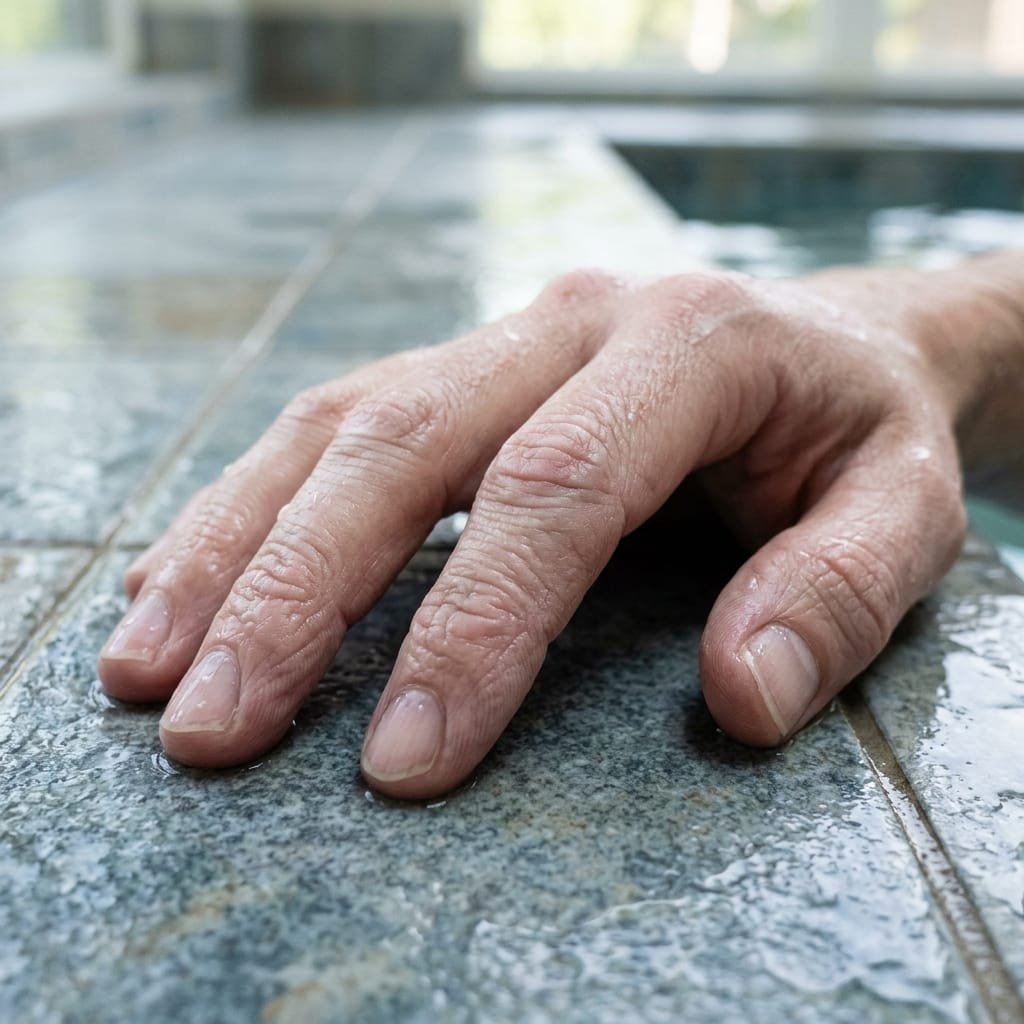
Why Do Your Fingers Wrinkle in Water? The Surprising Science Behind “Pruney” Skin
Have you ever stayed in the bath or swimming pool for a while, looked down at your hands and wondered why your fingertips suddenly looked like tiny raisins?
It seems simple: water gets into the skin and makes it swell.
But that’s not the whole story.
The wrinkling that happens on your fingertips after prolonged water exposure is actually an active response involving your nervous system and blood vessels. Researchers have found that the tiny blood vessels in the fingertips constrict, changing the volume beneath the skin and creating those familiar ridges and valleys.
And there’s an even more interesting question:
Why would your body bother doing this?
Your Fingers Aren’t Simply “Soaking Up” Water
For years, people commonly assumed that wrinkled fingers happened because the outer layer of skin absorbed water and expanded.
That explanation seems intuitive—but research has shown that water-induced wrinkling is more complicated.
The process depends on the autonomic nervous system, the part of your nervous system that controls many functions you don’t consciously think about. Studies have found that blood flow in the small vessels of the fingers decreases as the wrinkling develops.
In simple terms:
Water exposure → nervous-system response → blood vessels constrict → fingertip volume changes → skin forms wrinkles.
That’s why your fingers don’t simply become uniformly swollen like a sponge.
Why Does the Body Do This?
This is where the science becomes especially interesting.
One leading explanation is that wrinkled fingertips may help your hands interact with wet objects.
Researchers have proposed that the grooves created by the wrinkles can help move water away from the contact area, somewhat like the tread on a tire helps channel water away from the road surface.
A 2013 study found that participants with water-induced wrinkling were able to handle submerged objects more quickly than when their fingers weren’t wrinkled.
Another study published later reached a different conclusion and found no improvement in dexterity or touch performance, showing that the exact functional purpose of wrinkled fingers is still not completely settled.
More recent research has again found evidence that wrinkled fingers can improve grip efficiency when handling wet objects.
So the safest conclusion is:
Your wrinkled fingertips are an active nervous-system response, and improving grip in wet conditions is a plausible function—but scientists are still investigating exactly why the response evolved.
Why Don’t All Parts of Your Skin Wrinkle Like This?
You may notice that your fingertips and toes become dramatically wrinkled while your forearm or upper arm doesn’t develop the same pattern.
That’s because the skin on your palms, fingertips and soles has specialized characteristics.
These areas contain specialized blood vessels and nerve structures involved in temperature regulation, sweating and sensory function.
That’s also why the wrinkles tend to appear most noticeably on the pads of your fingers and toes.
Why Does It Take a While?
Your fingers usually don’t become wrinkled the instant they touch water.
The response develops over time, and the speed can vary.
Research published in 2025 found that the time needed for pronounced water-induced wrinkling varied considerably among healthy participants and was influenced by factors including water temperature and other conditions.
So if your fingers wrinkle quickly while someone else’s take longer, that doesn’t necessarily mean anything is wrong.
Does Water Temperature Matter?
Yes.
Research indicates that water temperature can influence how quickly wrinkling develops. Warm water can produce the response differently from cold water, and several other physical and chemical factors can affect the process.
That’s one reason you may notice particularly pronounced wrinkling after spending a long time in a warm bath.
Why Do the Wrinkles Eventually Disappear?
Once you get out of the water and your hands return to their normal conditions, the blood-vessel response resolves and the fingertip returns toward its usual shape.
The wrinkles aren’t permanent changes to your skin.
They gradually disappear as the underlying tissue and circulation return to their normal state.
This is why you can have extremely wrinkled fingertips after a long bath and completely normal-looking fingers later.
Is It Normal?
For most people, yes.
If your fingers become wrinkled after spending a reasonable amount of time in water and then return to normal afterward, this is generally a normal physiological response.
There’s no need to panic simply because your fingertips look dramatically different after swimming or bathing.
In fact, researchers have studied water-induced wrinkling for decades because it provides information about how the nervous system, blood vessels and skin interact.
What If Your Fingers Wrinkle Extremely Quickly?
This is where things become more interesting.
There is a condition called aquagenic wrinkling of the palms, in which pronounced wrinkling, small whitish bumps or swelling can occur after relatively brief exposure to water. It is uncommon and is different from the ordinary wrinkling most people experience after a long bath.
Certain medical conditions and medications have been associated with unusual water-induced palm wrinkling, so an unusually severe or rapid reaction should be discussed with a healthcare professional rather than self-diagnosed from an internet photo.
Can Wrinkled Fingers Tell Doctors Something About the Nervous System?
Interestingly, yes.
Because ordinary water-induced wrinkling depends on sympathetic nerve activity and blood-vessel constriction, researchers have investigated stimulated finger wrinkling as a potential indicator of certain aspects of autonomic nerve function.
This doesn’t mean you can diagnose a neurological condition by looking at your fingers after a bath.
Clinical testing is much more controlled.
But the phenomenon demonstrates something fascinating:
A simple wrinkle on your fingertip can reflect activity happening underneath your skin.
What Happens If One Hand Wrinkles Differently?
Small differences can happen naturally.
However, consistently abnormal or dramatically asymmetric wrinkling may be worth mentioning to a healthcare professional, particularly if it occurs together with other unusual symptoms.
Researchers have studied differences in water-induced wrinkling because the response involves sympathetic nerve function and circulation.
Again, though, finger wrinkling by itself is not a diagnosis.
The Fascinating Part
Your fingertips may look as if they’ve simply absorbed too much water.
But underneath that wrinkled surface, your body is doing something much more complicated.
Your nervous system is involved.
Your tiny blood vessels are changing their behavior.
And the surface of your skin develops a pattern of ridges and valleys.
Scientists have even investigated whether those wrinkles could improve the way humans handle wet objects. The evidence isn’t completely unanimous, but several studies support the idea that the response may have a functional advantage.
Final Takeaway
So, why do your fingers wrinkle in water?
Not simply because your skin is “filling up with water.”
The best-supported explanation is that prolonged water exposure triggers an autonomic nervous-system response that causes blood vessels in the fingertips to constrict, changing the underlying tissue volume and producing the characteristic wrinkles.
The reason this response exists is still being studied, but improving grip in wet conditions is one compelling explanation supported by experimental research.
So the next time you climb out of a bath and see those strange, raisin-like fingertips, remember:
Your hands aren’t just getting soggy—they’re responding to their environment.