
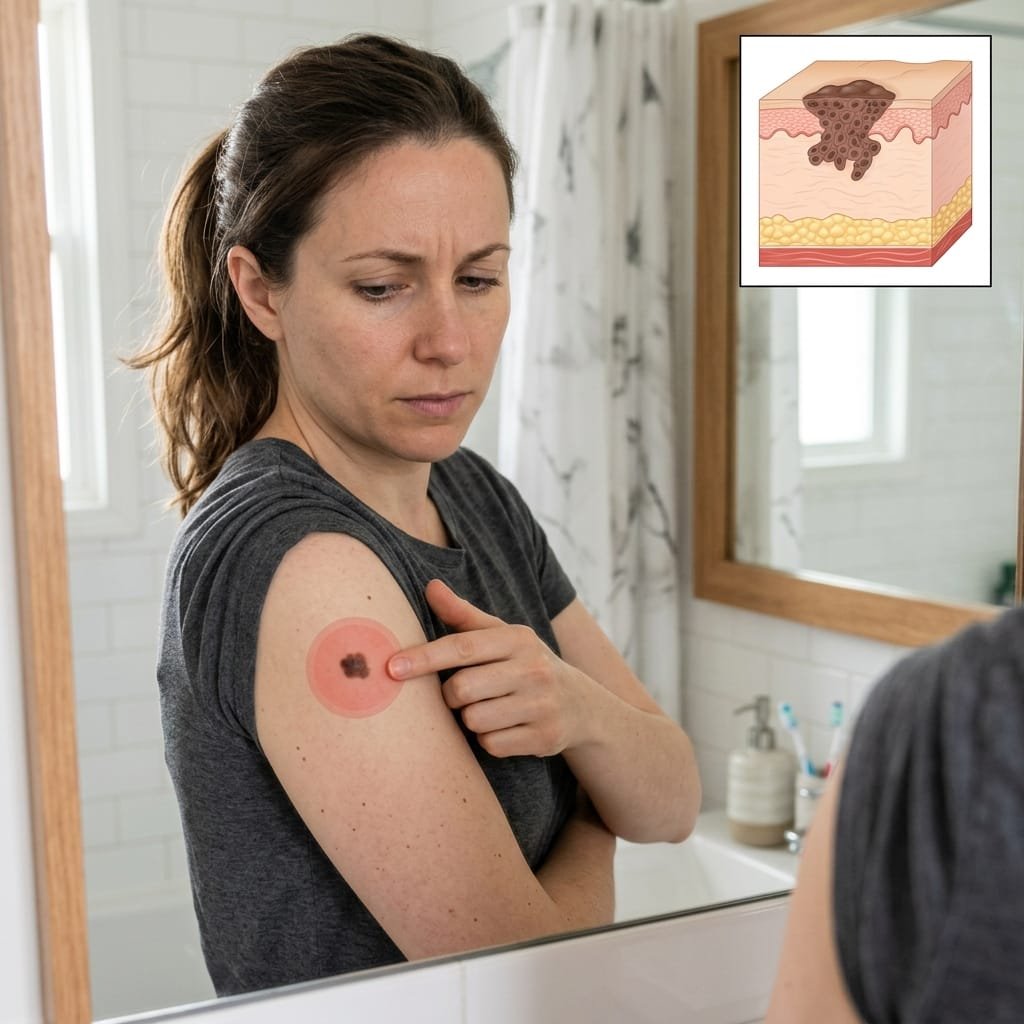
Changing Mole: A Warning Sign You Shouldn’t Ignore
A mole you’ve had for years can look completely ordinary—until one day you notice that something has changed.
Maybe it’s getting darker.
Maybe the edges no longer look even.
Maybe it has become larger, itchy, or started bleeding.
That doesn’t automatically mean skin cancer. Most moles are harmless. But a new or changing spot is something worth having checked, because changes in a mole can be an early warning sign of melanoma, a serious type of skin cancer.
What Changes Should You Watch For?
One useful way to remember possible melanoma warning signs is the ABCDE rule.
A — Asymmetry
Imagine drawing a line through the middle of the mole.
If one half looks noticeably different from the other, that’s something to pay attention to.
A typical harmless mole is often fairly symmetrical, although appearance alone cannot diagnose a mole.
B — Border
Look at the edges.
A concerning spot may have a border that looks irregular, ragged, notched, or poorly defined rather than smooth and even.
C — Color
Pay attention if the color isn’t consistent throughout the spot.
A suspicious lesion can contain different shades of brown or black, and sometimes areas of red, white, or blue.
D — Diameter
Melanomas are often larger than about 6 millimeters, roughly the width of a pencil eraser, when diagnosed.
But size alone does not rule melanoma in or out. Some melanomas can be smaller than 6 millimeters.
E — Evolving
This may be the most important one to remember.
A spot that changes in size, shape, color, or appearance deserves attention.
Even if a mole doesn’t fit every ABCDE characteristic, a noticeable change should not simply be ignored.
What About Itching or Bleeding?
A changing mole can sometimes become itchy, painful, crusted, ooze, or bleed.
A sore or spot that doesn’t heal can also be a warning sign that should be evaluated.
But again, these symptoms don’t prove cancer.
A mole can bleed because it was scratched, shaved, or irritated by clothing. That’s why a healthcare professional needs to evaluate a suspicious spot rather than trying to diagnose it from appearance alone.
The “Ugly Duckling” Sign
Here’s another useful idea.
Look at all the moles on your skin.
If one spot looks noticeably different from all the others, pay attention to it.
Dermatologists sometimes call this the “ugly duckling” sign. It can be useful because a melanoma may stand out from the person’s other spots even when it doesn’t perfectly match every ABCDE feature.
Does Every New Mole Mean Cancer?
No.
People can develop ordinary moles, freckles, age spots, and other harmless skin growths.
The important point is that you cannot reliably diagnose melanoma simply by looking at a photograph or comparing one mole with a checklist.
The American Cancer Society notes that even healthcare professionals can sometimes have difficulty distinguishing melanoma from an ordinary mole, which is why concerning changes should be examined by a doctor.
What If the Mole Has Been There for Years?
A long-standing mole can still deserve attention if it starts changing.
For example, notice if it:
- Gets noticeably larger
- Changes shape
- Develops uneven edges
- Develops multiple colors
- Becomes raised or changes texture
- Starts itching
- Starts bleeding
- Becomes painful
- Develops crusting or oozing
The change itself is important.
Don’t assume that an old mole is automatically safe simply because you’ve had it for a long time.
Where Should You Check?
Don’t only look at the areas you can easily see in a mirror.
Skin cancer can develop in less obvious places too.
During a skin check, dermatologists recommend looking over the entire body, including areas such as the scalp, back, palms, soles, between the toes, and around or underneath the nails.
A handheld mirror can help with areas that are difficult to see.
You can also ask someone you trust to help check areas you can’t easily examine yourself.
What If You Find Something Suspicious?
Don’t panic.
Instead, make an appointment with a qualified healthcare professional or dermatologist and show them the spot.
It’s especially important to get a spot checked if it is new, changing, itching, bleeding, or noticeably different from your other moles. The American Academy of Dermatology recommends having such changes evaluated by a dermatologist.
Don’t try to cut, burn, freeze, or remove a suspicious mole yourself.
And don’t rely on internet photographs to decide whether something is cancer.
Why Early Attention Matters
The reason doctors encourage people to notice skin changes is simple: finding melanoma early can make it much easier to treat.
The American Academy of Dermatology states that melanoma is highly treatable when detected early.
That doesn’t mean every unusual mole is dangerous.
It means a changing mole is worth checking rather than ignoring for months.
A Simple Monthly Habit
One practical approach is to become familiar with your own skin.
Take note of where your moles and other spots are.
When you check your skin again later, you’ll be more likely to notice something genuinely new or different.
Some people find it helpful to take photographs for their own records so they can compare changes over time. The American Cancer Society and American Academy of Dermatology both encourage skin awareness and self-examination as part of recognizing possible warning signs.
One Important Reminder
Seeing an ABCDE feature doesn’t mean you have melanoma.
There are many harmless skin conditions that can look unusual.
The purpose of the ABCDE rule isn’t to diagnose yourself. It’s simply a way to recognize changes that deserve professional attention.
Final Takeaway
Most moles are harmless.
But if you notice a spot that is new, changing, asymmetrical, irregular around the edges, developing multiple colors, growing, itching, or bleeding, don’t simply ignore it.
Remember:
A — Asymmetry
B — Border
C — Color
D — Diameter
E — Evolving
And if a mole is changing or looks different from your other spots, have it checked by a healthcare professional.
A few minutes of paying attention to your skin can help you notice something that deserves a closer look.