
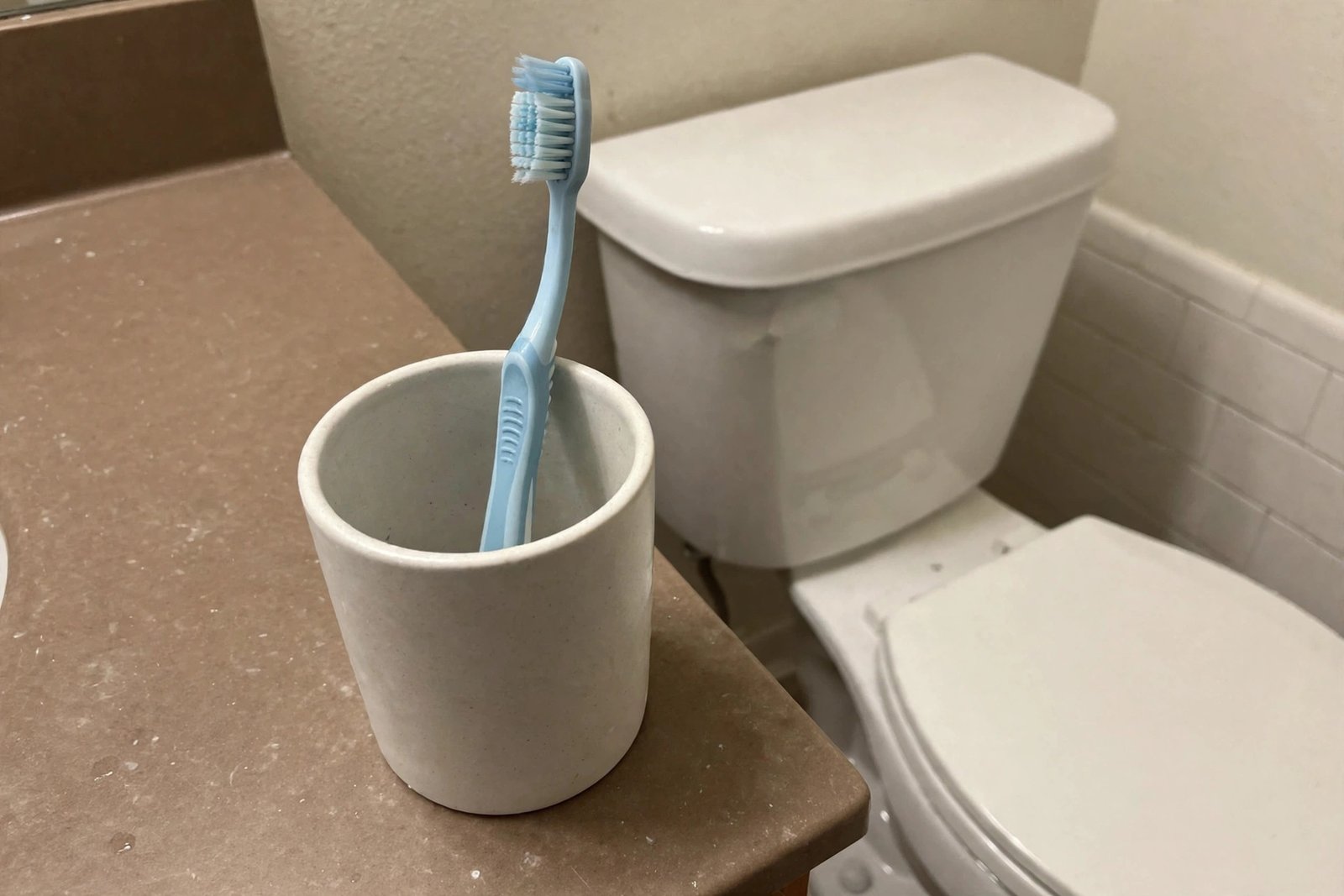
Every morning and every night, you put a toothbrush in your mouth for two full minutes, trusting that it is one of the cleanest objects in your bathroom. But a famous study found something most people never think about: more than 60 percent of toothbrushes tested from shared bathrooms were contaminated with fecal coliforms — bacteria that come from poop. And in roughly 80 percent of those cases, the contamination came from somebody else entirely.
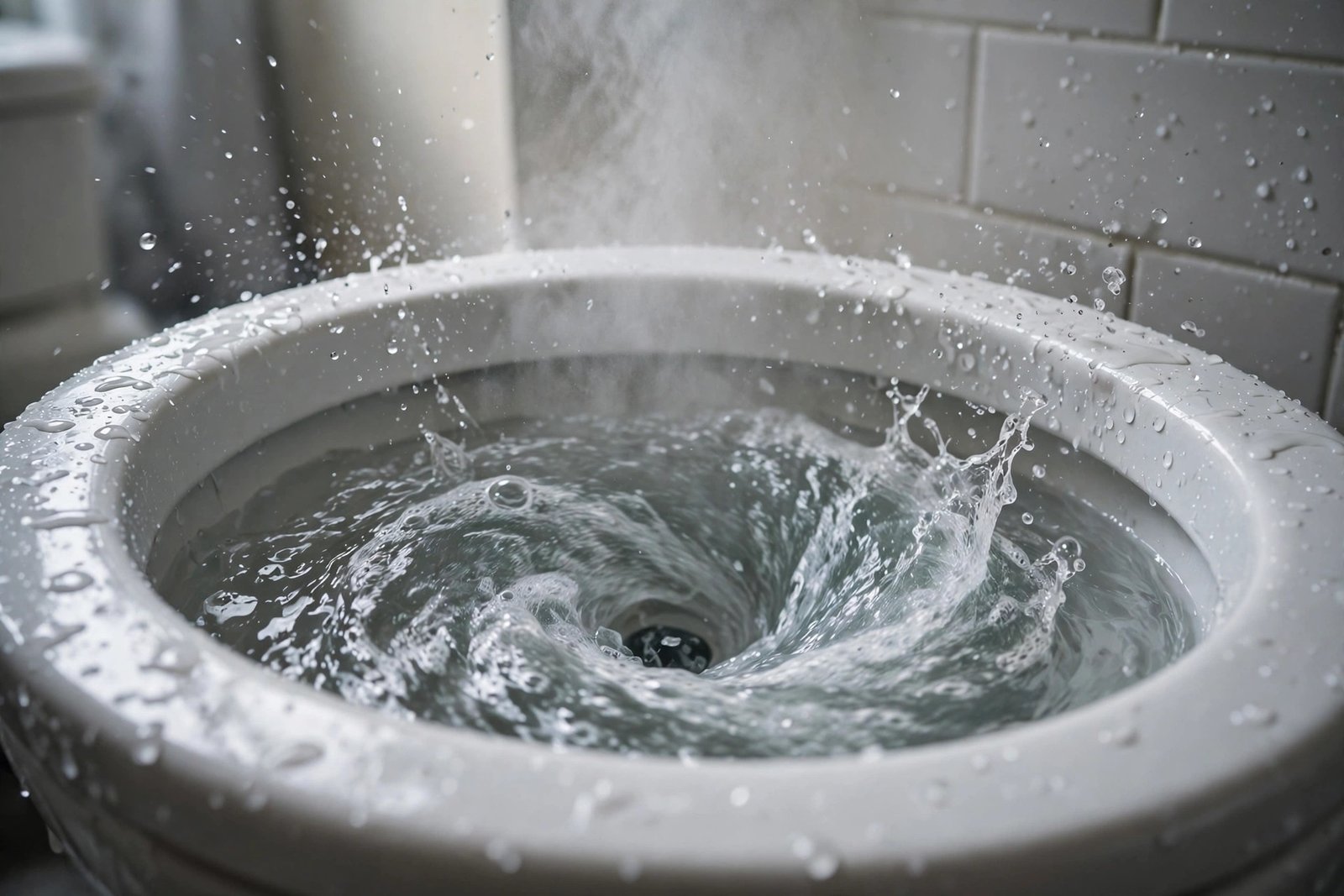
The culprit is something scientists call the “toilet plume.” Every time you flush a toilet with the lid up, the force of the flush launches thousands of tiny droplets into the air. Those droplets carry bacteria and other microbes, drift through the bathroom, and eventually settle — on the floor, on the counter, on the mirror, and on your toothbrush, which sits there with its wet bristles wide open, waiting.
The Study That Proved It
In 2015, a researcher named Lauren Aber at Quinnipiac University set out to answer a simple question: what is actually living on our toothbrushes? She collected used toothbrushes from students who shared bathrooms and tested them for bacteria. The results, presented at a meeting of the American Society for Microbiology, were uncomfortable: more than 60 percent of the toothbrushes harbored fecal coliforms, the bacteria found in human waste.
The most unsettling detail was where that contamination came from. About 80 percent of the time, the fecal matter on a toothbrush did not match its owner — it came from someone else sharing the same bathroom. As Aber put it at the time, using a communal toothbrush holder means you should not be surprised if your toothbrush has fecal matter on it, whether it is yours or someone else’s. Your bathroom neighbor’s toilet plume becomes your toothbrush’s problem.
The finding was not a one-off curiosity. Dentists and microbiologists have warned for years that toothbrushes are bacteria magnets, and independent researchers at the University of Manchester reported that a single toothbrush can harbor up to 100 million bacteria. Fecal matter is just the most shocking member of that crowd.
The Toilet Plume Is Real — And Powerful
For a long time, the toilet plume was treated as a gross-but-harmless idea. Then in 2022, researchers led by John Crimaldi at the University of Colorado Boulder put it under a laser — literally. Using lasers to visualize the air above a flushing commercial toilet, they published their results in Scientific Reports: a single flush generates energetic, fast-moving airborne plumes that rise as high as 1.5 meters (nearly 5 feet) into the air, and the particles can hang there for minutes afterward.
The plumes spread outward as well as upward. In the study, the researchers found that the plumes did not stay neatly over the bowl — they dispersed across the surrounding area, meaning the droplets can travel well beyond the toilet itself. Most home toothbrushes sit on the counter or in a holder within a few feet of the toilet. According to the physics, that is well inside the plume’s reach.
Here is what makes the toothbrush such an ideal landing pad: after brushing, the bristles stay damp for a long time. Bacteria that land on wet bristles do not just sit there — many can survive for hours, and some can multiply in the warm, moist bathroom environment. A toothbrush is essentially a moist, room-temperature hotel for microbes.
What Is Actually Living on Your Toothbrush?
Fecal coliforms get the headlines, but they are only part of the picture. Studies of used toothbrushes have found a whole cast of microbes: Streptococcus mutans and lactobacilli (the bacteria that cause cavities), Staphylococcus aureus, E. coli, and the fungus Candida albicans, which can cause oral thrush. Many of these organisms come from your own mouth — the human mouth is home to hundreds of species of bacteria, and brushing simply transfers them onto the brush.
Most of the time, your own mouth bacteria are not a problem for you — they already live in you. The risk changes when the microbes come from somewhere else: someone else’s mouth, or fecal bacteria launched by a toilet plume. People with weakened immune systems, young children, and anyone recovering from illness are the ones doctors worry about most.
There is also a simpler source of contamination that has nothing to do with the toilet: dirty hands. Most people touch their toothbrush with unwashed hands before and after brushing, adding whatever was on their fingers to the bristles. The bathroom is full of microbe-transfer routes; the toothbrush just collects from all of them.
Why Your Bathroom Makes It Worse
Almost everything about a typical bathroom storage setup helps bacteria, not you. The room itself is warm and humid, especially after a hot shower — perfect growing conditions. Toothbrush cups and holders collect stagnant water at the bottom, and studies have shown the holders themselves can become breeding grounds for bacteria.
One of the worst habits is covering a wet toothbrush. Travel caps and plastic toothbrush covers feel protective, but dentists warn they actually trap moisture and create a warm, enclosed pocket where bacteria thrive. Unless the brush is completely dry first, a cover does more harm than good.
Sharing a bathroom multiplies every risk. Multiple people means multiple plumes, multiple mouths, and — in shared holders — brushes touching each other. Remember the study: 80 percent of the fecal contamination came from somebody else. In a shared bathroom, your toothbrush hygiene is partly in someone else’s hands.
How to Protect Your Toothbrush
You do not need to throw away your bathroom routine — you need a few small changes that dentists have been recommending for years. The single most effective habit costs nothing: close the toilet lid before every flush. Closing the lid cuts the plume dramatically, which means far fewer bacteria ever become airborne in the first place.
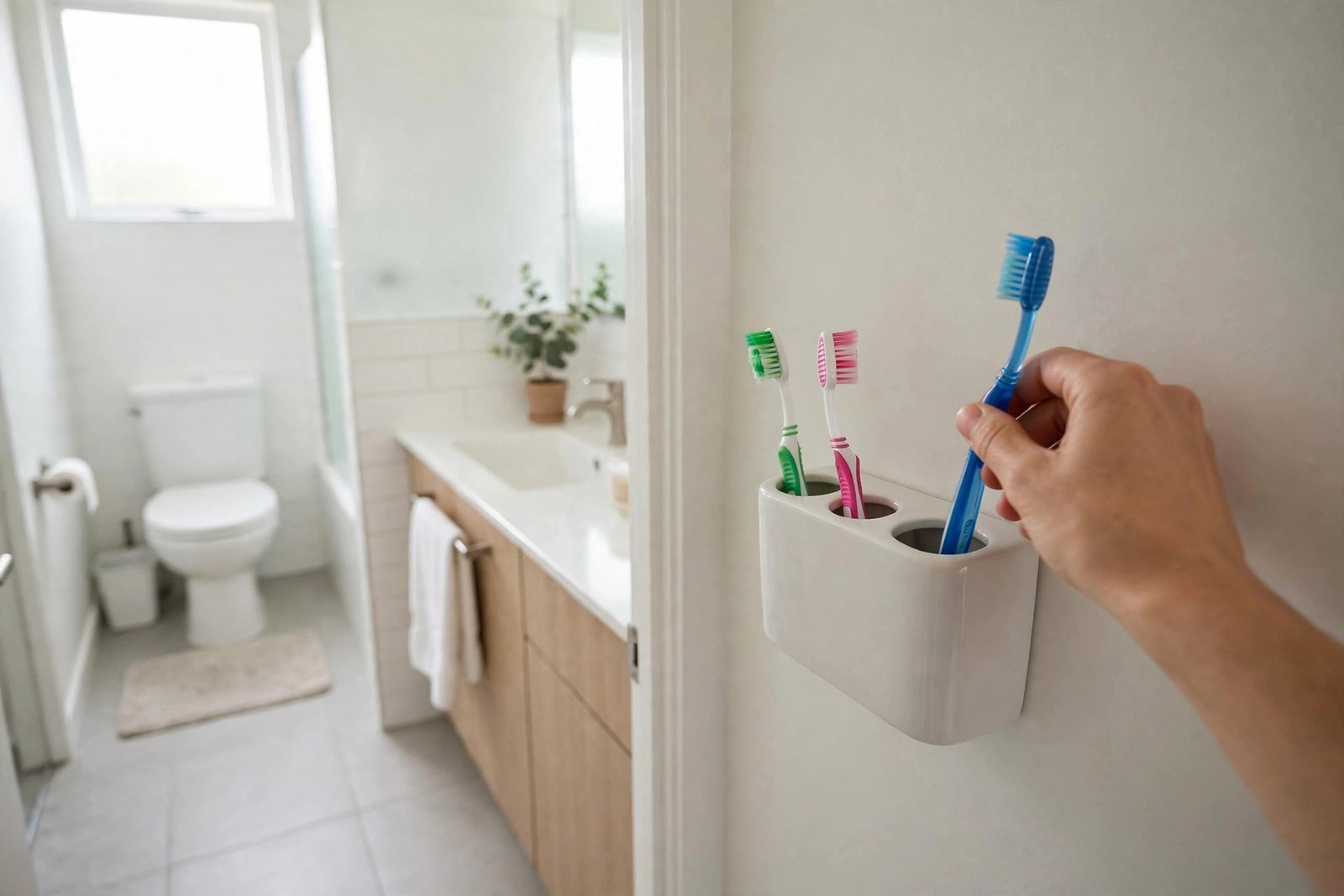
Distance matters too. Store your toothbrush as far from the toilet as the bathroom allows, and keep it upright so water drains off the bristles instead of pooling in them. Never let brushes touch each other in a shared holder. And let the brush air-dry between uses rather than capping it — the dry time is when bacteria die back.
- Close the toilet lid before every flush — the single biggest fix
- Store the toothbrush far from the toilet, standing upright
- Let it air-dry; skip the plastic travel cap unless it is fully dry
- Never share a toothbrush with anyone — not even family
- Do not store brushes touching each other in one holder
When to Throw It Out and Start Fresh
Even a well-stored toothbrush has a shelf life. The American Dental Association recommends replacing your toothbrush every three to four months — sooner if the bristles are frayed, splayed, or worn, because worn bristles clean less effectively and harbor more bacteria. You should also replace the brush after recovering from any illness, so you are not reintroducing the same germs back into your mouth.
Most people hold on to their brushes far longer than that, which means the bacterial load only grows over time. A fresh brush is the cheapest reset in oral care — and after everything you now know about toilet plumes and shared bathrooms, there is no better excuse to start the calendar countdown. Mark the date, close the lid, and keep that brush as far from the flush zone as you can.