
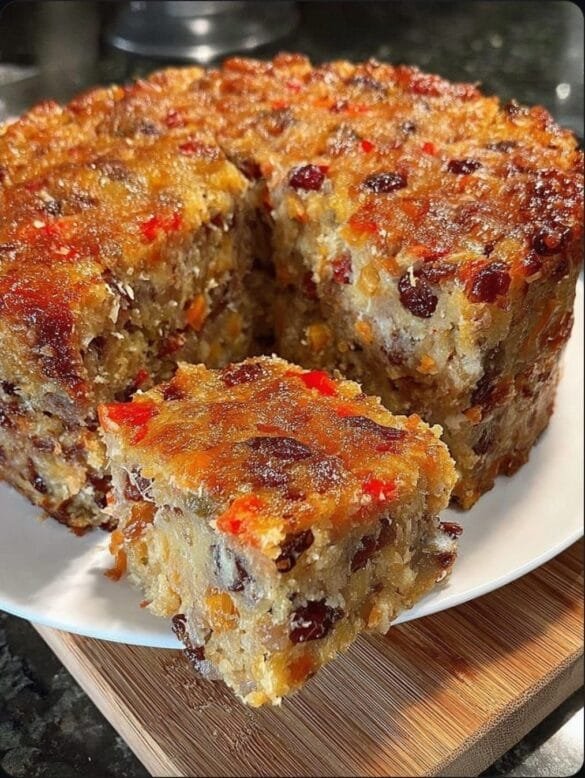
If traditional fruit cake has never been your favorite, this Never Fail Fruit Cake may completely change your mind.
This old-fashioned recipe is nothing like the dry, crumbly fruit cakes that people sometimes avoid during the holidays. It is dense, incredibly moist, packed with candied fruit and nuts, and held together with sweetened condensed milk for a rich, almost candy-like texture.
The original recipe uses candied cherries, candied pineapple, dates, pecans, coconut, a small amount of flour, and sweetened condensed milk. Everything is mixed together, packed firmly into a tube pan, and baked slowly at a low temperature.
It is a wonderfully simple holiday dessert because there is no complicated cake batter to prepare and no mixer required.
Why You’ll Love This Fruit Cake
There are plenty of reasons this recipe has earned its “never fail” reputation.
The ingredient list is straightforward, and the preparation is surprisingly easy. Instead of making a traditional cake batter, you simply combine the fruit, nuts, coconut, flour, and condensed milk.
The sweetened condensed milk provides sweetness and moisture while helping bind all of those delicious ingredients together.
The finished cake is dense and chewy, with plenty of texture from the pecans, dates, coconut, cherries, and pineapple.
It is particularly good during the holiday season, but you don’t have to wait for Christmas to make it.
Ingredients You’ll Need
- 1 pound candied cherries
- 1 pound candied pineapple
- 1 pound pitted dates
- 1 pound chopped pecans
- 4 packages flaked coconut, 8 ounces each
- 3 tablespoons all-purpose flour
- 2 cans sweetened condensed milk, 14 ounces each
The original recipe calls for the full amounts listed above.
Because there is so much fruit, nuts, and coconut in this recipe, the result is much closer to a rich fruit-and-nut confection than a light sponge cake.
How to Make Never Fail Fruit Cake
1. Prepare the Oven
Preheat your oven to 300°F.
Lightly grease a 10-inch tube pan.
Line the bottom with greased parchment paper.
This step is important because the finished fruit cake is dense and sticky, so you want it to release from the pan without breaking.
Set the prepared pan aside.
2. Chop the Fruit and Nuts
Place the candied cherries, candied pineapple, dates, and chopped pecans into a large mixing bowl.
If your fruit pieces are large, chop them into smaller pieces so they are easier to distribute throughout the cake.
The goal is to have plenty of fruit and nuts in every slice.
3. Add the Coconut
Add the flaked coconut to the bowl.
Mix the fruit, nuts, and coconut thoroughly.
The original preparation recommends mixing the ingredients together by hand, which is useful because the mixture becomes quite substantial as you continue adding ingredients.
4. Add the Flour
Sprinkle the flour over the mixture.
Stir until the flour is distributed evenly throughout the fruit, nuts, and coconut.
There is only a small amount of flour in this recipe. It isn’t intended to create a conventional cake batter. Instead, it helps bind the ingredients as the cake bakes.
5. Add the Condensed Milk
Pour the sweetened condensed milk into the bowl.
Mix thoroughly until everything is coated.
The mixture will be very thick and sticky.
Don’t worry if it doesn’t resemble ordinary cake batter. This is exactly what you want.
The condensed milk acts as both a sweetener and an important binding ingredient.
6. Pack the Mixture Into the Pan
Transfer the mixture to your prepared tube pan.
Press it down firmly and evenly.
This is an important step because you want the fruit cake to hold together after baking.
Use the back of a spoon, spatula, or clean hands to compact the mixture into the pan.
Try to eliminate large air pockets as you work.
7. Bake Slowly
Place the tube pan in the preheated 300°F oven.
Bake for approximately 1 1/2 hours.
The low oven temperature allows the dense mixture to cook gradually without excessively drying out the fruit.
Because ovens vary, begin checking toward the end of the recommended baking time.
8. Cool the Cake
Remove the cake from the oven.
Run a knife carefully around the edge of the cake to loosen it from the pan.
Remove the outer rim of the tube pan.
Allow the cake to cool until it is barely warm.
Then carefully remove the tube bottom and parchment paper.
The cake is dense and delicate while warm, so avoid trying to remove it too quickly.
What Makes This Fruit Cake Different?
Traditional fruit cakes often contain a flour-based batter surrounding dried fruit and nuts.
This version is dramatically different.
There is a relatively small amount of flour compared with the huge quantity of fruit, nuts, and coconut. Sweetened condensed milk provides much of the moisture and binding power.
That’s why the finished cake is so dense and rich.
It also explains why the cake can feel more like a holiday confection than a conventional layer cake.
How to Choose the Best Fruit
Candied cherries provide bright color and sweetness.
Candied pineapple contributes a tropical flavor and chewy texture.
Dates add natural caramel-like sweetness and softness.
Together, these fruits create a combination that is much more interesting than using only raisins.
If you’re preparing this cake for a holiday table, the colorful candied fruit also gives every slice a festive appearance.
Can You Change the Nuts?
Pecans are an excellent choice because their buttery flavor works beautifully with the sweet fruit and coconut.
If you don’t have pecans, walnuts can be used as an alternative.
You can also combine different nuts if you prefer more variety.
Whichever nuts you choose, chop them into manageable pieces so they are evenly distributed throughout the cake.
Tips for Making the Best Fruit Cake
Grease the pan well. The condensed milk and fruit make this a sticky cake.
Use parchment on the bottom. It makes removing the finished cake much easier.
Chop large fruit pieces. Smaller pieces distribute more evenly.
Mix thoroughly. Every ingredient should be coated with the condensed milk.
Pack the mixture firmly. This helps the cake hold together after baking.
Bake at a low temperature. The original recipe uses 300°F, which allows the dense cake to cook slowly.
Don’t rush the cooling process. The cake is easier to remove once it has cooled to barely warm.
How to Serve Never Fail Fruit Cake
This fruit cake is rich enough that a small slice goes a long way.
Serve it on its own with coffee or tea.
For a more indulgent dessert, add:
- A dollop of whipped cream
- Vanilla ice cream
- A light powdered-sugar glaze
- Warm caramel sauce
- Fresh berries
During the holidays, arrange thin slices on a dessert platter alongside cookies and other homemade treats.
Can You Make This Fruit Cake Ahead?
Yes.
Fruit cake is an excellent make-ahead dessert.
In fact, the dense texture makes it particularly convenient for holiday preparation because you don’t have to bake it immediately before serving.
Once the cake has cooled completely, wrap it securely and store it in an airtight container.
The original recipe notes that the cake can be kept refrigerated for an extended period.
For the best quality and food safety, however, use normal refrigerated storage practices and inspect the cake before serving.
Can You Freeze Fruit Cake?
Yes.
Wrap the completely cooled cake tightly in plastic wrap and then place it inside a freezer-safe container or bag.
You can also freeze individual slices, which makes it easy to enjoy a small portion whenever you want.
Thaw the cake in the refrigerator and allow it to come closer to room temperature before serving.
A Smaller-Batch Option
The original recipe makes a very substantial fruit cake.
If you’re baking for a smaller household, you can reduce the quantities proportionally and use a smaller baking pan.
Just remember that changing the pan size will affect the baking time.
A smaller cake may finish sooner, so begin checking it well before the original 1 1/2-hour mark.
Frequently Asked Questions
Why is my fruit cake so dense?
This particular recipe is naturally dense. It contains a large amount of fruit, nuts, and coconut with relatively little flour, so it will not have the light texture of a traditional sponge cake.
Can I leave out the coconut?
You can, but it will significantly change the texture and flavor. The coconut contributes bulk, chewiness, and sweetness to the finished cake.
Can I use different dried fruit?
Yes, if you’re adapting the recipe. Chopped dried apricots, raisins, cranberries, or other dried fruits can create interesting variations, although the result will no longer be exactly the original recipe.
Do I need a mixer?
No.
One of the best things about this recipe is that it can be prepared entirely by hand.
Why does the recipe use so little flour?
This isn’t a traditional flour-heavy cake. The recipe relies primarily on fruit, nuts, coconut, and sweetened condensed milk, with a small amount of flour helping bind the mixture.
How do I know when it is done?
The cake should be baked according to the recipe’s low-temperature method, with the dense mixture becoming set. Avoid judging it like a light cake because the interior will remain rich and dense.
A Holiday Fruit Cake Worth Trying
Never Fail Fruit Cake is a completely different take on the classic holiday dessert.
Instead of a dry cake filled with a few pieces of fruit, this version is loaded with candied cherries, pineapple, dates, pecans, and coconut, all held together with sweetened condensed milk.
The result is rich, chewy, moist, and packed with flavor in every bite.
If you’ve avoided fruit cake in the past because you thought it was always dry or boring, this recipe is worth giving a chance.
Make it for Christmas, take it to a holiday gathering, or wrap a few slices as a homemade gift. It’s an old-fashioned dessert with a wonderfully indulgent personality.