
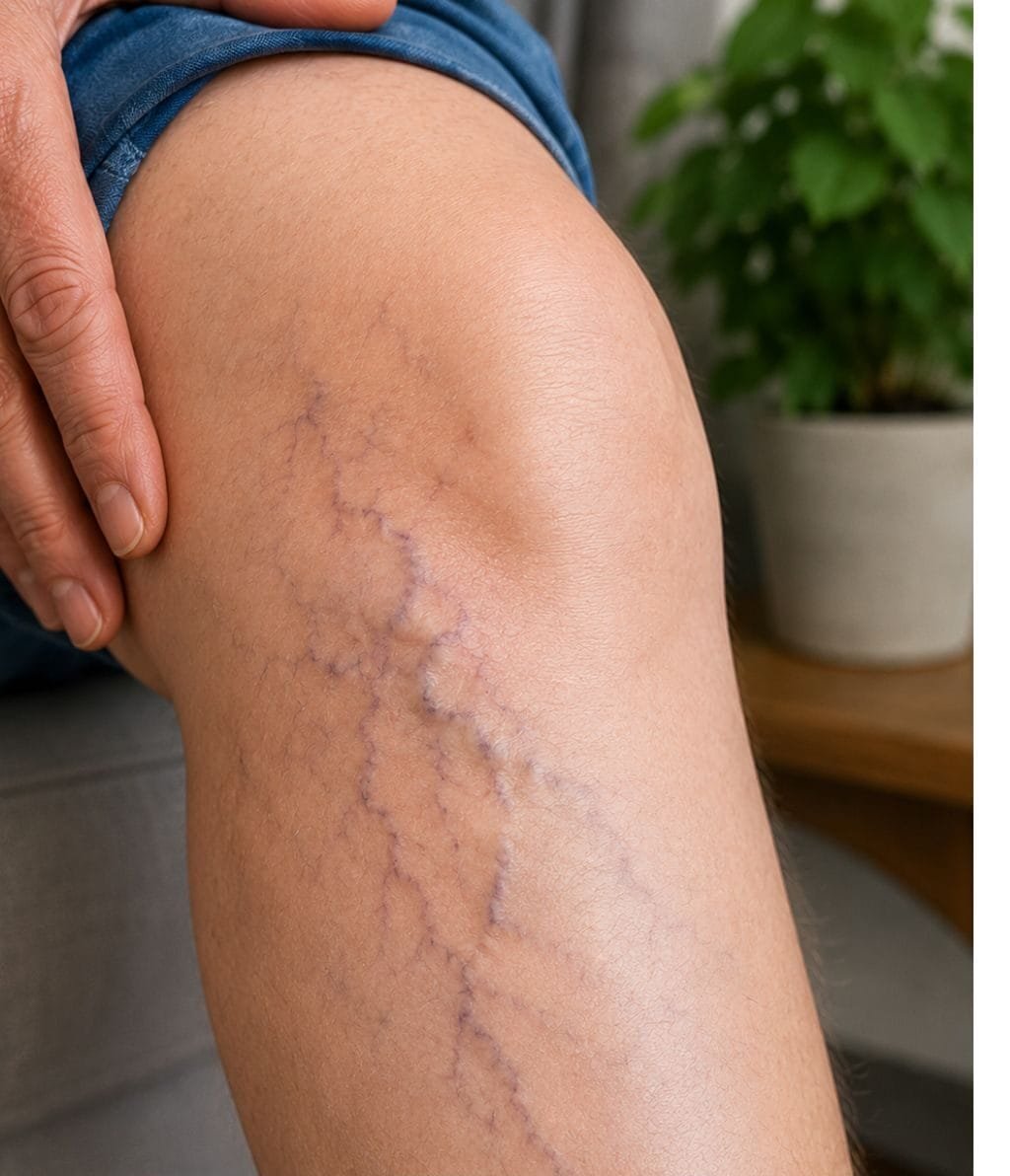
You glance down at your legs one day and notice something you don’t remember seeing before: thin blue or purple lines running beneath the skin.
Maybe they’ve always been there and simply became more noticeable. Or perhaps they’re gradually becoming darker, more prominent, or slightly raised.
For many people, visible veins on the legs can become more noticeable with age. Sometimes they’re simply spider veins, while larger, twisted or bulging veins may be varicose veins. But when visible veins are accompanied by pain, swelling, warmth, skin changes, or other symptoms, it’s worth paying closer attention.
So when should you consider visible leg veins a normal cosmetic change—and when should you have them checked?
Why Do Leg Veins Become More Visible With Age?
Your veins have an important job: they carry blood back toward your heart.
Leg veins have to work against gravity, and tiny valves inside them help keep blood moving in the right direction. Over time, these valves can weaken or become less effective. Blood may then collect in the veins, causing them to become larger and more visible beneath the skin.
Aging is one of the factors associated with varicose veins because the valves can experience wear over time.
That doesn’t mean every visible vein is a sign of a medical problem.
Sometimes it’s simply a matter of having veins that are closer to the surface of the skin.
Spider Veins vs. Varicose Veins
Not every visible vein is the same.
Spider veins
Spider veins are usually small and close to the skin’s surface. They can look like:
- Fine blue or purple lines
- Red branching lines
- A web-like pattern
- Small clusters of visible blood vessels
They’re generally smaller than varicose veins and are often considered mainly a cosmetic concern.
Varicose veins
Varicose veins are larger and may look:
- Twisted
- Bulging
- Rope-like
- Dark blue or purple
They can sometimes cause aching, heaviness, burning, cramping, itching or swelling in the legs. Symptoms may become worse after sitting or standing for long periods.
Why Do Some People Develop More Visible Veins?
Age isn’t the only factor.
Several things can increase the likelihood of visible or varicose veins.
Family history
If other members of your family have varicose veins, you may have a higher chance of developing them too.
Sitting or standing for long periods
Movement helps the muscles in your lower legs assist blood flow.
Spending long periods sitting or standing can contribute to pressure in the veins of the legs.
Pregnancy
Pregnancy increases blood volume and can increase pressure on the veins, making visible veins more likely.
Weight
Being overweight can put additional pressure on the veins and is associated with a higher risk of varicose veins.
Are Visible Leg Veins Dangerous?
Not necessarily.
For many people, spider veins or varicose veins are primarily a cosmetic issue.
However, varicose veins can sometimes cause symptoms and, less commonly, complications such as skin ulcers, bleeding, swelling or blood clots.
That’s why the appearance of the vein isn’t the only thing that matters.
Pay attention to how your legs feel as well.
Signs That Deserve More Attention
Visible veins are more worth discussing with a healthcare professional if you also notice:
- Persistent aching
- A heavy feeling in the legs
- Swelling
- Burning or throbbing
- Muscle cramps
- Itching around the veins
- Skin color changes
- A sore or ulcer near the ankle
- A vein that becomes painful or tender
These symptoms can occur with varicose veins and other vein problems.
If the veins are becoming increasingly uncomfortable or self-care isn’t helping, Mayo Clinic recommends discussing the problem with a healthcare professional.
What If One Leg Suddenly Becomes Swollen?
This is different from simply noticing a few spider veins.
A leg that suddenly becomes swollen, painful, warm or changes color can have causes other than ordinary varicose veins.
One possibility is deep vein thrombosis (DVT), a blood clot in a deep vein. Symptoms can include swelling, pain or tenderness, warmth and changes in skin color.
DVT can be serious because a clot can travel to the lungs.
If leg symptoms are sudden or severe, particularly if they’re accompanied by shortness of breath, chest pain, dizziness, fainting or coughing up blood, seek emergency medical care.
Can Exercise Help?
Regular physical activity can help support healthy blood flow in the legs.
Walking is one simple option because the muscles of the lower legs help move blood through the veins. Mayo Clinic also recommends regular exercise as part of self-care for people with varicose veins.
You don’t necessarily need an intense workout.
Even breaking up long periods of sitting with movement can be useful.
If you work at a desk, try getting up periodically instead of remaining in the same position for hours.
Does Raising Your Legs Help?
Elevating your legs while sitting or lying down can help ease discomfort associated with varicose veins.
Mayo Clinic recommends taking short breaks during the day to raise the legs, particularly for people experiencing symptoms.
It won’t necessarily make visible veins disappear, but it may help with symptoms such as swelling and aching.
What About Compression Stockings?
Compression stockings are another commonly used option for symptomatic varicose veins.
They apply pressure to the legs and can help support blood flow while reducing swelling and discomfort. Mayo Clinic notes that compression stockings are often among the first approaches used for symptomatic varicose veins.
However, compression isn’t appropriate for every circulation problem.
If you have significant leg symptoms or other medical conditions affecting circulation, it’s best to ask a healthcare professional which type is appropriate for you.
Can Visible Veins Be Removed?
If varicose or spider veins are causing significant symptoms—or you’re unhappy with their appearance—medical treatments are available.
Depending on the type and severity, treatments can include:
- Sclerotherapy
- Laser treatment
- Catheter-based procedures
- Other minimally invasive procedures
- Surgery in selected cases
A healthcare professional may use a venous Doppler ultrasound to evaluate blood flow and the valves in the veins. Ultrasound can also help identify a blood clot when one is suspected.
Treatment depends on what’s actually causing the visible veins and whether they’re producing symptoms.
Can You Prevent Varicose Veins?
You can’t control every risk factor, especially age and family history.
But several habits may support healthy circulation.
Try to:
- Stay physically active
- Avoid sitting or standing in one position for very long periods
- Maintain a healthy weight
- Raise your legs when resting
- Choose comfortable footwear
- Follow a balanced, lower-sodium diet if recommended for you
These measures may help reduce discomfort and support blood flow, although they can’t guarantee that visible veins won’t develop.
When Should You See a Doctor?
If you’re simply noticing a few small spider veins with no pain or other symptoms, it may not be urgent.
But make an appointment if:
- The veins are becoming painful
- Your legs regularly feel heavy or achy
- You develop persistent swelling
- The skin around a vein changes color
- You develop an ulcer near your ankle
- A vein becomes tender or inflamed
- Symptoms are interfering with normal activities
- Self-care isn’t improving your symptoms
A healthcare professional can determine whether you’re dealing with ordinary spider veins, varicose veins, chronic venous disease, or another condition.
The Bottom Line
Seeing more visible veins on your legs as you get older doesn’t automatically mean something is wrong.
Age-related changes in the valves of leg veins can contribute to varicose veins, while spider veins are often small and mainly cosmetic.
What matters is whether the veins are accompanied by symptoms such as pain, swelling, heaviness, itching, skin changes or tenderness.
And if one leg suddenly becomes swollen, painful or warm—especially with other concerning symptoms—don’t assume it’s simply aging. A blood clot can sometimes cause similar symptoms and needs prompt medical attention.
Your legs may be showing signs of getting older, but a new or rapidly changing symptom deserves to be taken seriously rather than automatically dismissed as “just age.”
Frequently Asked Questions
Are visible veins on the legs normal as you age?
They can be common with aging. Changes in the valves of leg veins can contribute to varicose veins, while spider veins are also common.
Why are my veins suddenly more visible?
Age, genetics, prolonged sitting or standing, pregnancy and weight can all contribute to more noticeable veins.
Are spider veins dangerous?
Spider veins are generally smaller and often mainly a cosmetic concern. However, any new symptoms such as pain or swelling should be discussed with a healthcare professional.
Can exercise reduce visible veins?
Exercise can support blood flow and may help ease symptoms associated with varicose veins, but it doesn’t necessarily make existing veins disappear.
Can varicose veins cause leg pain?
Yes. Some people experience aching, heaviness, burning, cramping, itching or swelling. Symptoms may become worse after prolonged sitting or standing.
When are visible veins an emergency?
Sudden leg swelling, pain, warmth or color changes can be symptoms of DVT. If these occur with sudden shortness of breath, chest pain, fainting or coughing up blood, emergency medical care is needed.