
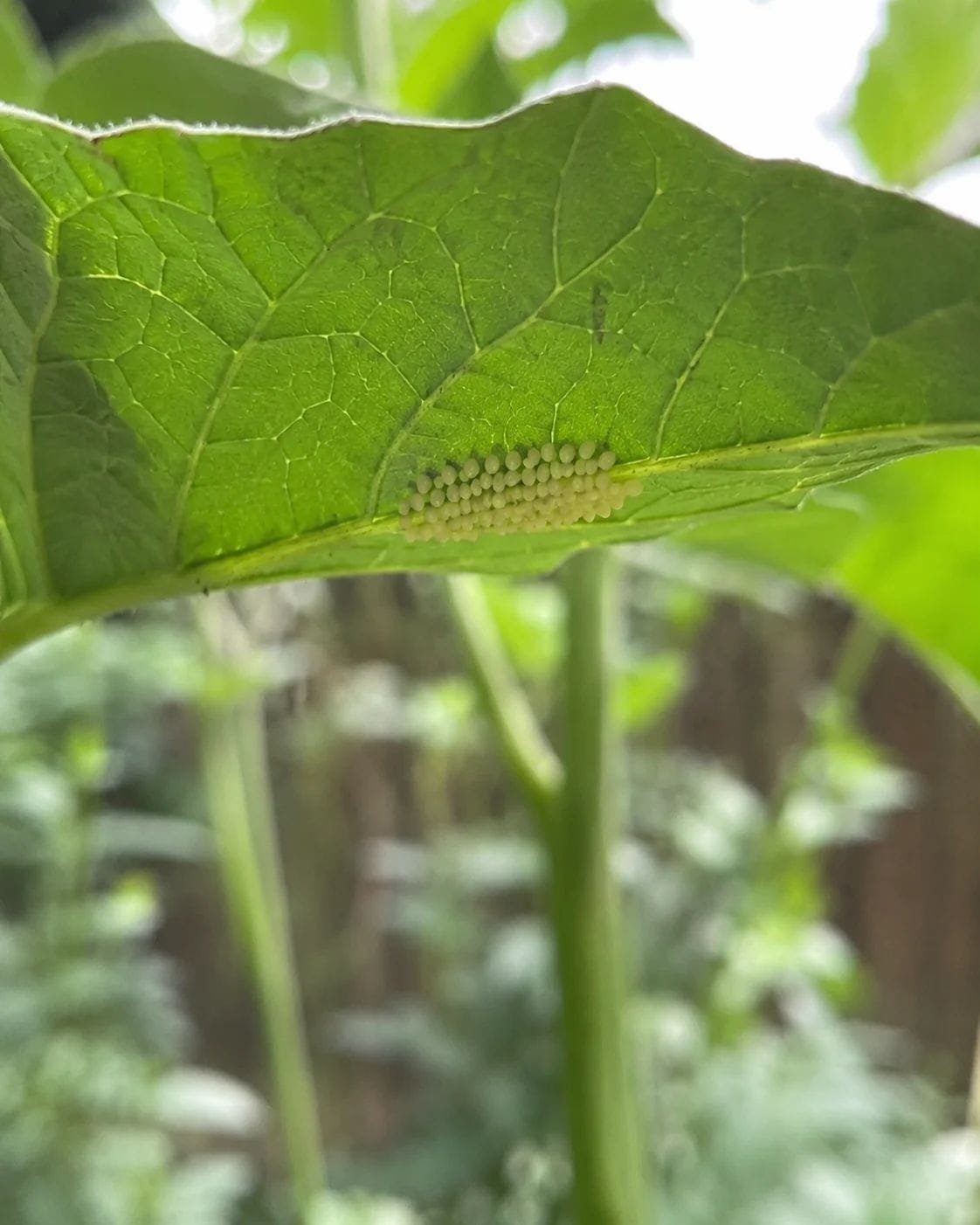
What Are These Tiny Eggs Under My Garden Leaf?
Finding a cluster of tiny pale eggs underneath a garden leaf can be surprising. They may look like tiny beads, seeds, or even a strange growth on the plant.
But in many cases, these small clusters are actually insect eggs.
The underside of a leaf is a common place for insects to lay eggs because it provides some protection from direct sunlight, weather, and predators. Garden experts recommend regularly checking both the upper and lower surfaces of leaves when inspecting plants for pests and eggs.
Why Do Insects Lay Eggs Under Leaves?
Leaves provide an ideal surface for many insects.
The underside is often less exposed than the top of the leaf, making it a convenient place for eggs to develop. Different insects use different patterns when laying eggs. Some leave individual eggs, while others produce tightly packed clusters.
For example, brown marmorated stink bugs lay barrel-shaped eggs in clusters on leaves. These clusters can contain around 20 to 30 eggs.
Other insects may produce completely different-looking egg masses.
That means the appearance and arrangement of the eggs can provide important clues, but a photograph alone may not be enough to identify them accurately.
What Could These Pale Eggs Be?
There are several possibilities.
Stink Bug Eggs
Stink bug eggs are often laid in groups underneath leaves. Depending on the species, they may be pale green, white, or other colors and can have a rounded or barrel-like appearance.
Some stink bug species can become garden pests because the adults and nymphs feed on plants.
However, not every egg cluster found in a garden belongs to a harmful insect.
Leaf Beetle Eggs
Some beetles also lay clusters of eggs underneath leaves.
For example, Colorado potato beetles lay orange eggs in groups on the undersides of leaves. These insects can be important pests of potatoes, tomatoes, and eggplants.
Other leaf beetles can produce different colors and arrangements of eggs. Yellowmargined leaf beetle eggs, for example, can occur in clusters on the underside of leaves.
Moth Eggs
Some moths also deposit egg masses on leaves.
Fall webworms, for example, lay large masses of light-colored eggs on the undersides of leaves. Later, their larvae can form conspicuous webs around leaves and branches.
So if you discover eggs today, it can be useful to keep watching the plant for several days.
The insects that hatch may provide a much easier clue to identification.
Not Every Egg Cluster Is Bad
This is an important point for gardeners.
Seeing eggs on a plant doesn’t automatically mean the plant has a pest problem.
Some insects are actually beneficial to gardens.
Green lacewings, for example, lay distinctive tiny eggs on foliage using thin stalks. Their eggs can look like tiny white droplets standing above the leaf. Lacewing larvae are predators of various small garden pests.
Other beneficial insects can also be found around plants.
So before spraying or destroying an unknown egg cluster, it’s worth trying to identify it first.
Should You Remove the Eggs?
It depends on what they belong to.
If the eggs are from a known garden pest and there are only a few clusters, physically removing the affected leaf or eggs may be an option. For some pests, manually removing egg masses is one of the recommended approaches for small home-garden infestations.
However, removing every unfamiliar egg you see isn’t necessarily a good idea.
You could accidentally remove beneficial insects that help control other garden pests.
That’s why identification is the first step.
How to Identify an Egg Cluster
If you find something like this under a leaf, look at several details.
1. Color
Are the eggs:
- White?
- Pale green?
- Yellow?
- Orange?
- Brown?
- Dark?
Color can help narrow down the possibilities.
2. Shape
Look closely at the individual eggs.
Are they round, oval, barrel-shaped, elongated, or almost impossible to distinguish individually?
3. Arrangement
Notice how they are positioned.
Some insects lay eggs in neat rows or tightly packed groups, while others leave them scattered or arranged in unusual patterns.
4. Location
The plant itself can provide an important clue.
Certain insects prefer particular host plants. For example, Colorado potato beetles are associated with plants in the nightshade family, including potatoes, tomatoes, and eggplants.
5. What Happens Next?
If you can safely observe the eggs without disturbing them, watch what happens over the following days.
The newly hatched insects may be much easier to identify than the eggs themselves.
Check the Rest of the Plant
If you discover an unusual egg cluster, don’t only inspect the spot where you found it.
Look at the entire plant.
Check:
- The undersides of leaves
- New shoots
- Stems
- Flower buds
- Damaged leaves
- Nearby plants
- Areas with webbing
- Areas with unusual discoloration
Garden extension guidance recommends regularly checking both sides of leaves because many pests and their eggs can be very small and easy to miss. A magnifying lens can make the inspection much easier.
Look for Other Signs of Insects
Eggs aren’t always the first sign of a garden pest.
You may also notice:
- Small holes in leaves
- Yellow or pale spots
- Curling leaves
- Chewed edges
- Sticky residue
- Webbing
- Tiny insects underneath leaves
- Discolored plant growth
For example, aphids can cluster on stems and leaves, while spider mites can produce fine webbing and speckled leaf damage.
Should You Be Worried?
Usually, finding one unknown egg cluster isn’t a reason to panic.
The important question is what insect laid the eggs and whether it is actually damaging your plant.
Some insects can become serious garden pests, while others are harmless or beneficial.
For that reason, it’s better to identify the eggs before deciding whether treatment is necessary.
If the plant is valuable or the infestation appears to be spreading quickly, take a clear close-up photograph and compare it with a reliable insect-identification resource or contact a local gardening or agricultural extension service.
Final Thoughts
Those tiny pale dots underneath a garden leaf may look mysterious, but they are often part of an insect’s normal life cycle.
The underside of leaves is a common location for egg clusters, and different insects can produce very different-looking eggs. Some belong to plant pests, while others may belong to insects that actually help your garden.
So the next time you spot a strange cluster under a leaf, don’t immediately assume it’s something harmful.
Take a close photograph, note which plant you found it on, look at the shape and arrangement of the eggs, and keep an eye on what happens next.
Sometimes the tiny mystery underneath a leaf is the beginning of discovering exactly what is living in your garden.