
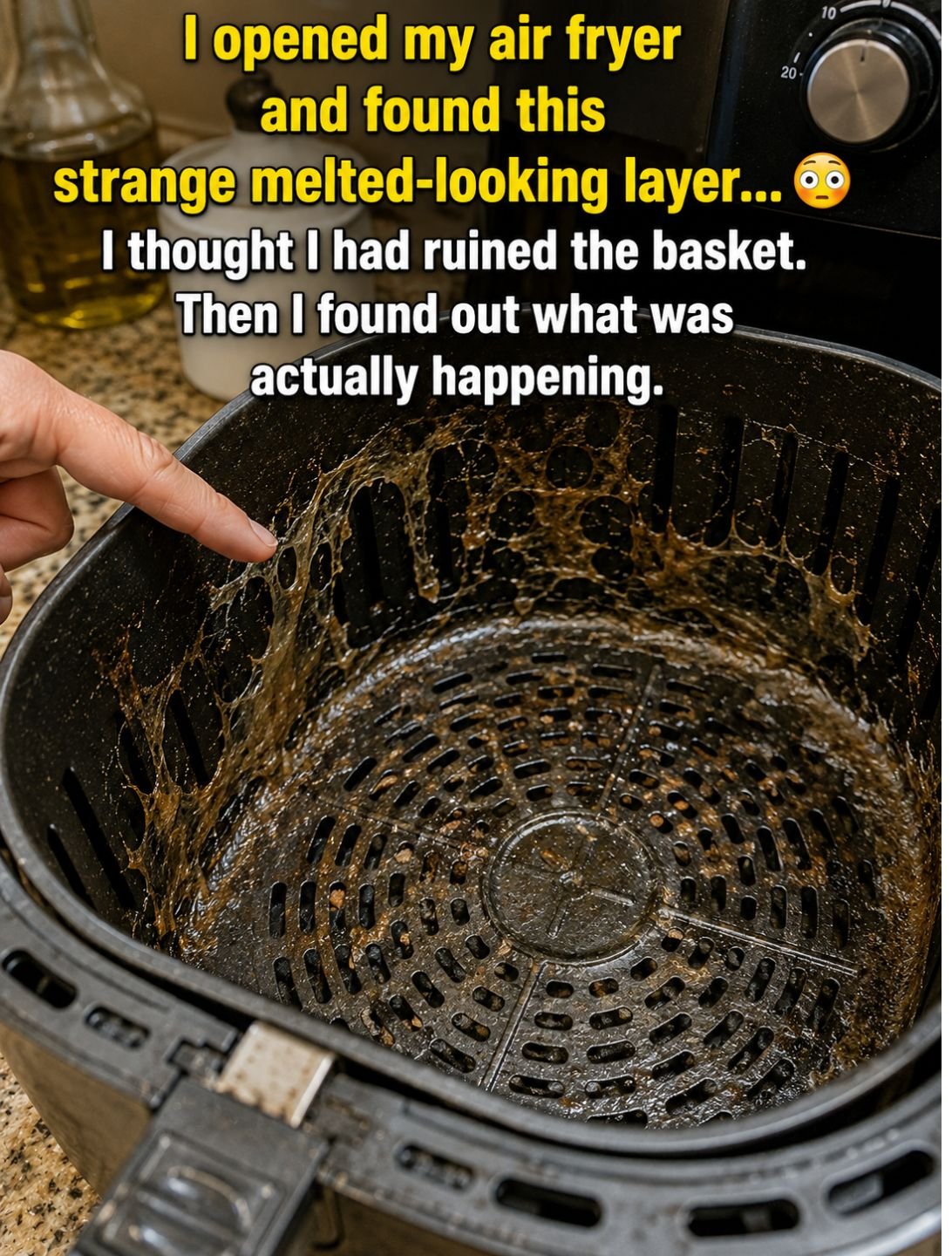
If you pulled out your air fryer basket and noticed a dark, sticky, amber-colored layer around the sides or underneath the cooking rack, you might immediately wonder:
“Did my air fryer melt?”
Not necessarily.
What looks like melted plastic can sometimes be a combination of cooked-on grease, food residue, and repeated exposure to high heat. However, if the actual nonstick coating is peeling, bubbling, or visibly damaged, that’s a different situation and deserves more attention.
The exact materials and cleaning instructions vary by air-fryer model, so your manufacturer’s manual should always take priority.
What Is That Sticky Buildup?
Air fryers circulate very hot air around food.
During cooking, fat and juices can drip from foods such as chicken, bacon, burgers, sausages, and fatty cuts of meat.
Some of that residue can remain on the basket or pan.
If it isn’t removed completely, repeated cooking can bake the residue onto the surface. Over time, it can become darker, harder, and surprisingly sticky.
Philips, for example, recommends soaking its air-fryer pan or basket in hot water and detergent for 5–10 minutes when food residue is stuck to the bottom.
Why Does It Look Like Melted Plastic?
Old grease can become extremely dark and glossy.
When combined with tiny food particles and repeated heating, it can form a thin, hardened layer that looks almost like melted plastic.
This is especially noticeable around:
- Basket edges
- Small holes
- Corners
- Under removable racks
- Areas where grease collects
The appearance alone isn’t enough to tell you exactly what the material is.
That’s why it’s important to inspect the basket carefully rather than immediately assuming the coating has melted.
But What If the Nonstick Coating Is Peeling?
That’s different.
Many air-fryer baskets and pans have nonstick coatings. Philips, for example, specifically warns against using metal utensils or abrasive cleaning materials because they can damage the nonstick coating.
Look closely at the surface.
If you’re seeing:
- Peeling
- Bubbling
- Flaking
- Large scratches
- Bare areas where the coating has disappeared
you may be looking at coating damage rather than ordinary grease buildup.
In that situation, check your air fryer’s manufacturer’s instructions or contact the manufacturer about whether the basket should be replaced.
Don’t Scrub It With Steel Wool
When people see stubborn buildup, the first instinct can be to attack it with something abrasive.
That’s usually not a good idea for a nonstick basket.
Abrasive materials can damage the coating.
Philips recommends a soft sponge for cleaning its air-fryer basket and pan and specifically advises against abrasive cleaning materials.
So don’t assume that the hardest scrubber is the best solution.
The Simple Soaking Method
For ordinary stuck-on grease and food residue, start with a gentler approach.
Step 1: Let the Air Fryer Cool
Don’t start cleaning immediately after cooking.
Allow the appliance and removable parts to cool.
Philips recommends allowing its air fryer to cool for approximately 30 minutes before cleaning.
Step 2: Remove the Basket and Pan
Take out the removable components.
Never put a wet sponge inside an energized appliance.
Step 3: Soak the Dirty Part
Place the removable basket or pan in hot water with dish detergent.
For stubborn residue, Philips recommends soaking for approximately 5–10 minutes to loosen it.
Step 4: Use a Soft Sponge
Gently work on the softened residue.
Don’t scrape aggressively.
Don’t use steel wool or abrasive scouring pads on a nonstick surface.
Step 5: Rinse and Dry
Rinse away the detergent and loosened residue.
Dry the parts thoroughly before putting them back into the appliance.
What About the Heating Element?
The basket isn’t the only place where residue can accumulate.
Grease can also reach the interior and heating-element area.
Philips recommends unplugging the air fryer, making sure it isn’t hot, removing the basket and pan, and cleaning the interior with a soft sponge. For stubborn residue around the heating element, its guidance allows a soft-to-medium bristle brush while warning against steel-wire or hard-bristle brushes.
Always follow the cleaning instructions for your specific model.
Why Fatty Foods Create More Mess
Some foods naturally release more fat during cooking.
For example:
- Chicken thighs
- Bacon
- Sausages
- Burgers
- Fatty steak
- Wings
When these foods cook, their rendered fat can spread around the basket.
If the basket isn’t cleaned thoroughly afterward, residue can accumulate.
That’s one reason a basket that looks clean after one meal can look dramatically different after weeks of repeated use.
Can You Put the Basket in the Dishwasher?
It depends on the model.
Many air-fryer manufacturers make removable baskets and pans dishwasher-safe.
For example, Philips lists dishwasher-safe removable parts on several of its air-fryer models.
But don’t assume every air fryer has identical components.
Check your specific model’s manual first.
What You Should NOT Do
Avoid these common cleaning mistakes:
Don’t Use Metal Scrapers
They can scratch nonstick surfaces.
Don’t Use Steel Wool
It can damage the coating.
Don’t Pour Water Into the Main Appliance
Only clean removable parts according to the manufacturer’s instructions.
Don’t Clean While It’s Hot
Give the appliance time to cool.
Don’t Ignore Peeling Coating
A dirty basket and a damaged basket are two different problems.
How to Prevent Heavy Buildup
The easiest way to deal with baked-on grease is to prevent it from becoming baked-on grease in the first place.
Clean the removable parts after cooking, particularly after preparing fatty foods.
Don’t allow grease to sit on the basket through multiple cooking cycles.
If you notice residue beginning to form, clean it while it’s still relatively easy to remove.
Regular cleaning can save you from aggressive scrubbing later.
What If You See Smoke?
A small amount of smoke can sometimes occur when accumulated grease or food residue becomes very hot.
But persistent or unusual smoke should not simply be ignored.
Turn the appliance off, unplug it when safe to do so, and allow it to cool.
Inspect the basket, pan, heating area, and interior for excessive grease or food buildup.
If you notice damaged components, melting, burning, electrical issues, or persistent smoke after cleaning, stop using the appliance and consult the manufacturer’s instructions or customer support.
Is the Air Fryer Ruined?
Not necessarily.
If what you’re seeing is simply hardened grease and food residue, a careful cleaning may restore the basket considerably.
But if the basket itself has visible coating damage, deformation, cracking, or another physical defect, cleaning won’t repair that damage.
At that point, replacement may be appropriate depending on the manufacturer’s guidance.
The Quick Inspection You Should Do Today
Take your air fryer basket out and look closely.
Check:
1. Is the surface simply greasy?
2. Does the buildup soften after soaking?
3. Are there actual scratches or peeling?
4. Is the basket warped or damaged?
5. Is there unusual smoke during cooking?
That quick inspection can help distinguish ordinary buildup from a potentially damaged basket.
Final Thoughts
That strange sticky layer inside your air fryer can look much scarier than it actually is.
In many cases, repeated cooking can leave behind layers of grease and food residue that become dark and hardened over time.
The solution is usually gentle, regular cleaning rather than aggressive scrubbing.
For example, Philips recommends hot water, dish detergent, soaking, and a soft sponge for stubborn residue on its air-fryer basket and pan, while warning against abrasive materials that could damage the nonstick coating.
But if the surface is actually peeling, bubbling, flaking, or visibly damaged, don’t treat it like ordinary grease.
Check your specific model’s instructions and consider contacting the manufacturer about replacement.
So before you assume your air fryer melted, take a closer look—the “melted” layer may simply be years of cooking residue hiding in plain sight.