Table of Contents
ToggleWhy Does Cooked Meat Sometimes Look Blue, Green, or Rainbow-Colored?
You slice into a piece of cooked beef and suddenly notice something strange.
Part of the meat appears to have a blue, green, purple, or rainbow-like shine.
It can look almost metallic—and if you’ve never seen it before, your first thought may be:
“Has this meat gone bad?”
Fortunately, an unusual rainbow sheen doesn’t automatically mean spoiled meat.
Cooked beef and other meats can sometimes appear iridescent because of the way light interacts with the meat’s muscle fibers and pigments. USDA explains that cooked sliced beef can show an iridescent appearance without necessarily being spoiled.
Why Does Meat Look Like a Rainbow?
The explanation has more to do with light and the structure of the meat than with the meat suddenly turning a strange color.
Muscle contains closely arranged fibers and various natural compounds, including pigments. When light hits the surface at certain angles, it can be reflected and separated into different colors.
That’s why the same piece of meat may look:
- Brown from one angle
- Greenish from another
- Blue or purple under certain lighting
- Completely normal when moved or viewed differently
The effect can be particularly noticeable on smooth, freshly cut surfaces.
Is Rainbow-Colored Meat Spoiled?
Not necessarily.
This is the part that surprises many people.
USDA specifically notes that cooked roast beef and sliced luncheon meats can have an iridescent appearance and that this does not necessarily mean the meat has spoiled.
The rainbow effect itself isn’t enough to declare meat unsafe.
Instead, you should look for other signs of spoilage.
What Does Spoiled Meat Usually Look or Smell Like?
A strange color by itself can be difficult to interpret.
But if cooked meat has an unpleasant odor or develops an unusually slimy or sticky surface, those are much more concerning signs.
USDA notes that spoiled cooked meat will likely have a slimy or sticky texture and a bad odor.
So don’t confuse:
Shiny rainbow reflection ≠ automatically spoiled
with
Slimy texture + unpleasant odor = much more concerning
When several warning signs appear together, it’s safer to discard the meat.
Why Does the Color Change When You Move the Meat?
This is one of the easiest ways to recognize an iridescent effect.
If the blue, green, or purple appearance seems to move or change as you tilt the meat or change the light, you’re likely seeing an optical effect.
The colors may appear stronger under bright kitchen lighting and disappear when the angle changes.
That’s very different from a fixed patch of green discoloration accompanied by spoilage signs.
What About Green Meat?
This is where you need to be careful.
Not every green-looking area has the same explanation.
A genuine rainbow sheen can include green, blue, purple, and other colors because of reflected light.
But a dull, fixed green discoloration, especially when combined with an unpleasant smell or slimy texture, shouldn’t automatically be dismissed as harmless iridescence.
If you can’t tell whether you’re seeing an optical sheen or actual discoloration—and the meat has other questionable characteristics—the safest choice is to avoid eating it.
Does Meat Pigment Play a Role?
Yes.
One important pigment in muscle is myoglobin, which contributes significantly to meat’s color.
USDA explains that myoglobin stores oxygen in muscle and contributes to the red, pink, or white appearance seen in different meats.
During storage and cooking, different forms of myoglobin can change, which can influence the appearance of meat. USDA research has documented changes in meat color associated with different forms of myoglobin during cooking and storage.
So meat color is more complicated than simply:
red = fresh
brown = bad
Real meat chemistry is much more complicated.
Can You Use Color to Tell Whether Meat Is Safe?
This is an important food-safety lesson.
You shouldn’t rely on color alone to determine whether meat has been safely cooked.
USDA specifically warns that visual color and texture aren’t reliable indicators of whether harmful bacteria have been destroyed.
For example, ground beef can remain pink even after reaching a safe temperature, while other meat can become brown before reaching a temperature sufficient to destroy harmful bacteria.
That’s why a food thermometer is much more useful than simply looking at the meat.
What Temperature Should Beef Reach?
The safe cooking temperature depends on the type of beef.
For ground beef, USDA recommends an internal temperature of 160°F (71°C).
For whole cuts of beef such as steaks and roasts, recommended temperatures differ from ground beef, so use current food-safety guidance appropriate to the specific cut.
The important point is:
Don’t decide that meat is safe—or unsafe—simply because of its color.
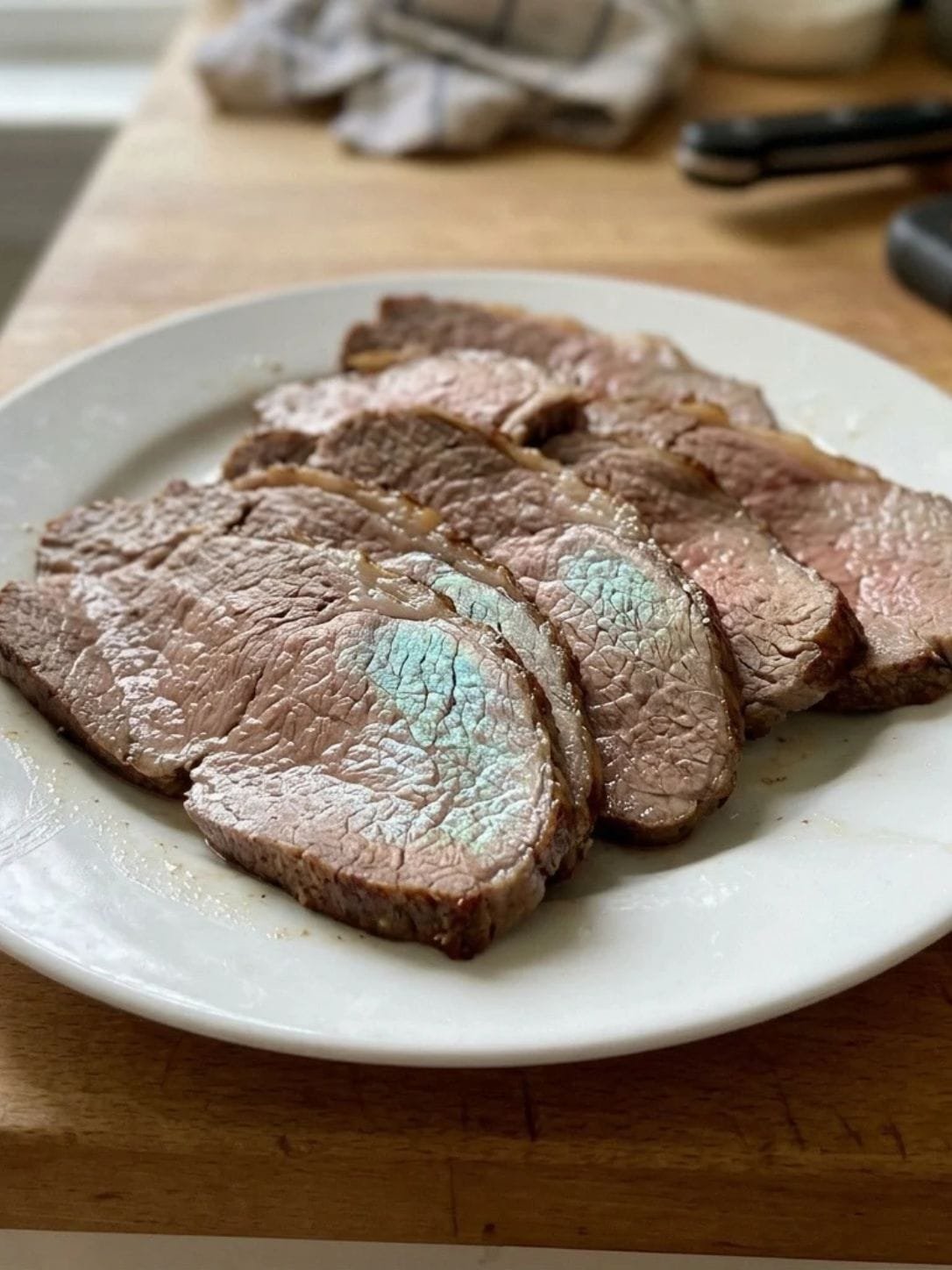
What About the Meat in the Image?
The beef shown in the image has a noticeable blue-green and rainbow-like sheen across several cut surfaces.
That appearance can be consistent with meat iridescence.
The photograph alone cannot prove whether any particular piece of meat is safe to eat. But the rainbow-like effect itself isn’t automatically evidence of spoilage.
If the actual meat also has an unpleasant smell, sticky/slimy surface, questionable storage history, or other signs of deterioration, don’t take the risk.
What Should You Check Before Eating Leftover Meat?
If you’re looking at cooked meat that’s been stored in the refrigerator, consider:
1. How long has it been stored?
Don’t keep leftovers indefinitely.
2. Was it refrigerated promptly?
Food should not be left sitting out for long periods.
3. Does it smell unusual?
An unpleasant odor is a warning sign.
4. Is the surface slimy or unusually sticky?
That is more concerning than a simple rainbow reflection.
5. Does the color change with the angle of the light?
A changing rainbow sheen can be consistent with iridescence.
When several warning signs point toward spoilage, discard the food rather than trying to save it.
Don’t Taste Meat to Test It
This is an important rule.
If you’re unsure whether meat has spoiled, don’t take a bite just to find out.
Taste isn’t a safe method for testing questionable food.
If something looks and smells clearly wrong, it’s better to throw it away.
The Interesting Science Behind the “Rainbow”
The strange colors can actually tell you something fascinating about how light interacts with food.
The surface of sliced meat contains microscopic structures that can affect how light is reflected.
Under certain conditions, the reflected light can separate into different wavelengths, creating the rainbow-like appearance you see.
So what looks like a chemical color change may actually be an optical effect created by the interaction of light with the meat’s structure.
That’s why the effect can look almost metallic.
Final Takeaway
If your cooked beef suddenly looks blue, green, purple, or rainbow-colored, don’t immediately assume that it has spoiled.
Meat can naturally show an iridescent sheen, and USDA notes that iridescence doesn’t necessarily indicate spoilage.
However, don’t use color alone to judge food safety.
Look at the smell, texture, storage history, and overall condition. If the meat is slimy, sticky, smells bad, or has other signs of deterioration, it’s safest to discard it.
And when you’re checking whether meat was cooked safely, remember:
A thermometer is more reliable than your eyes.