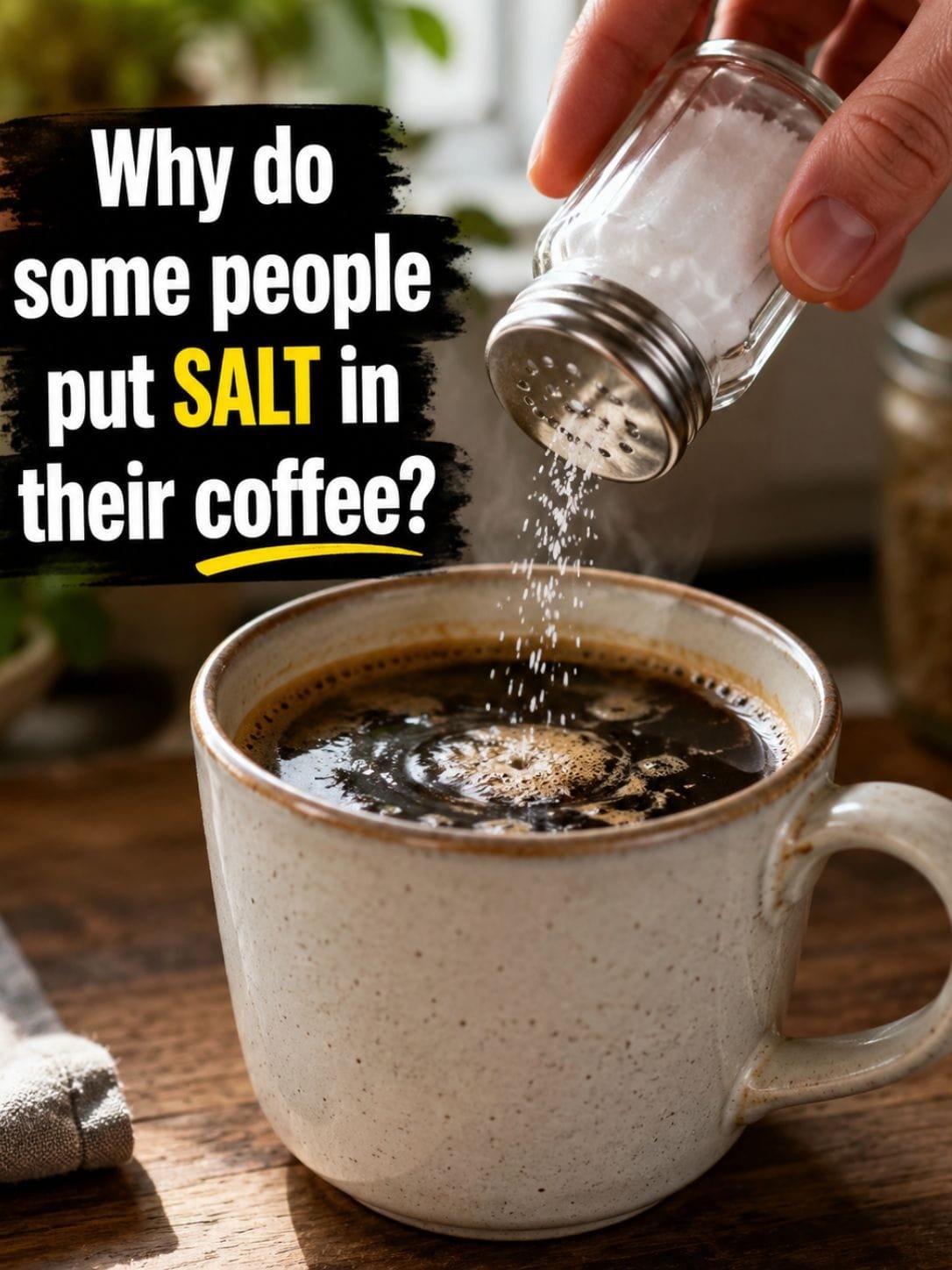
Why Do Some People Put Salt in Coffee? The Strange Trick That Actually Has a Reason
Putting salt in coffee sounds wrong.
Coffee is bitter. Salt is salty. So why would anyone combine the two?
The answer is surprisingly simple: a very small amount of salt can reduce the perception of bitterness in some situations. Scientists have studied this interaction for decades, and research shows that sodium can suppress perceived bitterness from certain bitter compounds.
But there is an important catch.
Salt doesn’t magically “fix” bad coffee, and it isn’t something you need to add to every cup. The effect depends on the coffee, the bitter compounds present, the amount of salt, and your own taste perception.
So why has this strange trick become popular?
Let’s break it down.
What Does Salt Actually Do to Coffee?
When you taste coffee, you’re not experiencing bitterness in isolation.
Your tongue and brain process several taste sensations at the same time. Coffee can have bitter, sour, sweet, roasted and other flavor characteristics, and the balance between them affects whether a cup tastes pleasant or harsh.
Salt can influence that balance.
Research published in Chemical Senses found that salts suppressed the perceived bitterness of several bitter compounds, although the degree of suppression varied depending on the compound and concentration.
Another study published in Nature found that salt can enhance flavor by suppressing bitterness.
That doesn’t mean salt removes bitterness from the coffee.
Instead, it can change how strongly you perceive some of the bitterness.
That’s the interesting part of the trick.
Why Would Someone Want Less Bitterness?
Because not all bitterness tastes the same.
A pleasant coffee can have some bitterness. In fact, bitterness is part of coffee’s characteristic flavor.
But sometimes a cup can taste overly harsh, especially if the coffee or brewing process produces a particularly bitter result.
Scientists have identified numerous compounds that contribute to coffee’s bitterness, and research continues to investigate how different compounds influence the final taste.
If the bitterness dominates everything else, a tiny amount of salt may make the cup seem more balanced.
You may notice the coffee tasting smoother or less harsh, rather than actually tasting salty.
The Secret Is the Amount
This is where many internet versions of the trick go wrong.
You aren’t supposed to turn your coffee into a salty drink.
The idea is to use a very small amount and see whether it changes the taste.
Start with an extremely small pinch, stir thoroughly, and taste.
If you can clearly taste salt, you’ve gone too far.
The goal is:
less perceived harshness — not salty coffee.
And there is no universal measurement that will work perfectly for every cup.
A large mug of strongly roasted coffee, a small espresso, and a lightly roasted pour-over don’t necessarily respond the same way.
Does Science Prove It Works in Coffee?
Here’s where we need to separate the science from the viral claim.
There is good scientific evidence that sodium can suppress the perception of certain bitter tastes.
There is also research specifically examining taste interactions involving coffee. One study found that pairing coffee with salt and other basic tastes changed the perceived sensory characteristics of the coffee.
But that does not mean scientists have established one perfect “salt your coffee” recipe that makes every coffee taste better.
The effect can vary.
A 2024 study looking at sodium chloride and human bitter taste receptors found that sodium affected some bitter receptor-compound combinations but not others.
That’s an important detail.
So the scientifically accurate claim is:
Salt can reduce the perception of certain bitter tastes, which helps explain why a tiny amount may make some coffee taste less bitter.
It’s not:
“Salt makes every coffee taste better.”
Your Coffee Might Have a Bigger Problem
Before reaching for salt, ask yourself why your coffee tastes bitter in the first place.
If every cup you make is unpleasantly bitter, the problem may have more to do with your coffee or brewing method than the absence of salt.
Coffee bitterness is influenced by its chemical composition, including compounds associated with roasting and brewing. Researchers have identified specific compounds that can increase or decrease perceived bitterness in coffee.
That means salt can potentially modify your perception of the cup, but it isn’t a replacement for good coffee preparation.
If your beans are stale, your extraction is poor, or your coffee simply isn’t to your taste, salt isn’t going to transform it into specialty coffee.
When Does This Trick Make the Most Sense?
Think of salt as an optional experiment—not a rule.
It may be worth trying when:
- Your coffee tastes unusually bitter
- You’re using a very dark roast and find it harsh
- You want to experiment with flavor perception
- You don’t want to add more sugar or creamer just to mask bitterness
If your coffee already tastes great, there’s no reason to add salt simply because you’ve seen the trick online.
What Happens If You Add Too Much?
Nothing mysterious.
Your coffee will probably taste salty.
And once the saltiness becomes obvious, you’ve defeated the purpose.
Taste interactions have limits. The studies showing bitterness suppression used controlled concentrations, and the effect varied across different bitter compounds.
That’s why a tiny amount is more sensible than adding a large spoonful.
Could Salt Replace Sugar in Coffee?
Not really.
This is another claim worth being careful about.
Salt doesn’t make coffee sweet.
It can reduce some bitterness, which may make the coffee seem more balanced, but that’s different from adding sweetness.
If you normally add two teaspoons of sugar, a pinch of salt isn’t going to create the same flavor.
What it may do is reduce one unpleasant part of the taste, allowing the coffee’s other flavors to come through more clearly.
Why Does This Taste Interaction Happen?
Taste is more complicated than simply having five independent switches on your tongue.
Different taste sensations can influence one another.
Research has shown that sodium can interact with bitter taste at multiple levels, including effects on particular bitter taste receptors. The 2024 receptor study found that sodium reduced signaling for some receptor-compound pairs while leaving others relatively unchanged.
That’s why scientists don’t describe salt as a universal “bitterness remover.”
The interaction depends on what is causing the bitterness.
This also explains why the trick might be noticeable in one coffee but barely noticeable in another.
Should You Put Salt in Your Coffee Before Brewing?
You’ll find different versions of this trick online.
Some people add salt directly to the brewed coffee.
Others add a tiny amount to the grounds before brewing.
But there isn’t enough evidence to claim that one universal method is the best approach for every coffee.
The most reliable takeaway from the science is about taste interaction, not a magic preparation formula.
If you’re experimenting at home, the simplest approach is to taste your coffee first and, if it’s particularly bitter, add a tiny amount and compare.
That gives you a much better idea of whether your particular coffee benefits from it.
And Don’t Forget the Sodium
A tiny pinch is very different from deliberately making a salty beverage.
If you’re watching your sodium intake, there’s no reason to start adding salt to coffee just because it’s a viral trick.
The goal of this experiment is flavor—not increasing your sodium intake.
And if your coffee tastes good without salt, there’s no nutritional or culinary requirement to add it.
The Better Way to Think About the Trick
Forget the idea that salt is a secret ingredient that makes coffee amazing.
A better explanation is:
Salt can interact with taste perception and reduce the perceived bitterness of some compounds.
That’s why a tiny amount may help an overly bitter cup.
It also explains why the trick won’t work exactly the same way for everyone.
Your coffee’s roast, brewing method, chemical composition and your own taste perception all matter.
So, Should You Try It?
If you’re curious, there’s very little mystery involved.
Make your usual coffee.
Taste it.
If it seems unusually bitter, add a tiny pinch of salt, stir well, and taste again.
If the coffee tastes smoother, you’ve discovered why people use the trick.
If it tastes salty, you’ve added too much.
And if you can’t tell any difference at all, that’s completely possible too.
The science supports the underlying bitterness-suppression effect of sodium, but it doesn’t guarantee that every person will prefer salted coffee.
The Bottom Line ☕
The strange habit of putting salt in coffee isn’t completely made up.
Salt can suppress the perception of certain bitter tastes, which helps explain why a very small amount can sometimes make a bitter cup seem smoother.
But it’s not a miracle cure for bad coffee.
If your coffee is already balanced and enjoyable, leave it alone.
If it’s unusually bitter, however, a tiny pinch of salt is a surprisingly interesting experiment—and now you know why it can work.